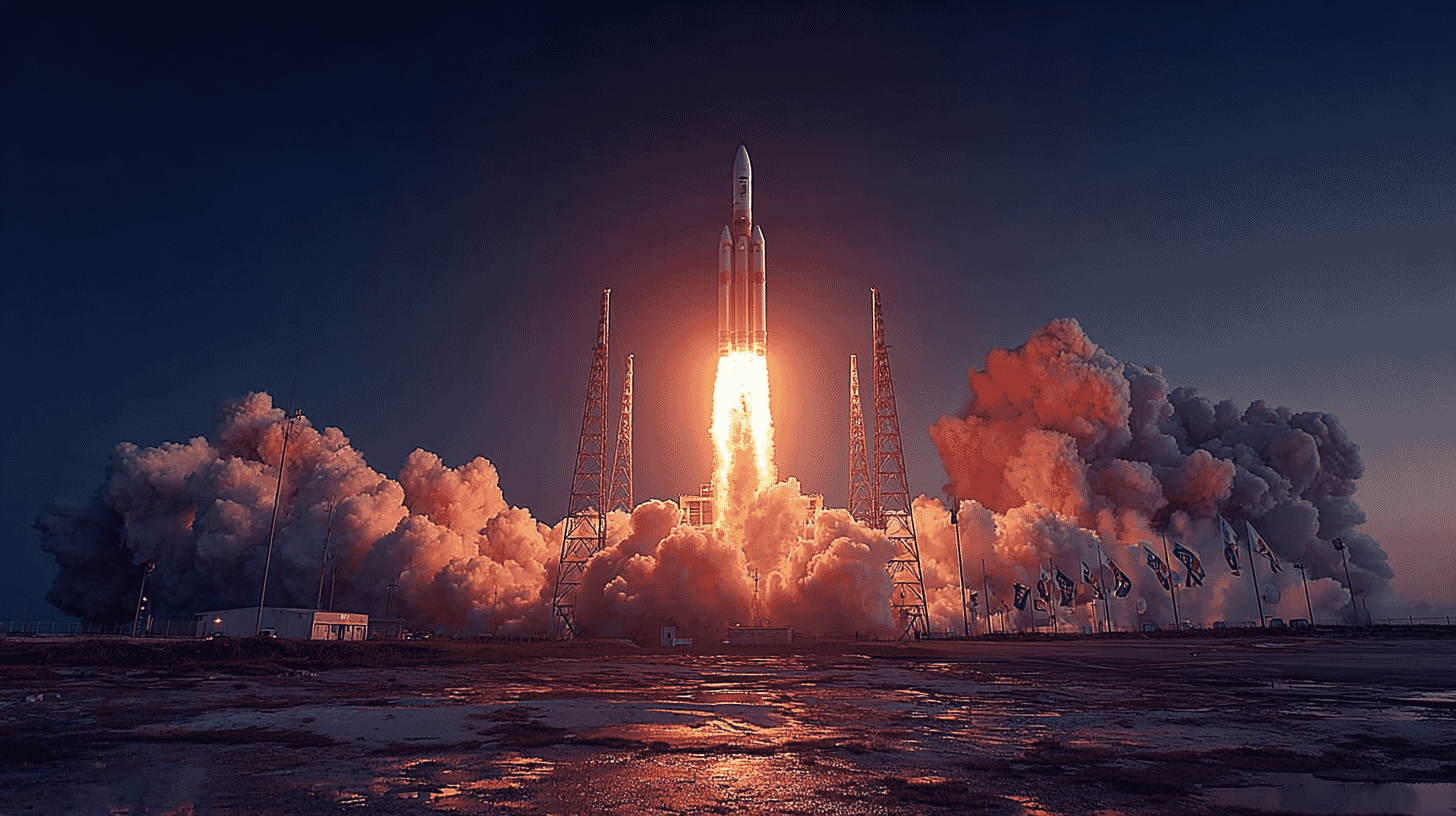
Japan's next-generation H3 rocket No. 8 has failed. Just when it seemed to have recovered from the 2023 debut failure with five consecutive successes, disaster struck again. What was the "fairing separation anomaly" that emerged from the investigation? Here is what the inquiry found, and what has happened since.
What Happened
On December 22, 2025, at 10:51:30 AM JST, the H3 rocket No. 8 lifted off from the Tanegashima Space Center in Kagoshima Prefecture. It was carrying the Michibiki 5, part of Japan's homegrown GPS satellite system. While the initial flight proceeded normally, approximately 25 minutes after launch, the second-stage engine's second burn failed to ignite properly and shut down prematurely. The satellite could not be placed into its planned orbit, and the launch was declared a failure.
This marks the second failure for the H3 rocket since its debut in March 2023. The success rate has dropped from 83% to 71%.
The Acceleration Recorded at the Moment of Separation
JAXA's investigation revealed that an abnormally large shock was observed at 225 seconds after launch, precisely when the fairing (the protective cover for the satellite) separated from the rocket.
The fairing separation mechanism has fundamentally remained the same design since the H-II rocket era of the 1990s, with no previous reported issues. However, this time, an unusual behavior was recorded: a large acceleration in the opposite direction of the vehicle's travel persisted for approximately 1.5 seconds immediately after separation.
This anomalous shock appears to have triggered a pressure drop in the second-stage liquid hydrogen tank. By the time the first burn started, pressure had fallen to about 80% of normal levels. As a result, the second burn could not be executed properly, preventing the satellite from reaching its intended orbit.
Onboard Cameras Captured the Anomaly
At a Ministry of Education investigation committee meeting on December 25, images from cameras mounted on the rocket were publicly released for the first time.
The images showed visible changes to the satellite's exterior after fairing separation, with what appeared to be panels peeling away. Additionally, during the first and second stage separation, debris-like objects were observed scattering in the footage.
JAXA estimates that parts of the satellite mounting structure (including the payload support structure and payload attach fitting) were likely damaged or destroyed.
Impact on Japan's Space Program
First, the launch of H3 rocket No. 9, originally scheduled for February 1, 2026, has been postponed. The rocket was supposed to carry Michibiki 7, but with the need to investigate the cause and assess the impact on subsequent vehicles, no new launch date has been set.
Furthermore, all of Japan's flagship rockets are currently grounded. The smaller Epsilon S rocket also experienced an explosion during a combustion test in November 2024, delaying its development. For the moment, Japan has lost its own route to orbit.
The planned seven-satellite constellation service for Michibiki is also expected to be delayed, affecting Japan's autonomous GPS operation plans.
The Importance of the H3 Rocket
The H3 rocket was developed as the successor to the H-2A, which served Japan for 25 years. It aims to cut launch costs from approximately 10 billion yen (about $68 million) for the H-2A to around 5 billion yen (about $34 million).
For fiscal year 2026, six launches were planned, including the HTV-X 2 cargo spacecraft to the International Space Station and the MMX (Martian Moons eXploration) probe, the world's first mission to return samples from the Martian system.
JAXA President Hiroshi Yamakawa said after the failure that the agency would put everything into finding the cause and aim for an early return to flight.
Looking Ahead
JAXA plans to narrow down the possible causes through Fault Tree Analysis (FTA), verifying the validity of hypothetical scenarios.
The main factors still under consideration include mechanical energy from shocks or contact during fairing separation, chemical energy from propellants, high-pressure gases, or pyrotechnic devices, and insufficient strength in the satellite mounting structure components.
In past failures involving the H-2A and H3 No. 1, it took roughly a year to resume launches.
Update: The Cause Identified, and Flights Resumed
On April 22, 2026, the Ministry of Education's investigation committee adopted an interim report naming the cause. A delamination inside the payload support structure (PSS), present since manufacturing, spread rapidly under the shock of fairing separation and destroyed the PSS. The satellite dropped into the vehicle, damaging piping on the second-stage liquid hydrogen tank; the resulting gas leak led to the early engine shutdown. The ministry's task force accepted the findings and the proposed fixes the following day. The corrective measure adopted was a PSS joined with fasteners rather than relying on bonding.
On June 12, H3 No. 6, the test flight of the "30" configuration that flies without solid rocket boosters, launched successfully and returned the H3 to flight. It carried a repaired PSS of the older design, partly to confirm the failure analysis.
The postponed No. 9 flight carrying Michibiki 7 was set for August 7, 2026, slipped because of an approaching typhoon, and launched successfully at 4:23:31 a.m. JST on August 11, placing the satellite in its planned orbit about 29 minutes later. It was also the first H3 to fly the fastener-joined PSS. Michibiki 7 is due to enter service around March 2027, but the loss of No. 5 pushes the planned seven-satellite constellation further out.
How are rocket launch failures perceived in your country? What level of public interest and expectations exist for space development?
References
- https://www.mext.go.jp/content/20260826-mxt_uchukai01-000051679_07.pdf
- https://global.jaxa.jp/press/2025/12/20251222-2_e.html
- https://spacenews.com/japans-h3-suffers-second-stage-anomaly-qzs-5-satellite-lost/
- https://spaceflightnow.com/2025/12/22/h3-rocket-suffers-upper-stage-anomaly-fails-to-correctly-deploy-navigation-satellite/
- https://www.space.com/space-exploration/launches-spacecraft/japanese-h3-rocket-fails-during-launch-of-navigation-satellite






Global Discussion
15 comments