
What if solar panels could be "painted" onto any surface? Traditional solar panels are heavy, rigid, and limited in where they can be installed. But "perovskite solar cells," born in Japan, are thin, lightweight, and flexible, capable of being applied to building walls and windows like a film. By 2040, the global market is projected to reach nearly $26 billion, with key materials alone exceeding $9.5 billion. This Japan-born technology is poised to become a game-changer in the global energy transition.
A Next-Generation Solar Technology Born in Japan
Perovskite solar cells were first reported to the world in 2009 by Professor Tsutomu Miyasaka of Toin University of Yokohama. "Perovskite" is not the name of a substance but rather a unique crystal structure, originally named after a mineral discovered in Russia in 1839.
At the time, Professor Miyasaka was researching dye-sensitized solar cells when a graduate student from another university brought in perovskite materials with potential light-absorbing properties. The 2009 paper reported a conversion efficiency of only about 4%, failing to attract significant attention. However, when researchers at Oxford University achieved 10% efficiency in 2012, scientists worldwide rushed into the field. Today, an estimated 40,000 to 50,000 researchers are working on perovskite technology, with conversion efficiencies exceeding 26%, rivaling traditional crystalline silicon solar cells.
The key characteristics of perovskite solar cells are that they are "thin, lightweight, and flexible." While conventional crystalline silicon cells require high-temperature manufacturing, perovskite cells can be produced by applying a solution coating at low temperatures. This enables solar cell formation on plastic films, opening up installation possibilities previously impossible with traditional panels.
Market to Surge to $26 Billion by 2040
According to Fuji Keizai's research, the global perovskite solar cell market is projected to surge from approximately 59 billion yen ($390 million) in 2024 to 3.948 trillion yen ($26 billion) in 2040, a roughly 67-fold increase.
The market expansion will be driven by replacement of existing silicon solar cells. Large-scale production is expected to begin in the late 2020s, with "tandem-type" cells combining perovskite and crystalline silicon gaining traction around 2030. Tandem cells promise further efficiency improvements and are projected to account for about 60% of the market by 2040.
By substrate type, glass-based cells currently dominate, but flexible film-based cells will continue to grow, capturing over 30% of the market by 2040.
Japan's domestic market is forecast to grow from 80 million yen ($530,000) in FY2025 to 34.2 billion yen ($226 million) by FY2040. Sekisui Chemical and Sekisui Solar Film will begin commercial production in FY2025, with Toshiba and other companies targeting market entry around FY2027.
Key Materials Market to Exceed $9.5 Billion
As perovskite solar cells grow, the components and materials market will expand dramatically. According to Fuji Keizai's January 2026 report, the combined market for barrier films and TCO substrates (transparent conductive oxide substrates) is projected to exceed 1.45 trillion yen ($9.5 billion) by 2040.
Barrier films protect perovskite cells from moisture and oxygen infiltration, directly affecting durability. The global barrier film market is projected to reach 887.7 billion yen ($5.9 billion) by 2040.
TCO substrates serve as transparent conductive electrodes on the light-receiving side, directly impacting conversion efficiency and durability. Indium, the primary raw material for mainstream ITO (indium tin oxide), is a rare and expensive metal, but cost reductions are expected as alternative materials are developed. The market is projected to reach 564.2 billion yen ($3.7 billion) by 2040.
For Japanese companies, this materials sector represents a significant business opportunity. Japan's expertise in solution coating technology and film converting could serve as key differentiators against foreign competitors.
Japan's Competitive Advantages and Government Support
Japan holds several competitive advantages in perovskite solar cells.
First, the "coating and drying" process essential for film-type perovskite production aligns perfectly with chemical process technologies Japanese companies have refined over decades. Solution formulation and substrate optimization are core competencies of Japanese materials manufacturers.
Second, iodine, a key raw material, is one of the few resources where Japan holds about 30% of global production. The ability to manufacture using domestic raw materials offers significant energy security benefits.
The government is actively providing support. The Ministry of Economy, Trade and Industry has formulated a "Next-Generation Solar Cell Strategy" targeting GW-scale mass production by 2030. The 7th Strategic Energy Plan sets goals of 20GW installation capacity and generation costs of 10-14 yen/kWh ($0.07-0.09/kWh) by 2040.
Sekisui Chemical's new factory construction involves approximately 320 billion yen ($2.1 billion) in investment, with the government subsidizing about 160 billion yen ($1.1 billion), or roughly half. A 100MW production line is scheduled to begin operation in 2027, with phased expansion to GW-scale capacity by 2030.
Challenges Toward Commercialization
Several challenges remain for commercial adoption.
Durability is the primary concern. As of 2024, film-type durability is approximately 10 years, shorter than the 20-25 years for silicon solar cells. Sekisui Chemical aims to achieve "20-year equivalent durability" by 2025, with ongoing technological development.
Environmental concerns regarding lead used in the power generation layer have also been raised. Complete lead elimination would reduce conversion efficiency, so current research focuses on "lead reduction" techniques combining lead with tin, or using inkjet printing to minimize usage.
Large-format module production is another challenge. While small cells achieve high conversion efficiency, efficiency tends to decrease when scaling up. Establishing mass production techniques and quality consistency remains essential.
The rapid rise of Chinese manufacturers cannot be ignored. Major crystalline-silicon players such as China’s LONGi Green Energy Technology and South Korea’s Hanwha Q Cells are advancing mass production plans, potentially triggering price competition that could disadvantage Japanese firms. Japanese companies are pursuing a "non-competitive strategy" focused on high-value-added film-type products rather than price competition.
Expanding Application Possibilities
The greatest appeal of perovskite solar cells is enabling installation in locations previously impossible for conventional solar panels.
BIPV (Building-Integrated Photovoltaics) applications integrating cells into building walls and windows are highly anticipated. Japan already ranks first globally in solar power installation per unit of land area, with limited space remaining for ground-mounted systems. Utilizing vertical surfaces like walls and windows could dramatically increase urban power generation.
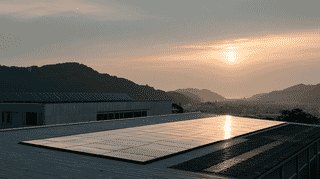
Logistics warehouses and factory roofs represent promising markets. Traditional silicon panels are too heavy for buildings with low load-bearing capacity. Lightweight perovskite cells enable retrofitting (BAPV) on existing structures.
Automotive roof integration is also being explored. Toyota has announced plans to install perovskite solar cells on electric vehicle roofs by 2030, expecting them to assist with charging while driving.
Indoor power generation is also possible, with applications emerging for IoT devices and electronic shelf labels. Poland's Saule Technologies has already commercialized electronic shelf label products, with smaller-scale applications leading market development.
Conclusion: Japanese Technology Opening New Frontiers in Renewable Energy
Perovskite solar cells represent a next-generation energy technology born in Japan and now the subject of intense global R&D competition. By 2040, the global market is projected to grow to approximately $26 billion, with key materials alone exceeding $9.5 billion.
Japan can source iodine domestically and leverage its expertise in film manufacturing and solution coating, rare competitive advantages in this field. Government support has intensified as a national strategy, with commercial production beginning in earnest from 2025.
For Japan, which once led the world in silicon solar cells before falling behind Chinese competitors, perovskite represents a symbol of potential "comeback." How this thin, lightweight, flexible technology will transform Japan's energy future is drawing significant attention.
What discussions or initiatives exist in your country regarding next-generation solar cells?
References
- https://eetimes.itmedia.co.jp/ee/articles/2507/18/news035.html
- https://www.nikkei.com/article/DGXZQOUC185GV0Y5A710C2000000/
- https://www.fuji-keizai.co.jp/press/detail.html?cid=25071
- https://www.itmedia.co.jp/smartjapan/articles/2601/27/news131.html
- https://www.meti.go.jp/shingikai/energy_environment/perovskite_solar_cell/pdf/20241128_1.pdf
- https://project.nikkeibp.co.jp/ms/atcl/19/feature/00007/00118/






Global Discussion
18 comments