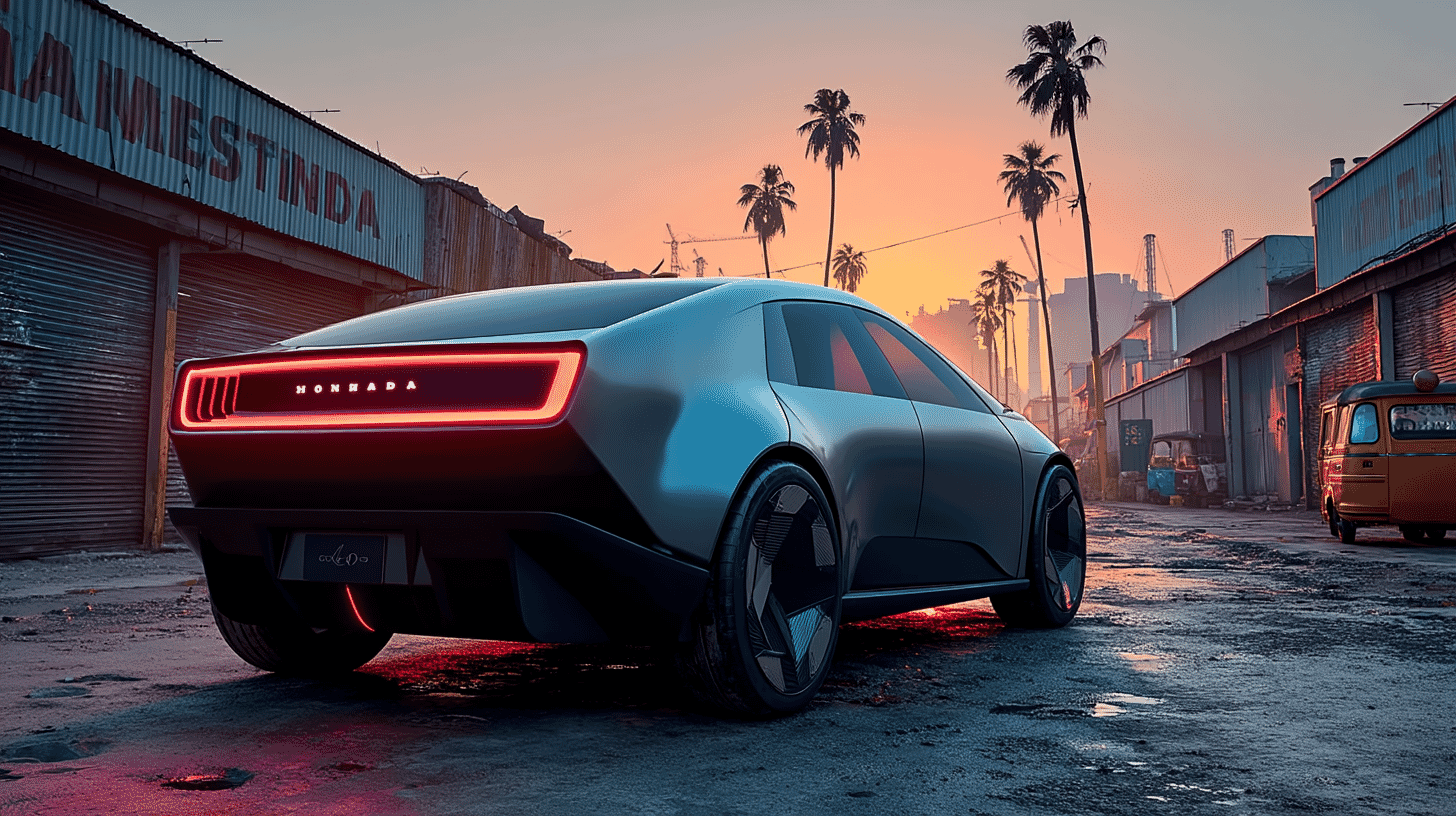
🇮🇳 The futuristic EV that lit up CES Las Vegas and was supposed to roll off an Ohio assembly line will, in the end, debut from a factory in Rajasthan, India. Honda's first car under its new "Zero" EV brand, the 0 Alpha, will launch in India before March 2027. This isn't just a regional reshuffle. It may be the first time a major Japanese automaker has truly walked away from "America first" for its flagship EV program, and Japan's second-largest carmaker is doing it with its back against the wall.
Two Years Ago, the Plan Looked Nothing Like This
Rewind to January 2024. At CES in Las Vegas, Honda unveiled the "0 Series" and rolled out two concepts, the Saloon sedan and the SUV, that looked lifted from a science-fiction set. A year later, at CES 2025, near-production prototypes followed. CEO Toshihiro Mibe declared a 2026 North American debut, then Japan, Asia, Europe, Africa, and South America. By 2040, every new Honda sold globally would be an EV or a fuel-cell vehicle. A joint battery plant with LG Energy Solution in Jeffersonville, Ohio was nearly ready.
Twenty-six months later, all of that is gone.
On March 12, 2026, Honda announced that the 0 SUV, 0 Saloon, and Acura RSX, the entire North American 0 Series lineup, were cancelled. It guided to a net loss of up to ¥690 billion for the year and warned that cumulative losses through FY2027 could reach ¥2.5 trillion once supplier compensation was counted.
The final figures, released on May 14, came in lighter: revenue of ¥21.80 trillion, an operating loss of ¥414.3 billion, and a net loss of ¥423.9 billion, Honda's first since listing in 1957. EV-related charges totalled ¥1.578 trillion, made up of ¥521.3 billion in impairments on production equipment, ¥331.4 billion in write-offs of development assets, and ¥667.3 billion in provisions for supplier compensation. Honda guides to a return to profit in FY2027.
A gaping hole remained at the center of Honda's EV strategy. To fill it, Honda reached for the youngest member of the 0 family, a vehicle most car-watchers had treated as a footnote when it debuted at Japan Mobility Show 2025 in October. The Honda 0 Alpha, built in India, will now carry the entire brand on its back.
Why Rajasthan?
Honda Cars India's Tapukara plant in Alwar District, Rajasthan, operational since 2014 and covering roughly 450 acres with annual capacity of 180,000 vehicles, is about to become the global launch site for a Japanese flagship EV. That's a first.
The reasoning is blunt and strategic.
Cost. Nikkei reported that Honda picked India for its lower manufacturing costs, intending to meet China's cheap EVs on price rather than retreat from them. Rajasthan Chief Minister Bhajan Lal Sharma said in March that Honda is putting Rs 1,200 crore (about $130 million) into retooling Tapukara for EV production. Supplier ecosystem, labour and land are all an order of magnitude cheaper than in the U.S. or Japan.
A market with a long runway. India registered 199,923 passenger EVs in fiscal 2026 (April 2025 to March 2026), up 83.6% year-on-year, per Autocar India's tally. Tata Motors led with 78,811 units, JSW MG was second on 53,089, and Mahindra third on 42,721. EVs are still only around 5% of total passenger vehicle sales, but few markets are growing this fast.
English-language operations. Manuals, software, support and supply chain documentation all run in English, which takes friction out of exporting to other markets.
Government tailwinds. Successor schemes to FAME-II, local content incentives, export duty rebates, and a national push to make India a global EV manufacturing hub.
Honda's project leader Toshikazu Hirose was unusually blunt in a Motor-Fan interview: "Manufacturing in India is about making the car cheap. That's our starting point, so we're trying to use as many India-sourceable parts as possible." The expensive high-strength steel hot-pressing techniques used in the 0 SUV and 0 Saloon won't work. Battery cells aren't made locally, so they will be imported and packed in India. "We're figuring out how to maintain the 0 Series world view despite using lower-grade components," Hirose said. One approach is to lean on smartphone integration instead of expensive in-car infotainment hardware; using a phone as the cabin's compute layer is cheaper than building one in.
In other words, the 0 Alpha isn't a budget version of the cancelled 0 SUV. It's a different vehicle, engineered backward from India's manufacturing constraints.
What We Actually Know About the 0 Alpha
From the JMS 2025 prototype and subsequent disclosures:
- Body type: What India calls a mid-size SUV; the wheelbase is reported at 2,700-2,800mm
- Design: "Thin, Light, and Wise" philosophy. Panel-style "screen faces" front and rear, illuminated emblems, U-shaped tail light signature
- Target buyer: "Generation Y" young families, Honda product planners told media
- Platform: A dedicated Alpha platform, not shared with the cancelled 0 Saloon or 0 SUV. Autocar India reports two LFP battery pack sizes
- Expected price: Indian outlets such as CarDekho and ZigWheels estimate around Rs 20 lakh (roughly $23,000, or ¥3.7 million at ¥163 to the dollar)
- Manufacturing: Tapukara, Rajasthan
- Launch: Second half of FY 2026-27 (October 2026 to March 2027); Indian media expect the first quarter of 2027, around the Bharat Mobility Global Expo
- Indian rivals: Hyundai Creta Electric, Maruti Suzuki e Vitara, Mahindra BE 6, MG ZS EV, Tata Sierra EV
- Export plans: Japan, plus reported plans for Thailand, Indonesia, Malaysia and the Philippines. Europe, North America and Australia are said to be out of scope
India's EV Market Is a Knife Fight
For Honda to make this bet pay off, it needs to break into one of the most savagely competitive emerging EV markets in the world.
Tata Motors sold 78,811 EVs in fiscal 2026 for a 39.2% share, down from 53.4% a year earlier. Volume still grew; rivals simply grew faster. The Nexon EV, Punch EV and Harrier EV remain national staples.
JSW MG (a JV between China's SAIC and India's JSW Group) took second with 53,089 units, up 74%, carried by the Windsor EV.
Mahindra was third at 42,721 units but posted the steepest growth of anyone, more than five times its FY2025 volume, on the BE 6, XEV 9e and XEV 9S. The BE 6 is the most direct competitor to the 0 Alpha.
Those three took close to 90% of the market between them. Hyundai's Creta Electric, Maruti Suzuki's e Vitara (launched in early 2026), Vietnam's VinFast and Tesla, which sold 342 Model Ys in its first Indian fiscal year, are all still marginal by comparison.
Honda enters from outside that top three, and while most incumbents already sell purpose-built India EVs, Honda is still finishing its redesign.
Following Suzuki's Playbook, a Generation Late
There's another protagonist in this story: Suzuki.
Through Maruti Suzuki India, Suzuki has held roughly 40% of India's passenger car market for decades and exports small cars worldwide from Gurgaon and Manesar. If Toyota's "Daihatsu Model" is the template for Asian small-car strategy, Suzuki's "Maruti Model" is the template for emerging-market export strategy.
Honda's 0 Alpha is essentially the Maruti Model applied to EVs. The WR-V, also Tapukara-built and reverse-imported into Japan, is the proof of concept. "Having a precedent means quality goes up from there. We've actually felt it going up," Hirose told Motor-Fan.
But the WR-V runs on gasoline. EVs add variables Honda hasn't tested in this configuration: battery longevity, software polish, fast-charger interoperability, OTA update infrastructure. Japanese consumers in particular may be skeptical of "Indian-made EV" battery reliability over a decade.
The Timing Tells the Story
The two events, cancellation in America and road-testing in India, happened within four days of each other. Honda announced the North American EV cancellations on March 12, 2026. On March 16, Honda Cars India flagged off pan-India public road verification testing of a camouflaged 0 Alpha prototype from the Tapukara plant, with engineers set to assess ride quality, durability, monsoon and heat performance, and charger compatibility.
That's not coincidence. It's evidence that Honda was running a Plan B in parallel: if the American scenario broke, shift the center of gravity to Asia.
The rationale isn't just about India. It's about resilience. The dollar was trading around ¥163 in July 2026, a 39-year high against the yen, which flatters Japanese exports on paper. But exchange rates aren't predictable, U.S. tariffs aren't predictable, China's Southeast Asian EV push isn't predictable, and shrinking EV subsidies in multiple markets aren't predictable. "Designed in Japan, built in America, sold worldwide" turned out to be a model that couldn't absorb external shocks.
"Designed for India, built in India, sold to multiple markets" is meant to absorb them.
Context International Readers Should Have
When American or European readers see "Indian-built EV," the reflex is sometimes: can the quality really hold up?
That's a dated reflex. The WR-V, Honda Amaze, Toyota Urban Cruiser HyRyder, Hyundai Creta and Maruti Suzuki Fronx are all Indian-built and all sell without issue across Japan, ASEAN and the Middle East. India's automotive manufacturing automation and quality control have improved dramatically over the last decade.
The real unknown for the 0 Alpha is EV-specific: long-term battery warranty performance and software-update infrastructure. Whether Honda can match Tesla and BYD on OTA updates and battery reliability is what will determine if "Indian-built EV" becomes a credible global proposition or a cautionary tale. We'll know within a few years of launch.
Key Numbers at a Glance
| Item | Value |
|---|---|
| 0 Alpha launch window | Second half of fiscal year 2026-27 (Oct 2026 – Mar 2027) |
| Manufacturing site | Tapukara plant, Rajasthan (~180,000 vehicles/year capacity) |
| Estimated price (India) | ~Rs 20 lakh (~$23,000 / ~¥3.7 million) |
| Tapukara EV investment | Rs 1,200 crore (~$130 million) |
| Honda FY2026 net result (final) | ¥423.9 billion loss, first since listing |
| EV-related charges (FY2026) | ¥1.578 trillion |
| Cumulative EV strategy losses through FY2027 | Up to ¥2.5 trillion |
| India passenger EV registrations (FY26) | 199,923 units (+83.6% YoY) |
| Tata Motors India EV market share | 39.2% |
| Cancelled North American EVs | 0 SUV, 0 Saloon, Acura RSX (announced March 12, 2026) |
References
- Honda 0 α Prototype Reveal - Honda Global Press
- Honda Zero Alpha India Launch Timeline (CarToq)
- Honda Zero Alpha Specs and Price - CarDekho
- Motor-Fan Interview with 0 Alpha Project Lead (Japanese)
- Nikkei: Honda's Reverse-Import EV Gamble (Japanese, paywalled)
- Honda Cars India - First EV Testing Begins
Related Coverage
- Honda's EV Strategy Reversal Kills the 0 Series and Triggers Its First Net Loss
- AFEELA Cancelled: Sony-Honda EV Dream Dies
In your country, are your domestic automakers shifting their design, manufacturing, and export hubs to emerging markets the way Honda is doing with India? Would an "Indian-built Japanese EV" be on your shopping list? Let us know in the comments.






Global Discussion
14 comments