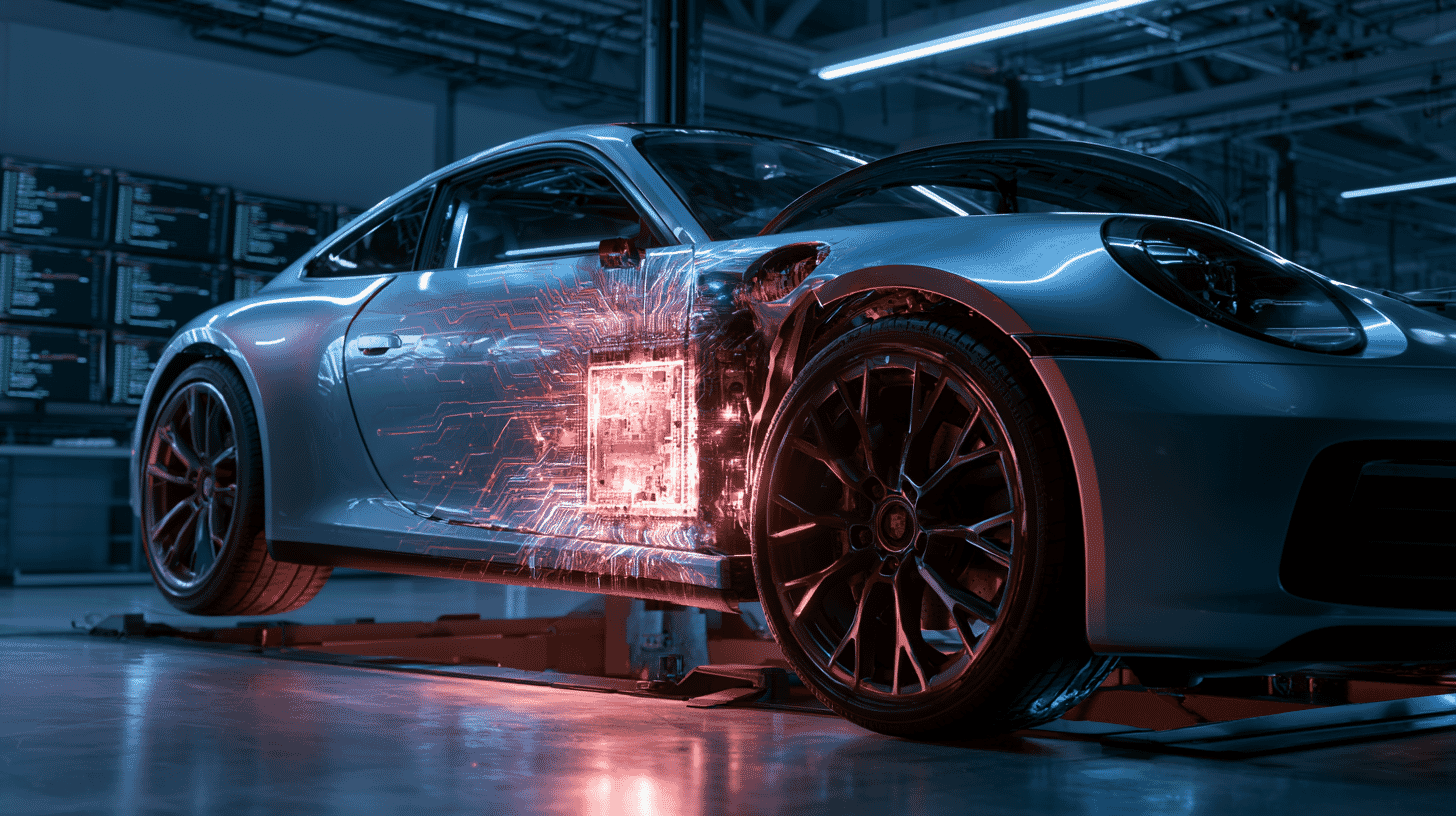
🚗💻 A struggling Japanese automaker, mid-restructuring, just made one of the boldest software bets in the industry, and almost no one outside the engineering press noticed.
On May 11, 2026, at Red Hat Summit in Atlanta, Nissan announced a collaboration that puts Red Hat In-Vehicle Operating System at the foundation of the central computer in its next generation of cars. The release itself is cautious, describing an initiative that "includes the evaluation of" the OS, which reads more like a co-engineering agreement than a signed supply deal. It's a quiet headline that hides a loud question: why is a company closing seven factories and cutting 20,000 jobs spending its energy on a Linux distribution? The answer says a lot about where the auto industry is heading, and why other automakers, including Volkswagen, have spent billions trying and failing at the same thing.
What Was Actually Announced
The deal, described by Kazuma Sugimoto, general manager of the software engineering department in Nissan's SDV engineering division, is narrower than headlines made it sound. Red Hat In-Vehicle OS (a Linux distribution built on Red Hat Enterprise Linux, RHEL) will sit at the heart of Nissan's next-generation Central Vehicle Computer, the single high-performance box that will replace the dozens of small electronic control units (ECUs) currently scattered across a modern car.
This computer is the brain of the "Nissan Scalable Open Software Platform" (SW PF), a cloud-native architecture Nissan has been quietly building on AWS since 2023. The choice is framed as a deliberate split: safety-critical functions stay on certified real-time systems, while everything that needs to be updated often (driver assistance features, infotainment, vehicle personalization) runs on Linux containers managed by Red Hat's OS. Updates can be shipped over the air, targeted at individual functions, without requalifying the entire vehicle.
The partnership embeds Red Hat engineers directly inside Nissan's development pipeline. That last detail matters more than it sounds, and we'll come back to it.
Why Red Hat, Specifically? Three Hard Reasons
Reason 1: The certification almost no one else has
In automotive software, the difference between "Linux that can run a car" and "Linux that can legally run a car" is roughly 18 months of paperwork and tens of millions of dollars. The barrier is ISO 26262, the functional safety standard whose ASIL ratings (A through D) determine what a piece of code is allowed to do in a vehicle.
In May 2025, Red Hat announced that its In-Vehicle OS had become the first open-source, continuously-certified Linux platform to clear ISO 26262 ASIL-B as a Safety Element out of Context, assessed by functional-safety certifier exida. Full release followed in the third quarter of that year. That sounds like alphabet soup, but the practical meaning is enormous: an automaker can now update the OS in shipping cars without sending the new code back through a multi-year certification process every time. Without that, OTA updates (the entire premise of an SDV) collapse into a regulatory black hole.
For years, the only realistic OS choices in this layer were proprietary real-time systems like QNX (which is excellent, but closed and per-vehicle licensed) or a roll-your-own Linux build that an automaker would have to certify itself. Red Hat changed that math.
Reason 2: Cars live three times longer than enterprise servers
A car sold in 2030 needs software support through roughly 2045 to 2050. Almost no consumer software company plans on that timescale. Red Hat does. RHEL release cycles routinely promise a decade of patches and security updates, and the company has been doing that for two decades.
Nissan's press release was unusually blunt on this point: "Given the multi-decade lifecycle of automotive platforms, Nissan identified Red Hat as a partner capable of sustaining an automotive software foundation over an extended period of time." Translated, that says: we want someone who'll still be patching this OS when our 2030 customers' kids inherit the car. Few tech vendors can credibly promise that. An enterprise Linux company can.
Reason 3: The CARIAD warning sign
This is the part nobody at Nissan will say in a press release, but it shapes everything.
In 2020, Volkswagen Group founded CARIAD as its in-house software arm, promising a single unified platform across VW, Audi, Porsche, Bentley, and the rest of the empire. By 2024, the project was a parable. According to industry analyses, VW Group had spent roughly 14 billion euros (about $15.4 billion) on the effort. Audi's Q6 e-tron and the new electric Porsche Macan were delayed by years. Bentley's electric flagship slipped from 2025 to 2028. Two CEOs lost their jobs partly because of CARIAD. The next-generation SSP platform that was supposed to launch in 2024 is now sometime after 2026, exact date unclear. Insiders described an organization that had grown to thousands of employees within months without a clear structure, with engineers attending 17 weekly status meetings instead of writing code.
VW's response, in mid-2024, was effectively a white flag worth up to $5 billion, raised to as much as $5.8 billion that November: a joint venture with EV startup Rivian to handle the software VW could no longer build itself. Even that has reportedly hit turbulence.
The CARIAD story is the cautionary tale every legacy automaker now studies. Nissan has watched it play out from the front row, and the implicit lesson is brutal: you cannot bootstrap a 5,000-person software org from scratch in three years and expect production-grade output. You partner. You buy time. You let someone who already runs the world's largest Linux distribution do the platform work.
That's what Nissan did.
Nissan's Time Problem
Context matters here, because the timing of this deal is not coincidental.
In February 2025, Nissan's merger talks with Honda collapsed in spectacular fashion. Honda wanted a subsidiary-style structure, Nissan refused, and a deal that would have created the world's third-largest automaker died in three months. Two months later, Ivan Espinosa took over as CEO and launched "Re:Nissan," a restructuring plan with brutal numbers: 20,000 jobs cut (15% of the workforce), 7 of 17 vehicle plants closed, and 500 billion yen (about $3.2 billion) in combined fixed and variable cost reductions by fiscal year 2026.
Buried inside Re:Nissan is a line that, in retrospect, telegraphs the Red Hat deal: "advance development and product development from FY2026 onward will be temporarily halted, with 3,000 employees redirected toward cost-reduction activities." When 3,000 of your forward-development engineers are pulled off forward development, you cannot also build a 14-billion-euro CARIAD.
Yet Nissan still has to deliver an SDV. The company has committed that 90% of all new models will feature AI-powered driver assistance, and in September 2025 it unveiled a driverless prototype using technology from UK AI startup Wayve, putting it, at least on paper, near Tesla on the autonomy frontier. ProPILOT 2.1 is shipping over-the-air updates today. The next-generation ProPILOT is targeted for production cars by fiscal year 2027.
You don't do all that and also build your operating system from scratch. You buy the OS.
The Toyota and Honda Comparison
The Japanese big-three are landing on three notably different SDV strategies:
Toyota built Woven by Toyota, a 2,500-person Tokyo subsidiary, and is developing its own platform called Arene, the most internally-owned of the three approaches, in the spirit of how Toyota traditionally controls its supply chain.
Honda partnered with Sony to create Afeela, an EV joint venture that has reportedly struggled. Honda's broader SDV plan has been visibly slower to materialize, and the company posted a 423.9 billion yen ($2.68 billion) net loss in the year ending March 2026, its first since listing in 1957, driven by 1.578 trillion yen of EV-related charges.
Nissan picked the third path: don't build the platform OS yourself, don't build a brand-new EV joint venture either. Buy the OS layer, build a software platform on top, and embed the vendor's engineers in your team. Of the three, it's the strategy that requires the least capital and the least time, both of which Nissan is short on.
What Happens to QNX?
A reasonable question after reading this far: did Nissan just ditch BlackBerry's QNX, which Counterpoint Research counted in more than 275 million vehicles worldwide as of December 2025?
Almost certainly not. Nissan's announcement is careful about this: the new architecture splits the car into a safety-critical domain and a high-frequency-update domain. Red Hat IVOS handles the second one. The first (the part that runs ADAS sensors, brake controllers, and steering) still needs the kind of microkernel real-time guarantees that QNX has been certified for since 2010. Nothing in Nissan's announcement suggests that side is changing.
What's actually happening is more interesting than a switch. Modern SDV architectures run both: a safety-certified RTOS alongside a Linux-based application OS, isolated by a hypervisor on the same silicon. The Red Hat OS is the layer where the visible features of the car live: the screens, the personalization, the apps that come and go. QNX-style systems remain underneath, doing the deterministic work that keeps the car from crashing while the entertainment system reboots.
So this isn't QNX being replaced. It's a new layer being added that didn't exist five years ago, and Nissan picking who builds it.
Who's Next
The Red Hat IVOS ecosystem, announced alongside Nissan, includes Qualcomm and Renesas as silicon partners, with the OS first certified on Renesas's R-Car S4 SoC. General Motors signed up earlier. The pattern that's emerging looks a lot like the smartphone-OS market did circa 2009: a small number of platform OSes, a handful of silicon partners, and OEMs choosing which alliance to join.
If that analogy holds (and there are reasons to doubt it, because cars and phones differ in fundamental ways), then the OEMs that pick the right platform in the next two years win the SDV decade. Toyota is betting it can run its own. Volkswagen is unwinding its bet on doing the same. Nissan, with no budget for a Toyota strategy and the cautionary tale of VW in plain sight, picked the third door.
Whether that turns out to be the smartest call in Japanese auto history or just the most pragmatic, we'll know around 2028, when the first cars running this platform actually reach driveways.
In your country, do drivers care about who makes the operating system in their car, or is it still all about the badge on the hood?
References
- https://news.yahoo.co.jp/articles/2c323769f82d3acdece8accde34b8a2cfa71c2ee
- https://www.businesswire.com/news/home/20260511851772/en/Nissan-and-Red-Hat-Co-Engineer-the-Future-of-Software-Defined-Vehicles
- https://aws.amazon.com/jp/blogs/news/nissan-sdv-development-acceleration/
- https://www.redhat.com/en/about/press-releases/red-hat-prepares-new-future-software-defined-vehicles-upcoming-general-availability-red-hat-vehicle-operating-system
- https://global.nissannews.com/ja-JP/releases/250513-02-j
- https://germanautopreneur.com/p/cariad-volkswagen-software-failure-lessons
- https://www.electrive.com/2025/09/19/volkswagen-rivian-software-joint-venture-allegedly-hits-turbulence/
- https://www.redhat.com/en/about/press-releases/nissan-and-red-hat-co-engineer-future-software-defined-vehicles
- https://www.automotiveworld.com/topics/software-defined-vehicle/qnx-software-now-embedded-in-275-million-vehicles/







Global Discussion
4 comments