
What if you could order a shooting star on demand? A Japanese startup has spent 15 years chasing exactly that: launching metal pellets from satellites to create artificial meteors visible across a 120-mile radius. After two failed attempts, they're going for round three. Here's the story of ALE's audacious quest to turn the night sky into the world's biggest entertainment venue.
A Dream Born Under the Leonid Meteor Shower
In 2001, a young astronomy student named Reina Okajima traveled to watch the Leonid meteor shower, expecting a dazzling cascade of light. Instead, she saw streaks appear one at a time. Disappointed but inspired, she turned to a classmate and said something that would change her life: "Shooting stars are just tiny particles burning up in the atmosphere. Couldn't we make them artificially?"
That offhand remark eventually led to the founding of ALE Co., Ltd. in 2011. Okajima, who holds a PhD in astronomy from the University of Tokyo and previously worked at Goldman Sachs, assembled a team of engineers, physicists, and space enthusiasts to pursue what many considered impossible: manufacturing shooting stars.
The company name ALE also reflects Okajima's love of ale beer and her hope that, once artificial shooting stars become reality, people will enjoy them together with a beer in hand.
How Artificial Shooting Stars Work
The concept is elegantly simple in theory, fiendishly complex in execution.
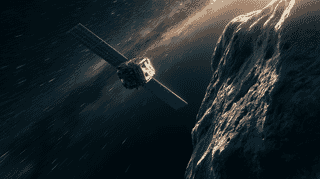
ALE's system involves loading a small satellite with hundreds of specially engineered metal pellets, each about 1 centimeter in diameter. Once the satellite reaches orbit at roughly 250 miles (400 km) altitude, it precisely ejects these pellets backward. The pellets then travel about one-sixth of the way around Earth before entering the atmosphere.
As each pellet hits the mesosphere, the atmospheric layer between 37 and 50 miles (60–80 km) above Earth, it heats up through aerodynamic friction and begins to glow brilliantly. This is exactly the same process that creates natural shooting stars, except ALE can control the timing, location, and even the color by adjusting the pellet composition.
The result would be visible across an area roughly 120 miles (200 km) in diameter, meaning millions of people could witness the show simultaneously. Unlike natural meteors that flash by in an instant, ALE's artificial shooting stars are designed to move more slowly, giving viewers a longer, more dramatic spectacle.
Each pellet burns up completely, leaving no debris and creating no space junk, a critical consideration in an era of growing concern about orbital pollution.
Two Launches, Two Setbacks
ALE's journey hasn't been smooth. The company successfully launched two satellites in 2019:
- ALE-1 lifted off in January 2019 aboard JAXA's Epsilon-4 rocket
- ALE-2 launched in December 2019 on Rocket Lab's Electron rocket from New Zealand
Both satellites reached orbit successfully, but neither managed to actually release the meteor pellets. The ejection mechanism failed on both missions. After extensive analysis with JAXA and external experts, ALE identified the likely culprit: in the vacuum of space, metal surfaces can bond together through a phenomenon called cold welding. The metal pellets essentially stuck to the loading mechanism, and the piston-and-spring system couldn't free them.
It was a devastating blow. The company had raised approximately $35 million (cumulative funding of about 5 billion yen) and spent years developing the technology. The planned debut event, a shooting star show over the Hiroshima-Setouchi region originally slated for 2020, had to be scrapped entirely.
Starlight Challenge: Third Time's the Charm?
On February 4, 2026, ALE announced "Starlight Challenge" at a press conference held at Cosmo Planetarium Shibuya in Tokyo. This is their third attempt, targeting a space demonstration during the 2028 fiscal year (April 2028 – March 2029).
CEO Okajima reflected candidly on the past failures: "It's precisely because of those failures that we're able to take this next step and be here today."
The next satellite features a completely redesigned ejection system. The main improvements are as follows.
- New drive system: the old one-way piston-and-spring mechanism is replaced with a motor drive that can reverse, allowing jams to be cleared
- New materials: the metal pellets are changed to a material less prone to sticking in vacuum
- The company said further details would be announced in summer 2026
When reporters asked about the probability of success, Okajima's response captured the team's spirit perfectly: "Scientifically, I can't say 100%. But emotionally, it's 100%."
If the 2028 demonstration succeeds, ALE plans to begin commercial operations in 2029 or 2030.
More Than Entertainment: The Science Behind the Spectacle
What makes ALE's project more than just a fireworks show in space is its scientific value.
The mesosphere, where shooting stars occur, is sometimes called the "ignorosphere" because it's too high for weather balloons and too low for satellites to study effectively. It remains one of the least-understood regions of Earth's atmosphere.
By creating artificial shooting stars with known compositions at precisely controlled times and locations, scientists can gather valuable data about atmospheric conditions in this mysterious zone. This data could help improve understanding of climate change mechanisms, wind patterns at extreme altitudes, and even contribute to research on spacecraft re-entry technology.
ALE has committed to sharing observational data with the broader scientific community, meaning every shooting star show would also be a scientific experiment.
Corporate Partners Join the Mission
Alongside the Starlight Challenge announcement, ALE revealed corporate partnerships with four Japanese companies from diverse industries:
- PR TIMES (press release platform): Launching a "Stars on Earth Project" to recruit supporting companies and raise awareness
- au Energy & Life (KDDI group): Introducing "Shooting Star Electricity": a retail power plan where subscribers get exclusive access to space education content and behind-the-scenes updates. The service launched on February 4, 2026
- Takara Standard (kitchen/bath manufacturer): Testing whether their enamel panel technology can withstand space conditions, exploring future space applications
- Trusco Nakayama (industrial tool distributor): Supplying mechanical tools and expanding their catalog to serve the growing space industry
These partnerships reflect a broader trend in Japan's space industry: traditional companies increasingly seeking connections to space ventures, not just for PR value but for genuine technology crossover.
Japan's Growing Space Business Ecosystem
ALE's story is part of a larger wave of Japanese space entrepreneurship. The country's space industry has been evolving rapidly beyond its traditional government-led model anchored by JAXA.
Japan's "Space Business" sector is growing, with startups tackling everything from satellite-based Earth observation (Synspective, Axelspace) to lunar transportation (ispace) and small rocket development (Interstellar Technologies, Space One). The government has been actively encouraging private-sector participation through programs like J-Startup and the "Space Business Investment and Loan Scheme."
ALE occupies a unique niche. While most space startups focus on practical applications like communications or Earth observation, ALE is betting that there's a market for space-based entertainment, an idea that sounded fantastical when the company was founded but seems increasingly plausible as the overall space economy grows.
The Business Case for Man-Made Meteors
If ALE succeeds, the commercial possibilities are intriguing. Imagine ordering a custom shooting star show for a city's New Year celebration, a major sporting event, or even a marriage proposal visible across an entire region.
ALE envisions customers ranging from national governments promoting tourism, to corporations running promotional campaigns, to individuals marking personal milestones. A single show could potentially be witnessed by millions of people within the 120-mile viewing area, a scale that dwarfs any concert or sporting event.
The company has also outlined more advanced future concepts, including multiple satellites working in coordination to create patterns in the sky, such as spirals of shooting stars, something impossible with natural meteors.
The Broader Debate: Dreams vs. Pragmatism
Not everyone is convinced. Critics question whether the resources invested in artificial shooting stars might be better directed toward more immediately practical space technologies. Others raise concerns about the commercialization of the night sky, drawing parallels to satellite constellation projects that have frustrated astronomers with light pollution.
Supporters counter that projects like ALE inspire public interest in space science, generate real atmospheric research data, and demonstrate that space can be more than just a frontier for government agencies and defense contractors. They point out that the entertainment angle makes space tangible and exciting for ordinary people in a way that satellite imagery databases never will.
What's Next
The road to 2028 will involve finalizing the new satellite design, securing launch arrangements, and continuing to build partnerships. ALE's summer 2026 update will be a key milestone, when more technical details about the improved ejection system are revealed.
For Okajima and her team, the Starlight Challenge represents something bigger than a third attempt at a technology demonstration. It's about proving that failure in space isn't an ending; it's data. And that a dream born under a disappointing meteor shower 25 years ago can still light up the sky.
In Japan, this project sparks a wide range of reactions, from excitement about pioneering space entertainment to skepticism about its practicality, from pride in Japanese innovation to concerns about spending priorities. Some see it as a beautiful fusion of science and art; others wonder if the money could be used for more pressing challenges.
What about in your country? Would you want to see artificial shooting stars in your night sky? Do you think space entertainment is a worthy pursuit, or should space resources focus solely on practical applications?






Global Discussion
15 comments