The memory chips powering AI are dominated by three companies from Korea and the U.S. A Japanese startup called SAIMEMORY has turned up with a different idea: stack the dies vertically rather than flat, and go for 2-3x the capacity at half the power and 60% lower manufacturing cost. Whether Japan can get back to the front of the memory industry after four decades is the question underneath.
The "Mystery Memory Maker" Reveals Itself
On February 3, 2026, at Intel Connection Japan 2026 held by Intel in Tokyo, a company appeared in public for the first time: SAIMEMORY. It is a wholly owned subsidiary that SoftBank set up in December 2024, and according to Intel it plans to begin operations in the first quarter of 2026. The collaboration agreement itself was signed the day before, on February 2.
CEO Hideya Yamaguchi told the audience: "We expect the AI era to bring a transformation greater than the primary and secondary industries. We will provide solutions for it."
SoftBank is the parent, but the project draws on a strong group of partners at home and abroad, including Intel, the University of Tokyo, Fujitsu, RIKEN, Shinko Electric Industries and Powerchip Semiconductor Manufacturing.
AI's Biggest Bottleneck: The "Heat and Performance Wall" in Memory
Why is a new kind of memory needed now? Training and running large AI models requires GPUs and CPUs to process vast amounts of data, and memory holds that data temporarily and reads and writes it at high speed. AI data centers today mainly use HBM (High Bandwidth Memory), but HBM has major problems.
First, stacking DRAM chips flat on top of one another makes heat unavoidable. Today's mainstream 16-layer stacks are close to the limit, with around 20 layers seen as the ceiling. The more layers there are, the more heat builds up in the lower chips, degrading performance and reliability.
In addition, HBM supply is nearly monopolised by three companies, SK Hynix, Samsung and Micron, and supply has not kept up with surging AI demand. HBM also costs six to seven times as much as ordinary DRAM, pushing up the cost of building data centers.
A Revolutionary "Vertical" Architecture: ZAM (Z-Angle Memory)
SAIMEMORY's next-generation memory, ZAM, sets out to change that structure itself.
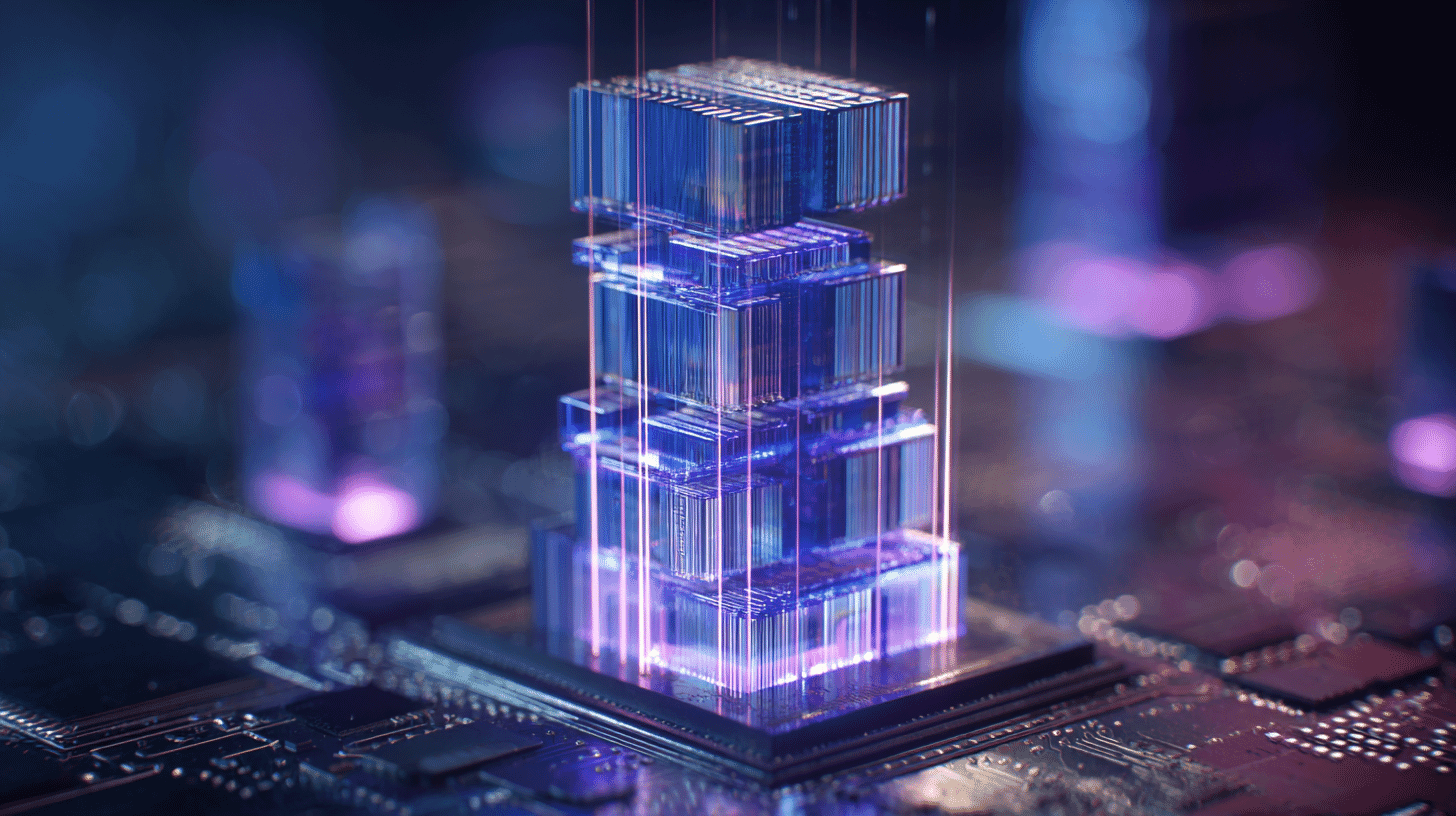
Where conventional HBM stacks chips flat, ZAM, as its name suggests, arranges the dies along the Z axis, that is, vertically. With this world-first structure, heat from each die escapes evenly upward, which is said to greatly ease the heat concentration that troubled flat stacking.
"Memory generally prioritises high capacity and wide bandwidth, but our memory puts low power consumption first," CEO Yamaguchi said, stressing a design philosophy that balances performance with low temperatures. ZAM's targets are as follows.
- Capacity: 2-3x that of HBM (per unit area)
- Power consumption: at least 50% lower than HBM
- Manufacturing cost: up to 60% lower than HBM
- Bandwidth: equal to or greater than HBM
The work builds on Intel's stacking and packaging technology, with SAIMEMORY leading technology provision and commercialisation.
Technology Rooted in U.S. National Labs
The technological foundation for ZAM comes from Intel's work under the Advanced Memory Technology (AMT) program, funded by the U.S. Department of Energy. This program, managed through Sandia National Laboratory, Lawrence Livermore National Laboratory, and Los Alamos National Laboratory, validated next-generation DRAM stacking and bonding techniques through the Next Generation DRAM Bonding (NGDB) initiative.
Gwen Voskuilen, a principal member of technical staff at Sandia, expressed enthusiasm for the technology's potential to bring high-bandwidth memory to systems that previously could not adopt HBM due to capacity and power constraints.
SoftBank Group announced a $2 billion investment in Intel in August 2025. For Intel, this collaboration marks its first serious return to the memory business since exiting the DRAM market in the 1980s, ironically, under pressure from Japanese competitors at the time. Now, decades later, Intel is partnering with a Japanese company to re-enter the very market it once left.
Development Timeline and Funding
SAIMEMORY has laid out the following roadmap:
- By FY2027 (ending March 2028): Complete prototype development (approximately ¥8 billion / ~$53 million investment)
- By FY2029: Achieve commercialization and establish mass production
SoftBank is contributing approximately ¥3 billion, while Fujitsu and RIKEN are investing around ¥1 billion combined. The remaining funding is expected to come through Japan's Ministry of Economy, Trade and Industry (METI) via NEDO, the national research and development agency.
This public-private framework mirrors the approach taken with Rapidus, another Japan-U.S. semiconductor collaboration leveraging IBM technology for advanced chip manufacturing, suggesting ZAM could evolve into a full-scale national project.
Reviving Japan's Memory Industry Legacy
In the 1980s, Japan dominated approximately 70% of the global DRAM market. The subsequent rise of Korean and Taiwanese manufacturers eroded that position, and the 2012 bankruptcy of Elpida Memory effectively ended Japan's presence as a major DRAM producer.
SAIMEMORY's ambition goes beyond launching a new product. It represents Japan's attempt to reclaim a strategic position in the semiconductor supply chain. Under METI's "AI and Semiconductor Industry Base Strengthening Framework," the government has planned over ¥10 trillion in public support through 2030, and SAIMEMORY is positioned as a key element of that strategy.
Challenges and Uncertainties
There are, however, reasons for caution.
Market leader SK Hynix develops quickly, and standards beyond HBM4 are already being drawn up. By fiscal 2027, when SAIMEMORY is due to complete its prototype, competitors' technology will have advanced further.
With the US government now Intel's largest shareholder (9.9%), some also point out that under the Trump administration's push to revive American manufacturing, Washington could seek to have ZAM produced in the United States. The project's exposure to geopolitical risk and industrial policy deserves attention.
Moreover, a development budget of ¥8 billion is not large by semiconductor industry standards. Compared with Rapidus's investment of trillions of yen, raising additional funds may become a challenge.
Can Japan Rewrite the Rules of Memory?
ZAM is taking on the triple wall of power, heat and cost in AI data centers. If it succeeds, it could change the cost structure of AI infrastructure worldwide. But the technology race with Korean rivals, geopolitical risk and a limited development window remain.
In Japan, hopes for a semiconductor revival are rising, alongside cautious voices asking whether this can really be done. What debates are there in your country about memory and chips for AI?
References
- https://www.saimemory.co.jp/news/press/20260203_01/
- https://pc.watch.impress.co.jp/docs/news/2083139.html
- https://www.softbank.jp/en/corp/news/press/sbkk/2026/20260203_01/
- https://eetimes.itmedia.co.jp/ee/articles/2602/03/news099.html
- https://eetimes.itmedia.co.jp/ee/articles/2602/03/news074.html
- https://www.cnbc.com/2026/02/03/softbank-subsidiary-saimemory-intel-ai-memory-z-angle-program.html





Global Discussion
15 comments