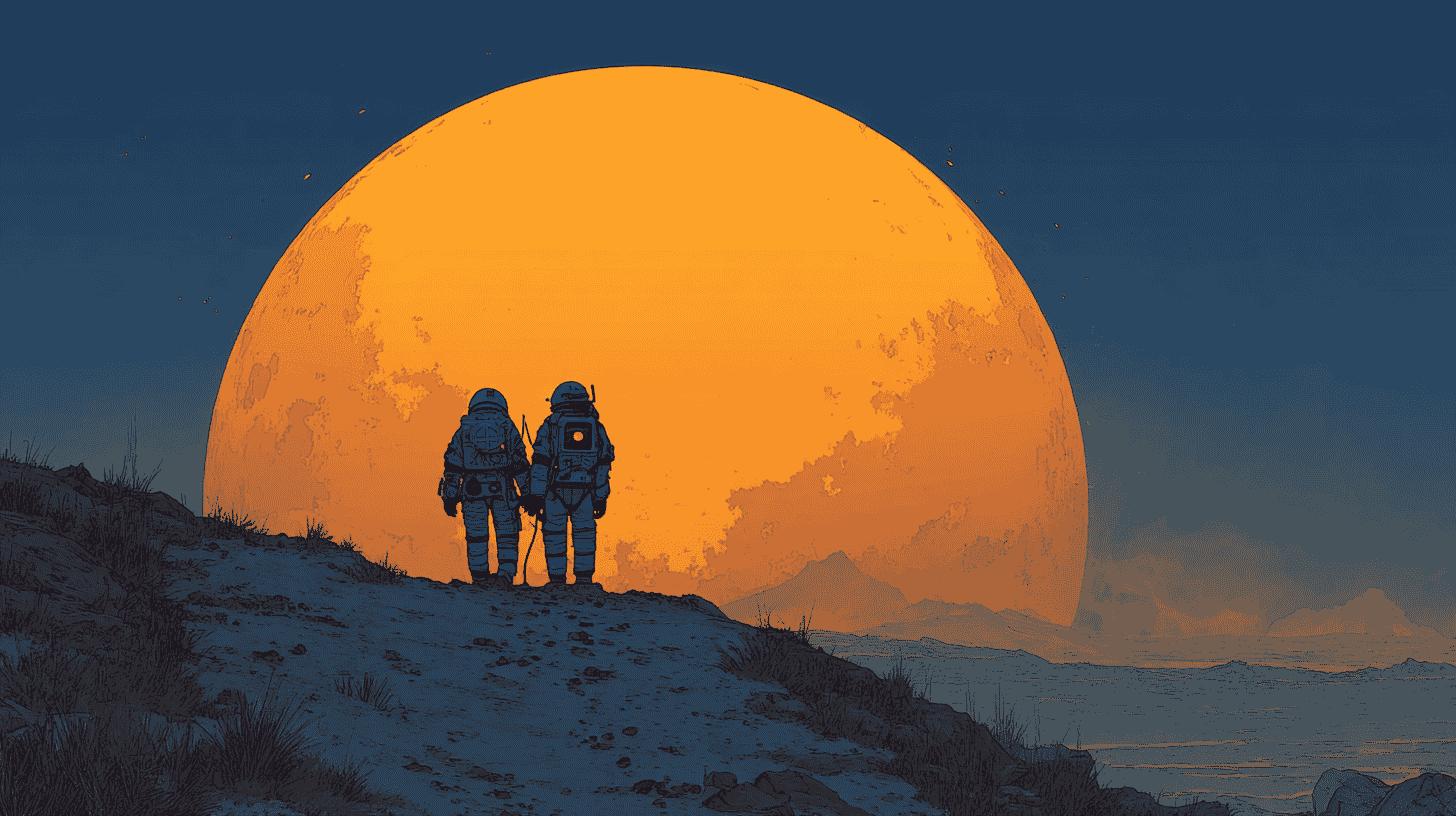
When they were kids, two brothers looked up at the night sky and made a promise to each other: "Let's become astronauts. Let's go to space together." That manga, which began in 2007, ends on June 11, 2026. 18 years. 432 chapters. 35 million copies. Two consecutive covers on Japan's most prestigious seinen weekly. Here's everything you need to know about how Chuya Koyama's Space Brothers is saying goodbye.
The Day That Arrived Quietly, Not Suddenly
On April 16, 2026, Kodansha's Morning magazine and the official Space Brothers X (Twitter) account confirmed that the manga's final chapter will appear in Morning issue #28, on sale June 11, 2026. Issues #27 (June 4) and #28 will feature the series on two consecutive covers, an honor Morning reserves for its most significant long-running works.
This wasn't a surprise announcement. As early as July 23, 2025, the paper band on volume 45 carried the words "Next volume, the grand finale!" The same week, a massive banner reading "Space Brothers, Next Volume, the End" went up at Tokyo's Shibuya MARK CITY for a full week. In March 2026, the official X account announced that only three chapters remained. Readers have been preparing, slowly, for this moment.
The final volume 46 will ship on July 23, 2026. The special edition includes a "Mutta & Hibito doll set" and a "Digital Photo Album," and pre-orders are already live.
432 Chapters, 18 Years, 35 Million Copies: An Entire Era
Space Brothers (宇宙兄弟, Uchū Kyōdai) launched in the combined New Year's issue of Kodansha's Morning magazine on December 6, 2007. The story centers on two brothers, Mutta Nanba and his younger brother Hibito. One summer night as kids, they spot what looks like a UFO streaking toward the Moon, and they make a vow: "We'll both become astronauts. We'll go to space together."
Fast forward to 2025 in the story's timeline: Hibito has become Japan's first member of a long-term lunar crew and is getting attention from around the world. Mutta, meanwhile, has just headbutted his boss, been fired, and sent back to live with his parents. Then an email from Hibito arrives, and the story begins.
The series ran on a (mostly) biweekly schedule, and cumulative print circulation has topped 35 million copies. In 2011, the manga pulled off a rare double win: the 56th Shogakukan Manga Award (General Category) and the 35th Kodansha Manga Award (General Category) in the same year.
JAXA and NASA Consulting Gave It Credibility Abroad
One big reason Space Brothers resonated far beyond Japan, especially with readers who love hard science fiction and actual engineers, is its obsessive commitment to technical accuracy.
Chuya Koyama worked closely with JAXA (the Japan Aerospace Exploration Agency) and NASA, carefully researching astronaut selection exams, lunar EVA procedures, Soyuz spacecraft operations, and life aboard the International Space Station. His relationships with active astronauts ran deep throughout the serialization. In fact, anime episode 31 (aired November 4, 2012) achieved a world first: Japanese astronaut Akihiko Hoshide, while actually aboard the ISS, recorded voice-acting lines for the episode from space.
"There's no shortage of space fiction. But a series that treats going to space as something rooted in everyday human life, this carefully? That's rare.", a sentiment widely shared across Japanese and English-language reviews.
Overseas Reach and Crunchyroll's Role
What carried Space Brothers to English-speaking audiences was the 99-episode TV anime adaptation by A-1 Pictures, which aired on Yomiuri TV (Nippon TV network) from April 2012 to March 2014. Crunchyroll simulcast the anime alongside its Japanese broadcast, quietly building a devoted fanbase in the West.
The anime is still streaming today on Crunchyroll and the Crunchyroll Amazon Channel (availability varies by region). In North America, Sentai Filmworks licensed both the TV series and the prequel film. Netflix carries the anime film Space Brothers #0 (2014) in some regions.
The English manga has had a more complicated journey. Crunchyroll's SimulPub subscription pulled its Kodansha titles in January 2023, but Kodansha USA Publishing continues to release digital volumes and same-day chapter releases via ComiXology and Amazon Kindle. Importantly, in January 2024, Koyama said publicly that the anime is planned to continue after the manga ends, meaning the large portion of the manga the anime never adapted could eventually be animated. For international fans who only know the anime, this is a big deal.
The Live-Action Film, Buzz Aldrin, and Coldplay
A live-action film adaptation was released by Toho in May 2012, starring Shun Oguri as Mutta and Masaki Okada as Hibito. Yoshitaka Mori directed; Koyama himself wrote the screenplay. Most striking: Apollo 11 moonwalker Buzz Aldrin appears as himself in a cameo. The theme song is British band Coldplay's "Every Teardrop Is a Waterfall" from the album Mylo Xyloto. The film won Best of Puchon and the NH Nonghyup Citizen's Choice Award at the 16th Bucheon International Fantastic Film Festival in South Korea.
The Final Arc: Mutta Adrift in Space
The current state of the story is, literally, life or death. On the return from a lunar mission, Mutta was separated from his spacecraft and began drifting through space with dwindling oxygen (this is volume 45). After a desperate rescue mission involving his brother Hibito aboard a Soyuz, Mutta just barely catches the "lifeline" Hibito throws him, and that's where volume 45 ends.
In the most recent chapters published in Morning (early 2026), Mutta has been rescued and is beginning descent back to Earth. What the final three chapters will show, and whether we'll see the "life after" of the characters fans have watched for 18 years, remains officially a mystery. The brothers once promised to go to Mars. Will the story end with the Moon receding behind them? Or with the red horizon of Mars ahead? No one outside Koyama and a handful of editors knows.
A Send-Off for a Generation
In spring 2026, bookstores across Japan are mounting retrospective displays, and a major outdoor campaign is planned again for Shibuya Station. Eighteen years is long enough for a generation to grow from middle school to their 30s, and for many readers, that's exactly what happened. On social media, fans are saying the same things in many languages: "I don't want it to end." "But I want to see how it finishes." "This manga changed my life."
Kodansha has treated Space Brothers as a flagship title for a long time. The two-week cover run, the memorial final-volume box set, the outdoor Shibuya campaign, the author's promise to continue the anime, none of this is ordinary. It's an entire publishing-scale effort to see one era off properly.
Space Brothers was never just science fiction. It was written for adults who once thought "I want to chase my dream, but I'm afraid", a story about second chances, forgiveness, and the slow courage of starting again. Its final chapter hits Japanese bookshops and convenience stores on June 11, 2026.
In your country, is there a long-running manga, comic, or animated series that shaped a generation? How did you first discover Space Brothers, and which moment stuck with you? We'd love to hear your story.
References
- https://natalie.mu/comic/news/668549
- https://morning.kodansha.co.jp/c/uchukyodai.html
- https://koyamachuya.com/
- https://www.animenewsnetwork.com/news/2026-03-19/space-brothers-manga-finale-slated-after-3-more-chapters/.235475
- https://us.oricon-group.com/news/5448/
- https://en.wikipedia.org/wiki/Space_Brothers_(manga)



Global Discussion
15 comments