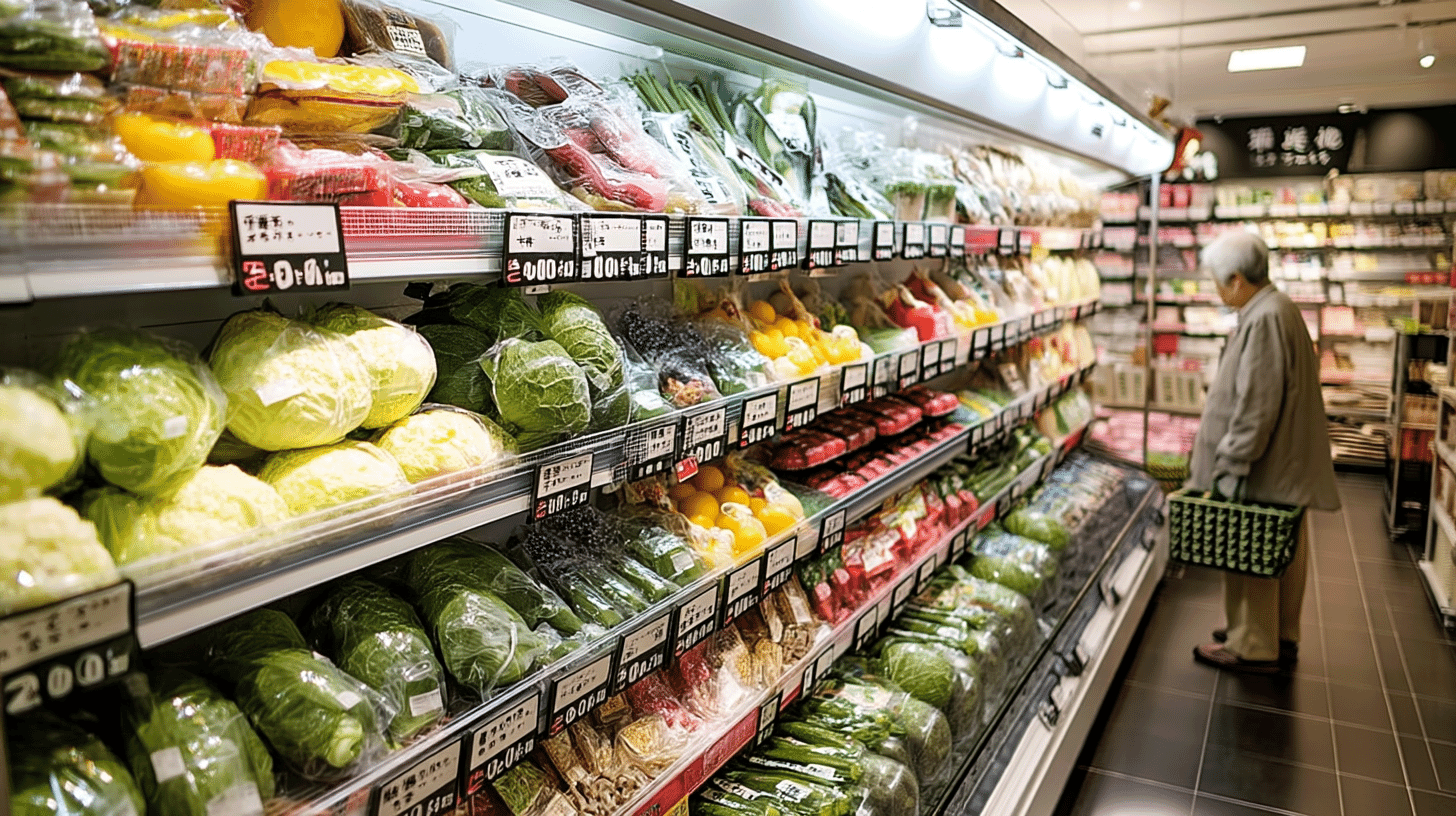
My Basket, Aeon's small-format supermarket that packs fresh food and daily necessities into a convenience-store footprint, keeps adding branches across the Tokyo area. It reached 1,371 stores in August 2026 and is aiming for 2,500 by fiscal 2030 and 5,000 in the longer run. Here is why retail's old rule that bigger stores win has been shaken, seen through an aging population and the rise of single-person households.
Convenience Store-Sized Supermarkets Are Everywhere
Walk through Tokyo, Yokohama, or Kawasaki and the "My Basket" (まいばすけっと) sign turns up again and again. The stores are roughly convenience-store sized but stocked like supermarkets, fresh produce through daily necessities, and they keep multiplying.
The Aeon Group chain had 1,262 stores as of the end of August 2025. My Basket's statutory filing puts revenue for the year to February 2025 at 290.3 billion yen, up 12.6 percent, with operating profit of 8.1 billion yen. Aeon plans 2,500 stores by fiscal 2030 and a 5,000-store network after that. Openings have continued since: four stores opened on August 21, 2026 in Tokyo's Bunkyo, Sumida and Koto wards and in Kashiwa, Chiba, bringing the total to 1,371.
Retail long ran on the principle that bigger stores win. So why are small ones gaining ground? The answer sits in Japan's changing demographics.
Understanding "Small Trade Areas": How Aging Changes Shopping Habits
Retailers talk about "small trade areas" (小商圏化). A trade area is the geographic range from which a store can draw customers, and in Japan that range keeps shrinking.
The primary driver is Japan's aging population. Elderly individuals tend to have reduced mobility and less motivation to go out compared to younger generations. As they stop driving or find it difficult to walk long distances carrying heavy groceries, traveling to distant large supermarkets becomes increasingly challenging.
Consequently, the trade areas of large supermarkets and shopping malls are contracting, while demand for small stores within walking distance from home is surging. My Basket runs a "dominant strategy," clustering multiple stores within 300 to 500 meters of one another.
The Rise of Single-Person Households and "Buy Only What You Need" Culture
Household structure has shifted too. The National Institute of Population and Social Security Research's 2024 projection has single-person households at about 20% of the total in 1980, 38.0% (21.15 million) in 2020, and 44.3% (23.30 million) by 2050.
Particularly noteworthy is the increase in elderly single-person households. Due to increasing rates of lifelong singlehood and spousal bereavement, single-person households aged 65 and over are expected to exceed 10 million by 2050.
For those living alone, bulk buying often leads to food waste, and refrigerator space is limited. A "buy only what you need, when you need it" style is becoming mainstream. My Basket stocks single-serving prepared foods and small-portion ingredients.
Cheaper Than Convenience Stores, Closer Than Large Supermarkets: The Perfect Position
My Basket has earned the nickname "convenience store killer" due to its price competitiveness. Centering on Aeon Group's private brand "Top Value," the chain achieves prices significantly lower than convenience stores.
Aeon president Akio Yoshida told an earnings briefing that a cup noodle running about 230 yen at a convenience store goes for roughly 130 to 140 yen as a "Topvalu Best Price" item at My Basket. Rice balls run about 117 yen including tax against roughly 180 yen at convenience stores.
On the other hand, the stores lack the spacious floor area and extensive product selection of large supermarkets. But for urban residents, finishing the daily shop within a few minutes' walk of home or work counts for a lot.
The chain increasingly takes ground-floor space in apartment blocks and low-rise commercial buildings, becoming a kind of "refrigerator downstairs" for residents. Close, quick, cheap. That combination is doing the work.
Directly-Operated Stores Enable Rapid Expansion and Quality Control
Another strength of My Basket is that all stores are directly operated by the company. While most convenience store chains rely on franchise systems, My Basket's headquarters directly manages every location.
With no franchise owners to recruit and train, stores can open fast. Yoshida has said staff "can work at stores after just half a day of training," pointing to how standardized the operation is.
Additionally, there's no risk of competition between franchisees, allowing the company to control multiple nearby stores without conflict. Logistics efficiency improves, and inventory turnover rates increase.
Leveraging Closed Convenience Store Locations for Efficient Expansion
A crucial element of My Basket's expansion strategy is the active utilization of closed convenience store locations.
In recent years, the convenience store industry has faced rising labor costs and intensified competition, leading to numerous unprofitable store closures. My Basket rents these vacant properties as-is, cutting development costs. The Nikkei reports the aim is to halve initial investment while expanding the network, at a time when construction materials are expensive.
Since stores are designed around floor spaces similar to convenience stores (approximately 130-260 square meters), the compatibility with as-is rentals is excellent.
Addressing the "Shopping Refugee" Problem
Japan faces growing social challenges related to "shopping refugees" and "food deserts." Particularly for urban elderly residents, obtaining daily groceries is becoming increasingly difficult.
Mini supermarkets like My Basket serve as a "last resort" for these shopping refugees. For elderly individuals who cannot easily reach large supermarkets, having access to fresh food and daily necessities near their homes is crucial for maintaining quality of life.
While government and local authorities work on shopping support measures, private expansion into small trade areas ends up serving a public function too.
Future Outlook: Toward a 5,000-Store Network
Aeon positions My Basket at the center of its metropolitan strategy. Paired with the delivery reach of its 510,000-member online grocery service Green Beans and USMH's supermarket business, the plan is to capture demand across a region that keeps drawing people in.
From fiscal year 2026 onward, the company plans an annual opening pace of over 200 stores, with expansion areas extending from traditional bases in Tokyo's 23 wards, Yokohama, and Kawasaki to suburban areas of Chiba and Saitama prefectures.
Going forward, the company aims to improve profitability by increasing the Top Value product composition ratio, building a structure capable of handling high urban rent costs.
What About Your Country?
How are shopping styles changing in your country? What impact are aging populations and changing household structures having on retail? We'd love to hear about the situation in your country!
References
- https://www.ryutsuu.biz/store/s081715.html
- https://news.yahoo.co.jp/articles/8b925379f6f4620373601768a1abdfd89f96011d
- https://toyokeizai.net/articles/-/877444
- https://diamond.jp/articles/-/377242
- https://www.ryutsuu.biz/store/r101611.html
- https://www.nikkei.com/article/DGXZQOUC239AR0T20C25A7000000/
- https://www.nli-research.co.jp/report/detail/id=78767
- https://md-next.jp/24818






Global Discussion
15 comments