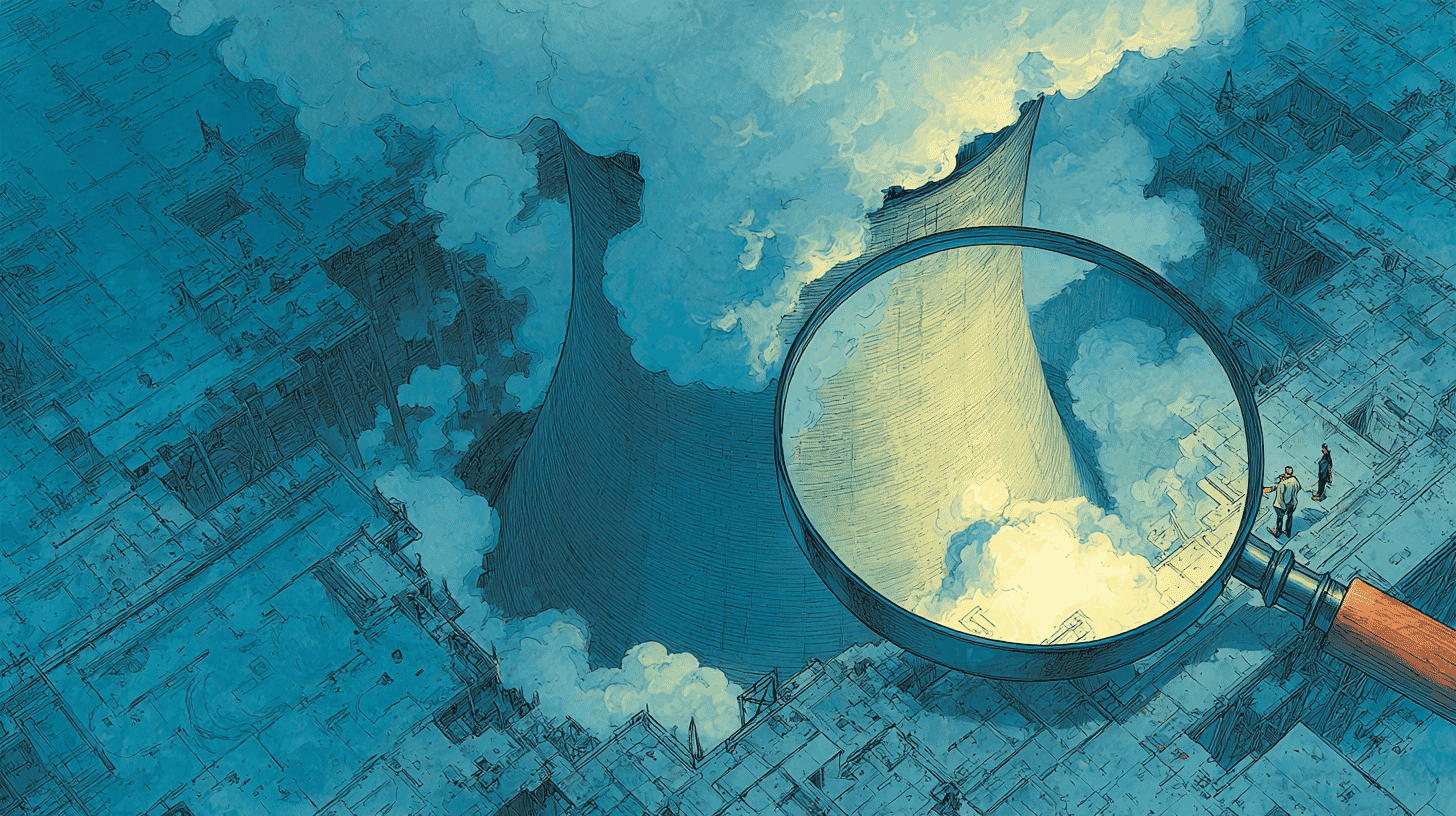
🏭 In early June, Japan's government did something it had ducked for more than a decade: it put actual numbers on rebuilding its nuclear fleet. Roughly 2.2 to 5.5 gigawatts of replacement capacity by the 2040s, or two to five reactors, and a cumulative 12.7 to 16 gigawatts, or eleven to fourteen reactors, by the 2050s. Weeks later, the country's nuclear regulator sat in a meeting room and used the words "fabrication" and "cover-up" to describe how a major utility had faked earthquake-safety data at Japan's most dangerously sited plant, and kept faking it even while investigators were watching.
That whiplash is the whole story of nuclear power in Japan right now. The hard part was never whether Japanese engineers can build a reactor that rides out a quake. It's whether anyone here can be trusted to run one honestly across the sixty or eighty years it will stand. And since walking away from nuclear isn't really on the table, the question is how the rest of the world has answered that same problem.
A decade of getting caught
Start with the record, because it's what makes the mistrust rational rather than reflexive.
The operator in the latest case is Chubu Electric Power, caught shrinking the single most safety-critical figure in a reactor's design, the maximum ground shaking it is built to withstand, at the Hamaoka plant, which sits almost directly on the Nankai Trough, the offshore fault where Japan expects its next great earthquake. After an outside tip prompted regulators to open an inquiry in May 2025, Chubu rewrote 69 of the 225 seismic data cases under review; the company disclosed the misconduct only in January 2026. That case, which we laid out in detail here, would be damning on its own. What makes it more than a one-company problem is everything around it.
Tokyo Electric Power, the utility behind the 2011 Fukushima disaster, has spent the years since collecting fresh security failures at its Kashiwazaki-Kariwa plant: misused ID cards, a broken intrusion-detection system, a de facto operating ban from 2021 to 2023, and, as recently as November 2025, an employee mishandling counter-terrorism documents, a lapse that surfaced just as the local governor was about to approve a restart.
Kansai Electric spent 2020 explaining why 75 of its executives and staff had accepted about ¥360 million (roughly $2.2 million) in cash and gifts, gold bars among them, from a single power-broker in a town that hosts its reactors. And in 2023 the antitrust regulator hit Chubu, Chugoku and Kyushu Electric with a record ¥101 billion (about $630 million) in fines over a cartel: the big regional utilities had quietly agreed not to chase each other's customers.
The sins differ, from safety fraud to security lapses to bribery to price-fixing, but the shape is one. Japanese critics have a name for the tight weave of utilities, ministries and academics that keeps this behavior insulated from consequences: the "Nuclear Village." It is the culture the country's own parliamentary inquiry blamed for Fukushima, and the pile-up above is why a single line has hardened into common sense here: we can build them, we just can't be trusted to run them.
But quitting isn't on the menu
Here is the uncomfortable other half. The country that most distrusts its nuclear operators also cannot easily do without them.
Three pressures are converging. Japan has a 2050 carbon-neutrality pledge, and its renewables build-out has run into hard limits: stalled offshore wind, thinning solar economics, and a mountainous, crowded country with little spare land. It imports nearly all its fossil fuel, so energy security is a standing anxiety on an island grid with no cross-border cables to lean on. And there is a new, fast-growing appetite on top: data centers. Government estimates in 2025 put more than half of Japan's projected growth in electricity demand on data centers and AI, which want steady, around-the-clock, low-carbon power, the thing a reactor supplies and a solar panel does not.
Meanwhile the current fleet is aging out. More than three gigawatts of existing reactor capacity will hit the 60-year operating ceiling before 2040, and building new plants takes fifteen to twenty years. That arithmetic is what pushed the government, in its June policy draft, to finally name replacement numbers instead of gesturing at "using nuclear." What it published, though, is a modeled estimate of how much capacity would be needed under certain assumptions, not approval to break ground anywhere specific. The new plants are meant to be next-generation designs: advanced light-water reactors, small modular reactors (SMRs, factory-built units assembled on site), and, further out, fast and high-temperature gas reactors, all built on the grounds of stations already slated for decommissioning. (The trust questions hanging over that plan are their own story.)
So the two facts sit side by side: build more, trust less. Which makes the operator question impossible to skip.
How the rest of the nuclear world arranges trust
Every country that runs reactors has to settle two things: who operates the plants, and who watches the operators. The revealing part is that the world's answers all differ, and not one of them is scandal-proof.
The United States runs the most fragmented model. Its more than 90 reactors are operated by a spread of investor-owned companies, overseen by the Nuclear Regulatory Commission, an independent federal body with resident inspectors stationed at every plant. But the American system has a second layer, less famous and arguably more important. After the 1979 Three Mile Island accident, the industry grasped that its members were, in one blunt phrase, "hostages of each other" (one company's meltdown would tar them all), so it built INPO, the Institute of Nuclear Power Operations, a private outfit that grades and disciplines its own members against standards often stricter than the regulator's. Peer pressure, formalized. It is widely credited with driving U.S. plant safety sharply upward over the decades since.
France sits at the opposite pole: one operator, EDF, which the state fully renationalized in 2023, running all 57 of the country's reactors and supplying about two-thirds of French electricity. One throat to choke, in theory. Its regulator was streamlined in 2025, folding the safety authority and its technical-analysis institute into a single body, ASNR, partly to speed an ambitious new-build program. Yet even a state monopoly produced a falsification scandal. At the Le Creusot forge, which made large steel reactor components, manufacturers were found to have buried irregularities in paperwork stretching back decades: a cover-up inside a nationalized supply chain, not a competitive free-for-all.
South Korea is the closest mirror to Japan's anxieties. Its reactors run under a single state-owned operator, KHNP, watched by the NSSC regulator. In 2012 and 2013 the country discovered that thousands of components, including safety-grade control cables, had been installed using forged quality certificates, a racket that produced about 100 indictments and forced several reactors offline during a summer power crunch. Koreans coined their own name for the insider network behind it: the "nuclear mafia." Critics also pointed out that the regulator's technical arm drew a large share of its budget from the very operator it was meant to police, capture written straight into the accounting.
Line them up and the lesson is deflating. Private and fragmented (the U.S., and Japan's own regional monopolies) or state-owned and unified (France, Korea), every ownership structure has generated its own falsification-and-concealment scandal. The org chart is not the variable that decides whether operators stay honest.
Japan already copied the best chart. It wasn't enough.
This is the part that should give the rebuild debate pause. After Fukushima, Japan did not merely create an independent regulator, the Nuclear Regulation Authority, spun out in 2012 specifically to end the ministry-industry coziness blamed for the disaster. It also copied America's INPO, standing up a self-policing peer-review body called JANSI, whose board is made up of the operator CEOs themselves. On paper, Japan now has the layered American model, plus an independent regulator, plus international peer review through the global operators' association.
And Chubu faked the data anyway. TEPCO kept fumbling security anyway.
What actually separates better systems from worse ones, across all these countries, is not the structure but whether the checks have teeth, and whether someone inside can safely raise a hand. And the frauds in Japan, Korea and France were each exposed by a tip, not by the routine machinery. A whistleblower flagged Hamaoka to the regulator, an anonymous tip cracked open Korea's forgery ring, new management disclosed the Le Creusot files. The formal systems mattered most at the moment they chose to act on what they were handed.
That is why the coming months weigh more than the org chart. Japan's regulator has signaled it may decide Chubu's punishment as early as this summer, and has hinted that failing the Hamaoka review outright is on the table. A watchdog that catches fraud and then flinches teaches every other utility exactly the wrong lesson, and it would be doing so precisely as the country prepares to hand those same utilities a mandate to build fourteen new machines.
Every country with nuclear power runs some version of that gamble. When your own country's highest-stakes industries (power, aviation, chemicals, finance) are run by a tight circle of insiders, what actually keeps them straight: the regulator, the competition, or the one person willing to blow the whistle?
References
- https://kantenna.com/topic/hamaoka-nuclear-seismic-data-fraud
- https://novaist.jp/articles/nuclear-replacement-targets/
- https://www.nrc.gov/reading-rm/doc-collections/fact-sheets/3mile-isle
- https://world-nuclear.org/information-library/safety-and-security/safety-of-plants/three-mile-island-accident
- https://itif.org/publications/2025/09/02/lessons-from-frances-nuclear-program/
- https://en.wikipedia.org/wiki/Nuclear_power_in_France
- https://academic.oup.com/jwelb/article/13/1/47/5837954
- https://www.world-nuclear-news.org/Articles/Korea-probes-forged-quality-certificates
- https://www.genanshin.jp/english/association/establishment.html
- https://toyokeizai.net/articles/-/919456


Global Discussion
0 comments