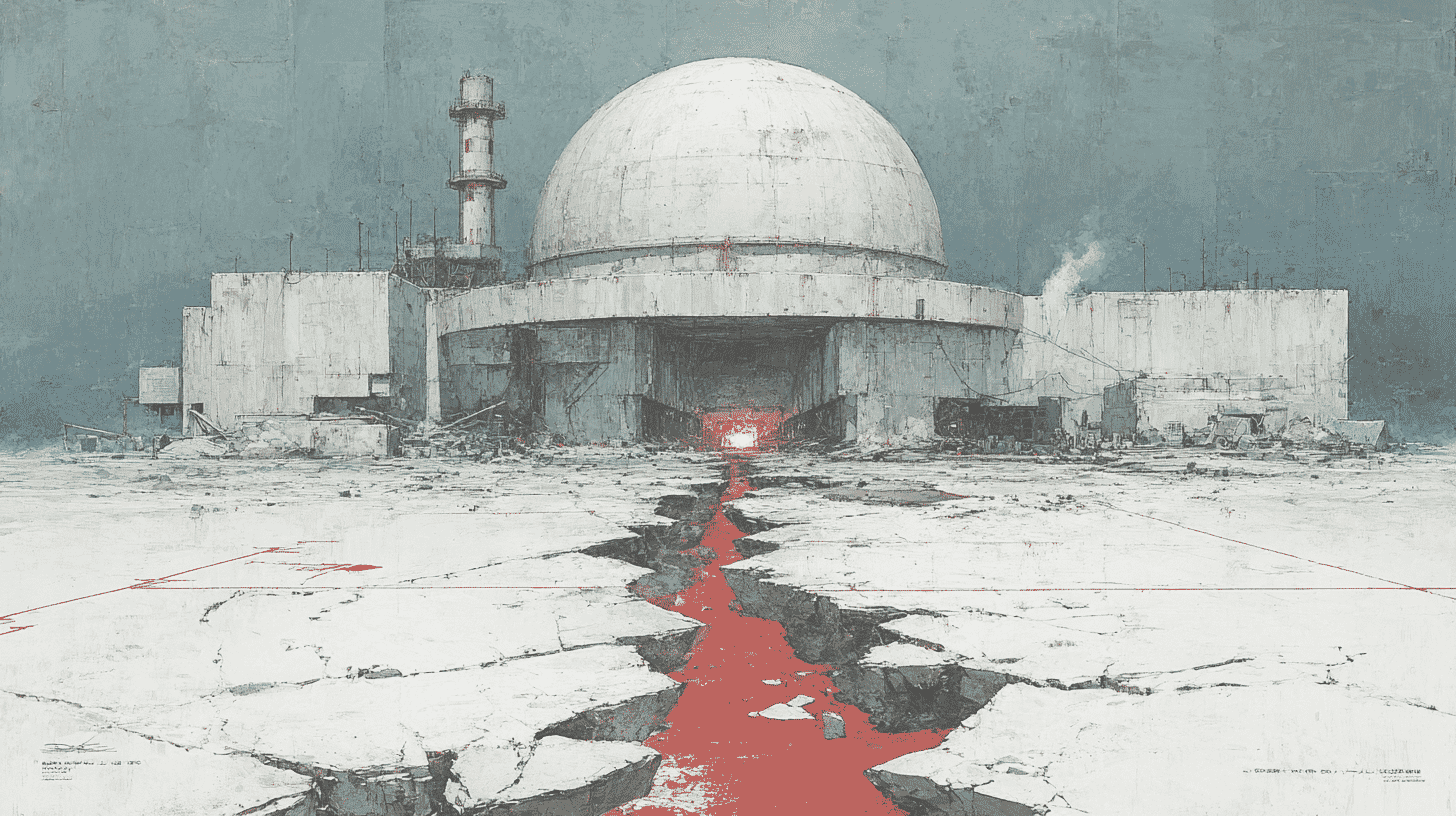
🏭 Japan's government says a magnitude-8-class megaquake will very likely strike the Nankai Trough within 30 years. Sitting directly above that zone is the Hamaoka nuclear plant. And the utility that runs it was caught faking the one number that decides how violent a quake the plant must survive. Then, even after regulators had started to dig, it kept right on faking it.
On July 1, Japan's Nuclear Regulation Authority laid out what its investigators had found, and the language was unusually blunt. The chairman used the words "fabrication" and "cover-up," and said an entire group of engineers appeared to have lost their sense of ethics. For a regulator that normally speaks in careful bureaucratic prose, that is close to shouting.
The one number they shrank
Every nuclear plant in Japan is built against a figure called the "design basis ground motion." In plain terms, that is the strongest shaking the reactor is engineered to ride out. Set it too low and everything downstream, from the thickness of the walls to the anchoring of the pipes, is designed for a gentler earthquake than the one that might actually come. It is the single most safety-critical number in the entire review.
That is the number Chubu Electric Power quietly made smaller. In its restart application for Hamaoka's Units 3 and 4, the company told regulators it had generated 20 seismic-wave datasets and picked a representative one near the average, a clean and statistically defensible method. What actually happened, according to the NRA, was that it asked a contractor to pull favorable data from a pool of more than a thousand candidates, and in some cases sifted through nearly 30,000, choosing the numbers that made the projected quake look weaker, then dressed the result up to appear neutral.
The unsettling part: it worked for years. Chubu applied for the Units 3 and 4 review back in 2014 and 2015, and in 2023 the NRA broadly signed off on the plant's maximum-shaking assumption of 1,200 gal, one we now know rested on cherry-picked data.
Why Hamaoka, of all places
Location is what turns this from a paperwork scandal into something colder. Hamaoka sits on the Pacific coast at Omaezaki, Shizuoka Prefecture, roughly 200 kilometers southwest of Tokyo, and almost directly on top of the Nankai Trough, the offshore fault where Japan expects its next great subduction earthquake.
How likely is that quake? The government's earthquake committee rates it in the highest risk tier. For years the official line was "about 80% within 30 years"; in 2025 the committee revised its method and now publishes a range, "60–90% or higher," alongside a lower alternative estimate, while telling the public to treat the high end as the planning figure. The worst-case scenario the government models for a full Nankai Trough rupture runs to roughly 298,000 deaths.
This is not an abstract risk to officials, either. After Fukushima, in May 2011, then-Prime Minister Naoto Kan singled out Hamaoka specifically and asked Chubu to shut it down because of its seismic exposure. It has been offline ever since, even as reactors have come back online elsewhere in Japan. So the number Chubu made smaller is the most important number at arguably the most dangerous nuclear site in the country.

Photo: E-190 / Wikimedia Commons (CC BY-SA 3.0)
They didn't stop when the regulator knocked
Faking safety data is bad enough. What pushed the NRA into open anger was the timeline.
The regulator learned of the problem in February 2025, from an outside whistleblower who reported years of falsified figures. From May 2025 its secretariat began formal hearings with Chubu. And it was after those hearings started, with investigators already asking questions, that Chubu went back and rewrote data on 69 of the 225 datasets under review, retroactively reshaping its earlier cherry-picking so it would look like a proper statistical process. In other words, the company appears to have kept doctoring the record specifically to get past the people investigating it.
Chubu only admitted the misconduct publicly in January 2026; its president and executives bowed in apology in Nagoya, and the company set up an outside committee. The fact that the manipulation had continued during the probe itself did not surface until the July 1 meeting.
The commissioners' reactions were, for this body, remarkable. One said the visible attempts to make the figures add up left him "holding my head in my hands." Another suggested the staff's sense of wrongdoing had gone numb, and that senior management may have been involved. Investigators found multiple departments implicated, pointing to something organized rather than a rogue employee. The chairman put it flatly: he suspected a cover-up, and called the data-faking and the concealment equally unforgivable.
The watchdog is the one really on trial
Here is where the story stops being only about one company. Japan's NRA was created in 2012, in the wake of Fukushima, precisely to prevent this kind of thing. Its whole design, pulling nuclear regulation out of the ministry that promotes nuclear power and standing it up as an independent body, was an answer to the "regulatory capture" that Japan's own parliamentary investigation blamed for the 2011 disaster: a regulator too cozy with the industry it was supposed to police.
So this scandal is really a live exam for that reformed system. And there are two ways to read the grade so far.
One reading is grim: a major utility gaming the safety review for the country's most seismically exposed plant is exactly the "Nuclear Village" behavior the reforms were meant to kill, proof that little has changed. The other reading is more encouraging: this time the system caught it. A whistleblower had a channel to the regulator, an independent NRA acted on the tip, voided the review to date (it now has to start from scratch), sent inspectors into Chubu's headquarters, opened a probe into whether executives were involved, and in May even moved to add criminal penalties for falsifying screening data to the reactor law. That is not a captured regulator looking away.
The catch is that the decisive move hasn't happened yet. The NRA plans to decide Chubu's punishment as early as this summer, once its own inquiry and the company's third-party committee report land, and it has signaled that failing the Hamaoka 3 and 4 review outright is on the table if the conduct is judged malicious enough. Whether the penalty is severe or a slap on the wrist is the thing the public is actually watching, because a regulator that catches fraud and then flinches teaches every utility exactly the wrong lesson.
That is the uncomfortable core of Japan's nuclear debate, and this case makes it concrete. The hard part was never whether Japanese engineers can build a reactor that survives an earthquake. It is whether the organizations that run these machines, and the ones that regulate them, can be trusted to stay honest across the 60 or 80 years a plant operates, especially when honesty is inconvenient and the next great quake is still, officially, a probability rather than a date.
In Japan, this trust is being tested in public, in real time. When the body that regulates your country's highest-stakes infrastructure, whether nuclear plants, aircraft or chemical works, catches someone cutting corners, do you trust it to come down hard? Or do you assume it will look the other way?
References
- https://www.japantimes.co.jp/news/2026/07/02/japan/chubu-electric-data-fraud-continue/
- https://www.nikkei.com/article/DGXZQOUA011PH0R00C26A7000000/
- https://news.yahoo.co.jp/articles/cbbeaf2e372b4d433000d08f9e3534f5ce433923
- https://news.yahoo.co.jp/articles/91c6e1f3c0b4918c5752f2fdd94c6eb84511011f
- https://www.chuden.co.jp/publicity/press/1217264_3273.html
- https://www.japantimes.co.jp/news/2026/05/27/japan/nuclear-plant-data-penalties/





Global Discussion
4 comments