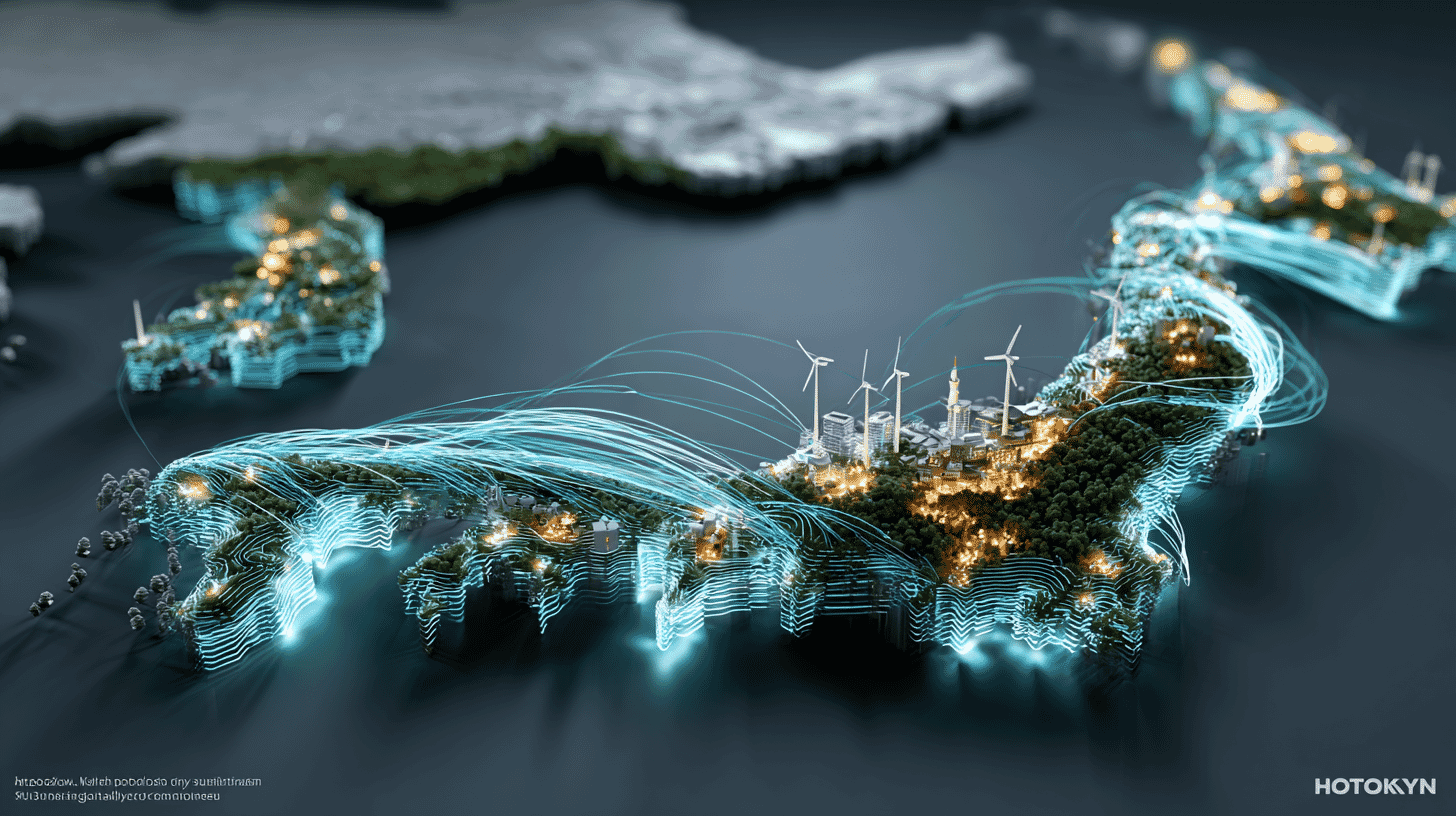
A single AI query costs less power than you have probably been told. The widely repeated line that a ChatGPT prompt burns ten times the electricity of a Google search traces back to a 2023 estimate built on GPT-3.5-era hardware. In February 2025 Epoch AI put a typical query at roughly 0.3 watt-hours, which is about what a Google search uses.
The pressure comes from volume and location, not from any one prompt. By fiscal 2034, new data centers and semiconductor fabs will add peak electricity demand equivalent to seven nuclear reactors in Japan, and roughly 60 percent of the country's data centers sit around Tokyo, where the connection queue is already backed up. Japan's answer to that is Watt-Bit Integration.
The Numbers Behind Japan's AI Power Crunch
Start with the figures. The Organization for Cross-regional Coordination of Transmission Operators (OCCTO), which aggregates Japan's grid demand forecasts, projected in January 2025 that nationwide end-use electricity consumption would reach 852.4 TWh in fiscal 2034, up about 5.8 percent from the 805.9 TWh estimated for fiscal 2024. Almost all of that growth comes from one source: new data centers and semiconductor fabs.
Peak demand from those facilities is forecast to add 560 MW in fiscal 2025 and 7,150 MW by fiscal 2034, roughly the output of seven nuclear reactors. Data centers will consume 44 TWh and semiconductor plants another 7 TWh in fiscal 2034, together making up about 14 percent of industrial power demand. Looking further out, some scenarios put data center consumption at 10–20 percent of total national electricity by 2050, a load equivalent to the entire Kansai or Chubu power grid.
OCCTO's January 2026 update trimmed the near-term numbers, though. Data-center-related peak demand now runs below the previous forecast through fiscal 2033, not because demand vanished but because construction delays and design changes pushed start dates back by several years. That slippage matters, as the critics section below makes clear.
The problem isn't just scale. It's geography. About 60 percent of Japan's data centers are clustered around the Tokyo metropolitan area, particularly in Inzai and Shiroi in Chiba Prefecture. Connection requests in TEPCO's service area now total roughly 9.5 GW through 2037, equivalent to nine nuclear plants, and grid bottlenecks are pushing project timelines past business plans.
"We want to build in Tokyo or Osaka, but we can't get connected." That's the reality Japanese data center operators are facing right now.
Same Problem, Different Answers Around the World
This electricity bottleneck is the universal challenge of the AI era. Every region is writing a different prescription.
Case 1: Virginia, USA, When Residents Pay the Bill
Northern Virginia is the world's largest data center hub. By some estimates, about 70% of global internet traffic passes through the region daily. Data centers consumed more than 25 percent of Virginia's electricity in 2024, about 32 TWh out of 128 TWh.
The political fault line cracked open when residents started seeing it on their bills. In PJM's July 2024 capacity auction, data center demand drove prices for the 2025-2026 delivery year up 833 percent year over year. In the December 2025 auction, for 2027-2028, prices pinned the FERC-approved cap of $333.44 per MW-day, and data center load accounted for $6.5 billion, or 40 percent, of the $16.4 billion total, according to market monitor Monitoring Analytics.
How that lands on households varies by zone. IEEFA estimates the capacity price surge adds roughly $18 a month for residential customers in western Maryland and about $16 in Ohio.
On November 25, 2025, Virginia's State Corporation Commission approved a new rate class, GS-5, in Dominion Energy's biennial review. It covers customers with peak demand of 25 MW or more and a monthly load factor above 75 percent, and applies to contracts signed on or after January 1, 2027. Those customers must pay for at least 85 percent of contracted distribution and transmission demand and 60 percent of generation demand, sign 14-year contracts, and post collateral. Most of Virginia's roughly 450 data centers are expected to land in the class.
Land and power are enough to win the projects. They are not enough to absorb the political cost that arrives with them, which is what Virginia has been learning.
Case 2: Ireland, From Moratorium to Conditional Reopening
Ireland built itself into Europe's data center hub by attracting Microsoft, Google, Amazon, and Meta. The cost was painful. Data centers' share of metered electricity consumption climbed from 5 percent in 2015 to 21 percent in 2023 and 23 percent in 2025, with consumption up 518 percent over the decade.
Between 2021 and 2022, the Commission for Regulation of Utilities and grid operator EirGrid effectively halted new data center connections in the Greater Dublin region, a de facto moratorium. In December 2025 the CRU withdrew that policy and replaced it with a new framework, and the conditions are strict. Any new data center must install on-site generation or storage sized to its own demand. At least 80 percent of annual demand has to come from Irish renewable projects that are genuinely new, meaning not already contracted under existing support schemes, procured through a corporate PPA or built by the operator itself.
In effect: bring your own renewables.
When the grid physically cannot keep up, politics pulls the brake. And the brake doubles as a lever, forcing a green energy buildout that would otherwise have moved slower.
Case 3: Singapore, Hitting the Physical Limit
Singapore covers 734 square kilometers, slightly more than Tokyo's 23 wards at roughly 628, yet packs in over 70 data centers totaling 1.4 GW. From 2019 through 2022, Singapore imposed a moratorium on new data center construction. Even after lifting it, the government uses a "Call for Applications" (CFA) framework to selectively approve projects.
The second round, DC-CFA2, opened on December 1, 2025 and allocates at least 200 MW of new capacity. It imposes the strictest sustainability requirements in Asia-Pacific: at least 50 percent green energy, PUE of 1.25 or better at full IT load against 1.3 in the 2023 pilot, and best-in-class IT energy efficiency. Applications closed on March 31, 2026. Meanwhile, a 700 MW low-carbon data center park is planned for Jurong Island, a roughly 50 percent expansion of total Singapore capacity in one project.
When physical limits arrive early, the only levers left are efficiency and decarbonization. The shift from quantity to quality stops being a choice.
Japan's Answer: What Is Watt-Bit Integration?
Now to Japan. Not the US approach (let the market push costs onto data centers), not the Irish approach (mandate self-procured renewables), not the Singapore approach (cap by physical area). Japan chose something different: integrate the design of electricity (Watt) and telecommunications (Bit) infrastructure, and steer data centers to the regions where renewables are abundant.
This is Watt-Bit Integration.
The starting point was the GX2040 Vision, approved by the Japanese Cabinet on February 18, 2025. The vision explicitly calls for unified planning of electricity and telecommunications infrastructure to simultaneously achieve AI-driven DX, decarbonization, and national resilience. In March 2025, METI and the Ministry of Internal Affairs and Communications launched the "Watt-Bit Integration Public-Private Council," which published its first summary report in June 2025.
Naoki Nishikado, the Mitsubishi Research Institute fellow who originated the concept, sketches a three-phase roadmap.
| Phase | Content |
|---|---|
| Watt-Bit Integration 1.0 | Optimize between existing data centers and grid infrastructure. Coordinate operations during demand peaks; shift data center loads when renewable surplus is available |
| Watt-Bit Integration 2.0 | Steer new data centers to areas near decarbonized power sources, Hokkaido (wind), Kyushu (solar), Tohoku (geothermal) |
| Watt-Bit Integration 3.0 | Position data centers as digital infrastructure for regional industries. By 2040, build 5 large hub clusters and 20–30 smaller "Watt-Bit Cities" nationwide |
The conceptual core is something called workload shift. AI training jobs and overnight batch processing tolerate latency, which means they can be physically relocated. Run them at Kyushu's solar-rich data centers during the day; shift the same compute load to Hokkaido or Tohoku at night, where wind generation runs strong. Match the flow of data (Bit) to the supply of power (Watt).
The University of Tokyo and Fujitsu began a joint demonstration of this concept in January 2026.
Concrete Example: A GPU Data Center in a Closed Schoolhouse
One real-world case attracting attention is in Kagawa Prefecture, on the island of Shikoku. Highreso, which runs the GPU cloud service GPUSOROBAN, opened its Takamatsu City data center in December 2024 inside a prefectural research facility, operated through its subsidiary Highreso Kagawa. On March 3, 2026 it opened a second Kagawa site in Ayagawa Town.
That one sits under the gymnasium of the former Ayakami Junior High School, closed in March 2022, in space that used to hold bicycle parking and club practice areas. The company put 11 billion yen, roughly 70 million dollars, into a facility of about 1,008 square meters, fitted with NVIDIA H100s and other GPUs, with full operation targeted for summer 2026. Classrooms in the main building are slated to become a community space. The municipality supplies the idle asset, the company brings the compute; Highreso has now stacked five sites in Ishikawa, Kagawa, and Saga on that pattern. Nishikado calls it "not strictly a Watt-Bit Integration project, but a useful reference case."
Healthcare smart-care for elderly facilities, smart agriculture for large-scale rice farming, autonomous local buses, most of these "industries with feet on the ground" are based in regional Japan. If "locally produced, locally consumed compute" spreads, regional compute demand could exceed half of total Japanese demand by 2040, according to MRI's projections.
Will It Actually Work? The Critics Speak
Watt-Bit Integration faces serious questions.
Latency. Financial trades, autonomous-driving control loops, and other millisecond-sensitive workloads can't run from a data center hundreds of kilometers from Tokyo. AI training is movable; real-time inference often isn't.
Network costs. Geographically distributed data centers only work if you also build redundant fiber networks, internet exchange points, and submarine cables. But private telecom investment has historically followed economic rationality and concentrated in large urban centers. Truly integrating power and telecom infrastructure will require substantial public support.
Speed. Hyperscalers typically plan five-year deployment cycles. Building out the necessary power, transmission, and fiber in regional Japan can take a decade or more. Wood Mackenzie has reported that gas turbine plant construction can take up to ten years, pushing some hyperscale and semiconductor projects past 2029. OCCTO's downward revision is that lag showing up in the national numbers.
The ESG paradox. Japan's renewable share remains modest, and Tokyo-area data centers still rely heavily on coal and LNG thermal generation. Global tech companies want 100 percent renewable, but in Japan they often end up powering their facilities from one of the more carbon-intensive grids among developed economies. Watt-Bit Integration alone can't resolve this. It has to be combined with nuclear restarts, offshore wind, and aggressive solar buildout.
A Different Mental Model: Treating Power and Compute as One System
Even with the caveats, Watt-Bit Integration carries a distinctive philosophy. The rest of the world is mostly imposing obligations on data centers through pricing, renewables, and efficiency rules. Japan's design starts upstream: align where data centers go with where the power can come from, by treating both grids as one design problem.
This is a solution born from constraints. Japan doesn't have America's land mass or its fleets of nuclear and LNG plants. It can't pull Singapore's lever of pure efficiency optimization in a single city-state. It isn't small enough to overhaul industrial and energy policy as fluidly as Ireland. So it is trying to use AI infrastructure investment as one lever to move three policy goals at once: reducing Tokyo concentration, decarbonization, and regional revitalization.
Whether this works will become clear over the next 10–15 years. If regional case studies multiply, Hokkaido, Tohoku, Kyushu, Kagawa, Watt-Bit Integration could become a recognized third path globally.
Where power gets generated, moved, and consumed is one question. Where data gets processed is another. Solving them separately is the old way; Watt-Bit Integration is an attempt to solve them together.
How is your country tackling the AI-era data center power challenge? Distribute regionally? Maximize efficiency? Mandate self-generation? Let us know.
References
- https://news.yahoo.co.jp/articles/4ec53fbda7be6f4fe46e50d2c90a0d40f9139c97
- https://www.meti.go.jp/press/2024/02/20250218004/20250218004.html
- https://www.meti.go.jp/press/2025/06/20250612001/20250612001.html
- https://businessnetwork.jp/article/26630/
- https://www.mri.co.jp/knowledge/insight/20250325.html
- https://www.occto.or.jp/assets/juyousoutei/2024/files/250122_juyousoutei.pdf
- https://www.iiea.com/blog/data-centres-in-ireland-the-state-of-play
- https://introl.com/blog/virginia-sb-253-data-center-electricity-rate-shift-2026
- https://introl.com/blog/singapore-green-data-center-mandate-dc-cfa2-2026
- https://cafe-dc.com/japan/data-center-energy-consumption-in-japan-to-triple-by-2034-report/







Global Discussion
14 comments