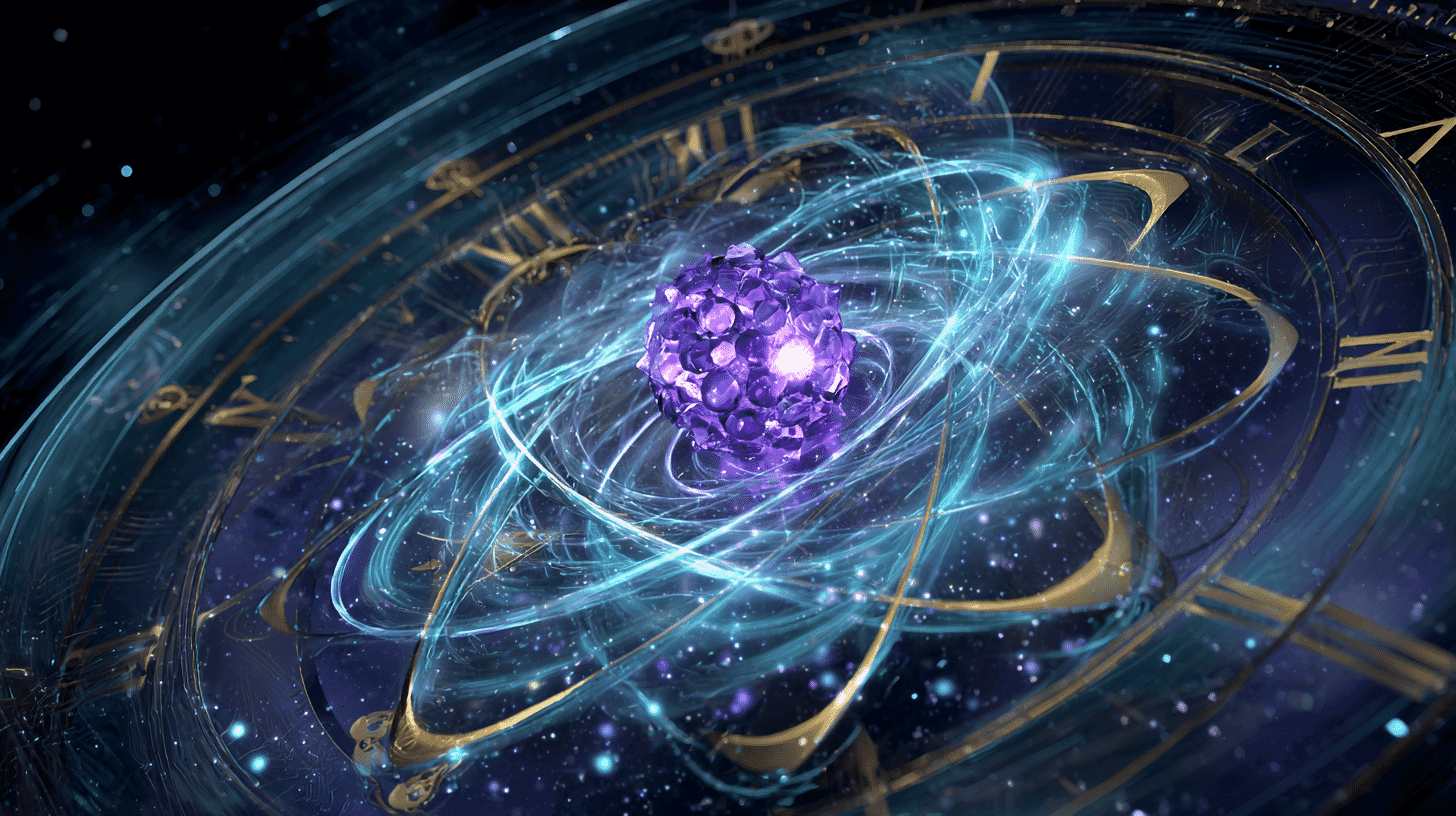
What if a clock could run for 13.8 billion years, the age of the universe, without losing a single second? Scientists are getting closer to making this a reality. A Japanese-led international research team has just decoded a crucial mechanism for the next-generation "nuclear clock," discovering that electrons in crystals are responsible for resetting the nuclear state. This breakthrough brings us one step closer to ultra-precise timekeeping that could revolutionize everything from GPS to the search for dark matter.
What Is a Nuclear Clock and Why Does It Matter?
The atomic clocks that power GPS satellites and define the second use the vibrations of electrons orbiting atoms, typically cesium, as their timekeeping reference. But scientists have long dreamed of something even better: a clock based on the atomic nucleus itself.
The nucleus is tens of thousands of times smaller than the atom around it, which makes it far less susceptible to external disturbances such as electromagnetic fields or temperature swings. In theory, a nuclear clock could be at least an order of magnitude more accurate than the best atomic clocks.
Of the roughly 3,000 nuclides known to science, thorium-229 stands alone as a candidate. Its nuclear excited state sits at just 8.4 electron volts (eV), against thousands or millions of eV for most nuclei. That puts it within reach of vacuum-ultraviolet lasers, making thorium-229 the only nucleus that can be controlled directly with coherent laser light.
The Breakthrough: Understanding the Quenching Mechanism
An international research team led by Okayama University, together with JASRI (Japan Synchrotron Radiation Research Institute), Kyoto University, RIKEN, Osaka University, AIST (National Institute of Advanced Industrial Science and Technology), and Vienna University of Technology in Austria, has made a significant advance in understanding how solid-state nuclear clocks can work. Using high-intensity X-rays at SPring-8, one of the world's most powerful synchrotron radiation facilities, the researchers conducted detailed experiments on thorium-229 atoms embedded in crystals. They specifically investigated the "quenching phenomenon," where excited nuclear states return to their ground state faster than their natural decay rate.
This quenching process is analogous to a "reset" function in a clock. For a solid-state nuclear clock to operate accurately, scientists need to reliably initialize (reset) the nuclear state between measurements.
By comparing experiments at room temperature (36°C) and low temperature (-120°C), the team discovered that the quenching occurs through a specific mechanism: X-ray irradiation creates excited electrons in the crystal, which then diffuse through the material and interact with the thorium nuclei, transferring energy and causing the nuclei to de-excite.
Solid-State Nuclear Clocks: Advantages and Applications
There are two main approaches to building a nuclear clock: ion-trap based and solid-state based. Ion-trap nuclear clocks suspend individual thorium ions in a vacuum using electromagnetic fields. This approach offers the highest precision potential but requires large, complex apparatus. Solid-state nuclear clocks, on the other hand, embed thorium atoms within crystal structures. While somewhat less precise, this approach enables dramatically smaller and more portable devices.
The Japanese team's research specifically advances the solid-state approach. By understanding and potentially controlling the quenching mechanism, scientists can ensure reliable clock operation with proper reset functionality.
If realized, solid-state nuclear clocks could transform several fields. Navigation and timing systems would see dramatic improvements. Current GPS has accuracy of a few meters; nuclear-clock-enhanced satellites could achieve centimeter-level positioning. This would benefit autonomous vehicles, precision agriculture, and disaster response.
Earth science would gain a powerful new tool. Ultra-precise clocks can detect tiny variations in gravitational potential, enabling detection of crustal movements, underground resource exploration, and monitoring of volcanic activity.
Fundamental physics research may benefit most of all. Nuclear clocks are predicted to be highly sensitive to variations in fundamental physical constants, such as the fine-structure constant. Some theories suggest these "constants" might slowly change over cosmic timescales. Nuclear clocks could test such predictions with unprecedented sensitivity. Additionally, certain dark matter candidates could cause measurable oscillations in clock frequencies, opening a new window for dark matter detection.
The Global Race for Nuclear Clocks
The development of nuclear clocks has become an intense international competition. In September 2024, a joint team from Vienna University of Technology and JILA/NIST in the United States unveiled the world's first nuclear clock prototype, drawing wide attention. That same year several groups performed laser spectroscopy on the thorium-229 nuclear transition, work ranked among the biggest physics results of the year.
Japanese researchers, leveraging the world-class SPring-8 facility, have pursued a distinctive approach focused on solid-state control of thorium-229. In July 2024, they discovered that X-ray irradiation could reduce the isomeric state lifetime by a factor of ten. The current research explains the physical mechanism behind this phenomenon.
Researcher's Perspective
Ming Guan, a graduate student at Okayama University who participated in the research, commented: "Through days of research that made 13.8 billion years feel like a fleeting moment, we were able, working together, to touch the deep laws woven from condensed matter, atomic nuclei, and electrons."
The research results were published in the American physics journal Physical Review Letters on January 8, 2026.
Looking Forward
Several hurdles remain before nuclear clocks become practical. The most immediate is generating vacuum-ultraviolet laser light at 148-149 nanometers and using it to excite the nuclei directly. Thorium-229 is also extremely scarce, with global supply put at only a few dozen grams, so using the material efficiently and improving production techniques both matter.
Note added after publication: in June 2026, a team at Tsinghua University and a team at the Vienna Center for Quantum Science and Technology each reported, in arXiv preprints, a working thorium-229 nuclear clock in which a continuous-wave 148nm laser is locked directly to the nuclear transition. Neither result has yet been peer reviewed.
Thorium-229 is also a rare isotope, with only a few tens of grams said to exist worldwide, so using it efficiently and improving how it is produced are important challenges as well.
Given the pace of the past few years, practical nuclear clocks are drawing steadily closer. The Japanese team's account of the quenching mechanism is a real step toward compact, portable solid-state versions.
Nuclear clocks sit at the far edge of precision measurement, and in Japan the work is followed as research that could redefine the second itself. What conversations are happening in your country about ultra-precise timekeeping and what it would make possible?







Global Discussion
18 comments