🌊 In September 2023, a research ship hauled up a sea spider from nearly 3,700 meters down in the Japan Trench. It belonged to a species that had been recorded only twice before. Then researchers at Hokkaido University noticed tiny oval capsules stuck to its body. DNA showed they were flatworm eggs, laid by a species nobody has identified.
From the Kuril-Kamchatka Trench to the Japan Trench
The animal is Ascorhynchus mariae, described in 1971 from six individuals collected at 3,145 to 3,250 meters in the Kuril-Kamchatka Trench, off Simushir Island. One more specimen was reported in 2020, from 3,432 meters near the same site.
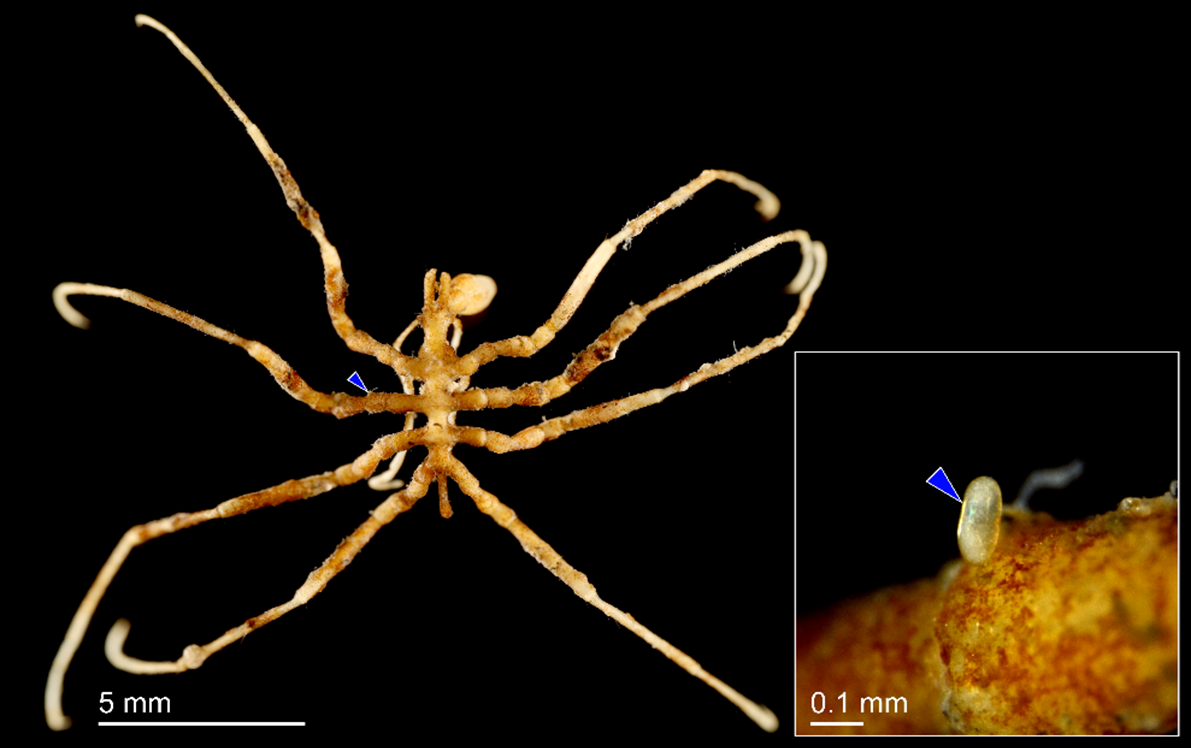
The new specimens came from a deep-sea survey by the research vessel Hakuho-maru: a female on September 27, 2023, from 3,685 to 3,693 meters, and a male two days later from 3,890 to 3,893 meters. That makes this the third record worldwide, the first in Japanese waters and the deepest. The Asahi Shimbun puts its leg span at about 2 centimeters.
Shogo Sekiguchi, a doctoral student at Hokkaido University, and lecturer Keiichi Kakui described the female for the first time and redescribed the male. They also gave the species a Japanese name: Hebijita-tokkuri-umigumo. Hebijita means snake's tongue, after a two-pronged bump on the head.
Source: Hokkaido University
Their closest relatives live in salt marshes
Five capsules were attached to the female by short stalks: on the trunk, on two legs, and on the pincer-like appendages near the mouth. Three more empty, shell-like structures turned up on the female and the male. The one capsule the team measured was 0.17 millimeters long and 0.09 millimeters wide.
Their shape gave no hint of what had laid them, not even the broad animal group, so the team turned to DNA. It pointed to flatworms, the group that includes planarians, and specifically to the family Trigonostomidae. The closest match in the analysis was the genus Ptychopera, with moderate support.
Known Ptychopera species live from the splash zone down to 15 meters, in salt marshes, brackish pools and seagrass beds. The eggs were genetically far from all of them, and they came from the deep waters of the Japan Trench. The university says this strongly suggests an unknown species in the family. The paper goes a step further: it could probably be an undescribed genus, although confirming that will take DNA from genera nobody has sequenced yet. No adult has been found, so the parent can't be named.
The study, published October 16, 2026, in the taxonomy journal SPIXIANA, is, according to the authors, the first report of flatworms using sea spiders as a place to lay eggs. Until now, the university says, the known egg-layers on sea spiders were leeches in shallow water and snails in Antarctic waters. These are free-living flatworms, not a parasitic group.
Why deep-sea flatworms almost never show up
Flatworms have delicate bodies that are easily damaged during sampling, so the deep-sea record is thin. Before this study, free-living flatworms backed by actual specimens from deeper than 3,000 meters came down to only two species: a polyclad from 3,232 meters in the Escanaba Trough in the northeastern Pacific, and a triclad from 6,176 to 6,200 meters in the Kuril-Kamchatka Trench. The Japan Trench eggs are now the second-deepest record.
The deepest one came from Kakui as well. In 2024, he and a Hokkaido colleague described black capsules about 3 millimeters wide stuck to rocks, each holding three to seven developing flatworms. Science sites abroad ran it as the story of mysterious black eggs from the abyss.
A walking cradle on the mud
Most of the deep seafloor is mud, the team notes, on plains and slopes with few hard surfaces to attach an egg to, while a sea spider has a hard exoskeleton and walks slowly without sinking. Because capsules or shells were on both individuals, the team thinks this flatworm probably uses the sea spider regularly, and suggests sea spiders may serve as an abyssal cradle for many deep-sea animals. So far, that idea rests on two specimens.
In 2025, the same Hokkaido researchers found a juvenile feather star, still at its anchored stage, on the leg of a sea spider from about 2,000 meters off southeastern Hokkaido, the first known case. On the Pacific coast of North America, a US team reported evidence in PNAS in 2025 that three sea spider species at methane seeps from California to Alaska farm methane-eating bacteria on their exoskeletons and eat them.
Not spiders, and odd all the way through
Despite the name, sea spiders are not spiders. They are arthropods in the chelicerates, the group that also includes spiders, scorpions and horseshoe crabs. About 1,400 species are known worldwide, and about 170 from Japan.
Their bodies are so slender that the gut and reproductive organs extend into the legs. A 2017 study of 12 species in Current Biology found that their hearts beat only weakly. Waves of contraction in the gut, which runs into each leg, did most of the work of moving oxygen.
In most sea spiders, it is the father who carries the young while they develop. The Japan Trench female shows a different version: the eggs on her belonged to another animal entirely.
Somewhere down there, the flatworm that laid these eggs still has no name. Japan's waters have turned up other odd ways of living in the dark, such as bacteria at Okinawa's hydrothermal vents that grow on electricity alone. If you could drop a camera into the deep water off your own coast, what would you want to find?
References
- https://www.hokudai.ac.jp/news/2026/10/post-2479.html
- https://pfeil-verlag.de/wp-content/uploads/2026/10/spx49-1_02_se.pdf
- https://www.asahi.com/articles/ASVBX2SQRVBXIIPE001M.html
- https://eprints.lib.hokudai.ac.jp/dspace/handle/2115/91101
- https://www.sciencealert.com/scientists-find-mysterious-oozing-black-eggs-almost-4-miles-below-the-oceans-surface
- https://www2.sci.hokudai.ac.jp/dept/bio/research/4940
- https://pmc.ncbi.nlm.nih.gov/articles/PMC12232434/
- https://doi.org/10.1016/j.cub.2017.05.062
- https://www.sciencedaily.com/releases/2024/02/240218211136.htm







Global Discussion
4 comments