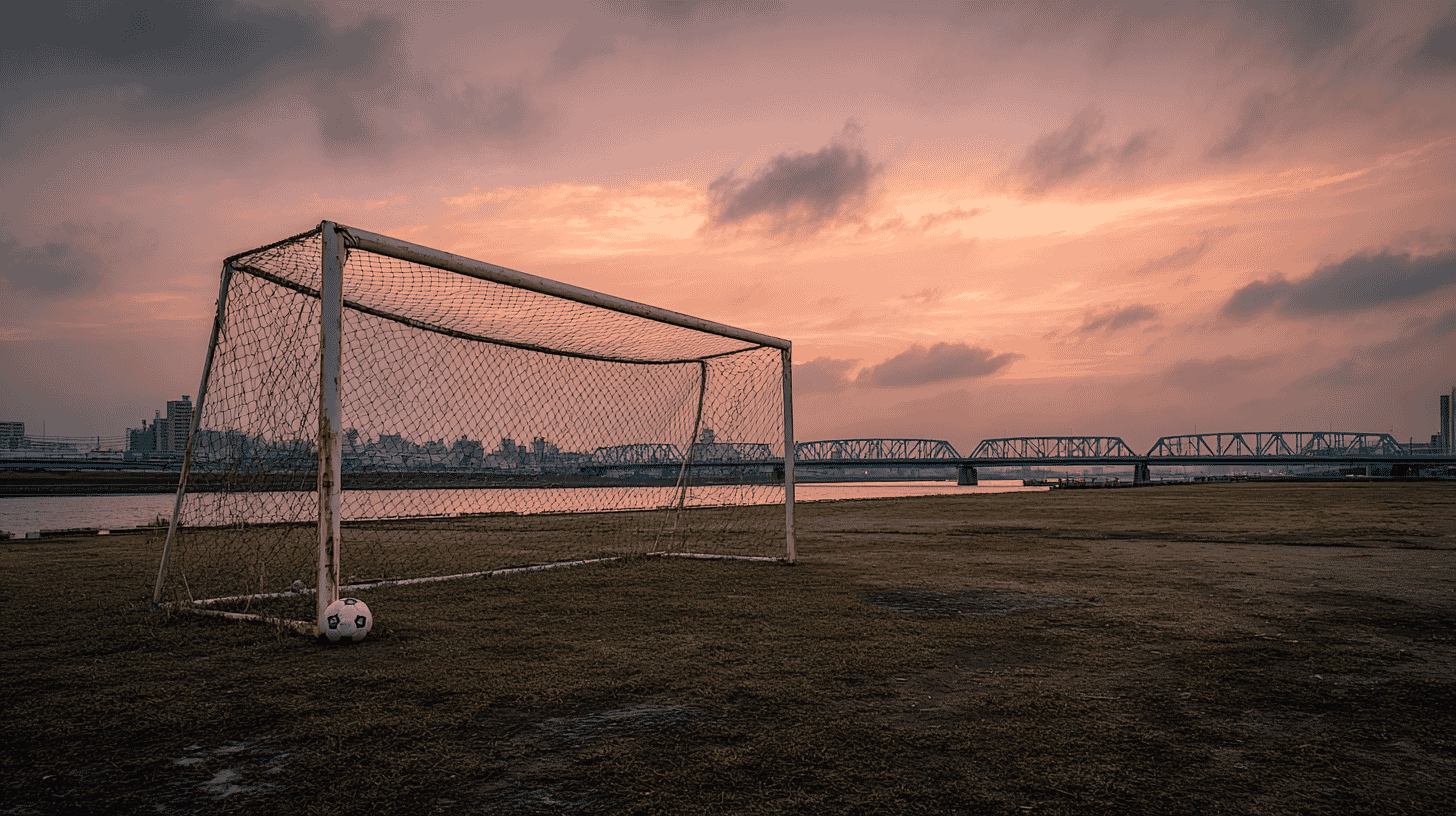
⚽ Captain Tsubasa is back. Rising Sun FINALS, the latest installment of Yoichi Takahashi's football manga, resumed on October 6, 2026, after a break of about four months, and the official announcement says the story is entering the decisive stretch of the Madrid Olympics. Takahashi also owns a real club named after the team his hero played for as a boy. Nine days before the manga returned, that club lost its final league match and, with it, the Kanto title. Its last route to promotion this year is a national tournament in late October.
Where the story stands
In January 2024, Takahashi announced he was stepping back from conventional manga production, citing declining stamina and a changed working environment. The magazine serialization ended in April 2024, but the story did not. He switched to pencil storyboards, the rough page layouts Japanese artists call "name," one step before finished art.
Rising Sun FINALS has run in that form since 2024, posted weekly on the official Captain Tsubasa WORLD site and Shueisha's Young Jump+ app. It paused after Chapter 100 on May 26, 2026. Chapter 101 went up on October 6, and new chapters will again appear every Tuesday.
The official site also has an English edition, where Chapter 101 appeared on the day of the restart. The latest chapters are free; older ones link out to Shueisha's Young Jump.
The kids who grew up on Oliver y Benji
Captain Tsubasa started in Weekly Shonen Jump in 1981, and the official site puts the series' sales in Japan above 90 million copies. Abroad it went by other names: Oliver y Benji in Spain, Holly e Benji in Italy, Olive et Tom in France, Supercampeones in Latin America and Captain Majid in the Arab world. Spain first saw it in 1990, on Tele5.
Fernando Torres is the best-known example. In an interview published by the J.League, he said the show was not why he moved to Japan; it was "the reason I started playing football." Al Jazeera reports that Andrés Iniesta and Alessandro Del Piero, among others, have also credited it with getting them hooked on football.
A real Nankatsu, in the author's hometown
In the manga, Tsubasa grows up in Nankatsu, a fictional city in Shizuoka, and plays for its elementary school team, Nankatsu SC. According to nippon.com, the city's name comes from the shortened name of Takahashi's own high school, Minami-Katsushika High School in Tokyo. Takahashi was born in the Yotsugi neighborhood of Tokyo's Katsushika ward.
The real Nankatsu SC grew out of the Tokiwa Club, a local team founded in 1983. In 2013, Takahashi became head of its supporters' association, and the club took the name from his manga. In January 2019 he set up Nankatsu SC Co., Ltd., and he is the club's owner and president. Its women's team, Nankatsu SC WINGS, plays in the second division of the Nadeshiko League.
Yahiro Kazama, who coached J1 sides Kawasaki Frontale and Nagoya Grampus, took over as head coach and technical director in 2024 and still leads the team.
"From Katsushika to the J.League"
That is the club's slogan, and its official site calls J.League entry the short-term goal. Japan's men's pyramid runs J1, J2 and J3, then the JFL (Japan Football League, effectively the fourth tier), then regional leagues. Nankatsu plays in the Kanto Soccer League Division 1, effectively the fifth tier. The way into the JFL is the Regional Champions League in November. Its places go mainly to the champions of Japan's nine regional leagues, with up to three more for top finishers at October's All Japan Adults Football Tournament that want to join the JFL.
The ward already has a site. In March 2024, Katsushika bought a sports ground of about 68,000 square meters near JR Shin-Koiwa Station and opened it to residents that September as the Higashi-Shinkoiwa Sports Ground. What is being studied is a football-only stadium built to J1 standards. A ward committee began work on the stadium concept on July 3, 2026; according to the ward's summary, members pointed to Captain Tsubasa and to the chance of building the first football-only stadium in Tokyo's 23 central wards.
Who would pay for the stadium?
At a resident briefing in February 2026, the ward presented estimates gathered from industry: 21 billion yen to 30 billion yen for the stadium itself, or $133 million to $190 million at 158 yen to the dollar. An annual operating estimate in the same materials put income at 287 million yen and costs at 457 million yen, a gap of 170 million yen (about $1.1 million) a year before fixed advertising revenue. The ward said roughly 200 million yen a year from naming rights and advertising would make the venue viable.
Natural-grass management was also flagged as a challenge. According to the same briefing, a grass pitch can realistically be used about 100 days a year, and its upkeep costs 30 million to 40 million yen annually. Who would build and run the stadium has not been decided; the ward is focusing on private-led options. In March 2026, Nankatsu SC told the mayor it was planning on the assumption that it would raise the construction and operating money itself.
The plan also has opponents. The Japanese Communist Party group in the ward assembly, which says the ward spent 32.5 billion yen (about $206 million) on the land, has called the plan tax money poured into large-scale development. In February 2026, it told the assembly that the written opinions submitted to the city planning council on turning the site into a city park were all opposed, and asked for a review that does not start from a stadium. At the resident briefing that month, people worried about noise for the apartment blocks next to the site. A resident who supports a stadium in principle wrote on note that a natural-grass pitch needs recovery time, which makes community use harder.
The ward says it borrowed most of the land money and that, once the site becomes a city park, grants from the Tokyo Metropolitan Government and others will cover it, leaving the ward with virtually no burden.
National guidance also asks for the public case to be made. A 2018 guideline from the Japan Sports Agency and the Ministry of Economy, Trade and Industry says sports teams must explain the public value of their activities, or communities will not accept public spending on stadiums. At the ward's committee in July 2026, members said that, as a facility inside a city park, the stadium's public value, in areas such as education and disaster prevention, needs to be spelled out. As of February 2026, the ward said only two things were settled: a stadium was a goal under study, and the site would become a city park.
Reality doesn't follow the script
Kazama's first season, 2024, ended in sixth place. In 2025, Nankatsu scored 52 goals in 18 league games and still finished second, one point behind Tokyo United. This year, with promotion to the JFL again the goal, the club finished third: nine wins, four draws, five losses, 31 points. Tokyo United won the league with 40.
Okudo, the club's home ground in Katsushika, was being converted from artificial to natural grass this year. According to Takahashi's official column, the September 27 finale was Nankatsu's first home game on the new surface. The visitors were Tokyo United, who won 3-1 and clinched the title on it.
On the club's site, Takahashi writes that "unlike in the world of manga, things often don't go as planned," and that this is what makes running a club both fun and hard.
The final-day defeat closed the direct route, but not the year. Nankatsu has qualified for the All Japan Adults Football Tournament in Miyazaki Prefecture, held from October 24 to 28, 2026, and opens against Mitsubishi Heavy Industries Nagasaki SC. A finish near the top could still earn it a place in November's Regional Champions League.
Between the page and the pitch
Tsubasa plays on at the Olympics every Tuesday. The club that carries his first team's name heads into a knockout tournament in Miyazaki at the end of October. Only one of those stories has an ending its author can write.
If you visit Tokyo, nine statues of the manga's characters stand around Yotsugi and Tateishi, and Yotsugi Station on the Keisei Oshiage Line is decorated with scenes from the series.
Did a cartoon put you, or someone you know, on a pitch? And would you follow a real club just because a fictional team wore its name first?
References
- https://www.oricon.co.jp/news/2484525/full/
- https://www.toy-people.com/jp/?p=114868
- https://captain-tsubasa.world/
- https://captain-tsubasa.world/en/
- https://www.jleague.jp/news/article/17028/
- https://www.aljazeera.com/sports/2022/10/3/who-is-captain-tsubasa-a-hero-for-spanish-footballers
- https://tg24.sky.it/lifestyle/2024/04/04/captain-tsubasa-manga-holly-e-benji
- https://www.nankatsu-sc.com/about-nankatsu-sc
- https://www.nankatsu-sc.com/wp-content/uploads/2023/07/ec9b6834f0e6e152236ab7248678b9b2.pdf
- https://www.city.katsushika.lg.jp/_res/projects/default_project/_page_/001/005/619/260105.pdf
- https://prtimes.jp/main/html/rd/p/000000016.000178755.html
- https://www.soccer-king.jp/news/japan/japan_other/20231107/1828031.html
- https://www.footballchannel.jp/?p=997407
- https://www.tokyofootball.com/news/20250705.php
- https://www.jfa.jp/match/regional_league_2026/about.html
- https://www.city.katsushika.lg.jp/information/kouho/1005537/1034921/1035933/index.html
- https://www.tokyo-np.co.jp/article/228775
- https://www2.city.katsushika.lg.jp/_res/projects/default_project/_page_/001/042/875/1_gaiyo.pdf
- https://www.soccer-king.jp/news/japan/20241224/1969128.html
- https://www.goalnote.net/detail-standings.php?tid=17010
- https://www.nankatsu-sc.com/76812.html
- https://www.tokyofootball.com/news/20260927.php
- https://www.nankatsu-sc.com/75884.html
- https://www.city.katsushika.lg.jp/_res/projects/default_project/_page_/001/032/972/080214siryou.pdf
- https://www.city.katsushika.lg.jp/_res/projects/default_project/_page_/001/032/972/080214giziroku.pdf
- https://www.nankatsu-sc.com/71618.html
- https://www.jcp-katsushika.jp/activity/oshirase/1448/
- https://www.jcp-katsushika.jp/activity/city/1913/
- https://note.com/ryusuke_hirai/n/n07a579900ea6
- https://www.mext.go.jp/sports/b_menu/shingi/008_index/toushin/__icsFiles/afieldfile/2018/07/02/1406622_1.pdf
- https://www.gotokyo.org/jp/spot/1723/index.html
- https://www.nippon.com/ja/guide-to-japan/gu900277/



Global Discussion
4 comments