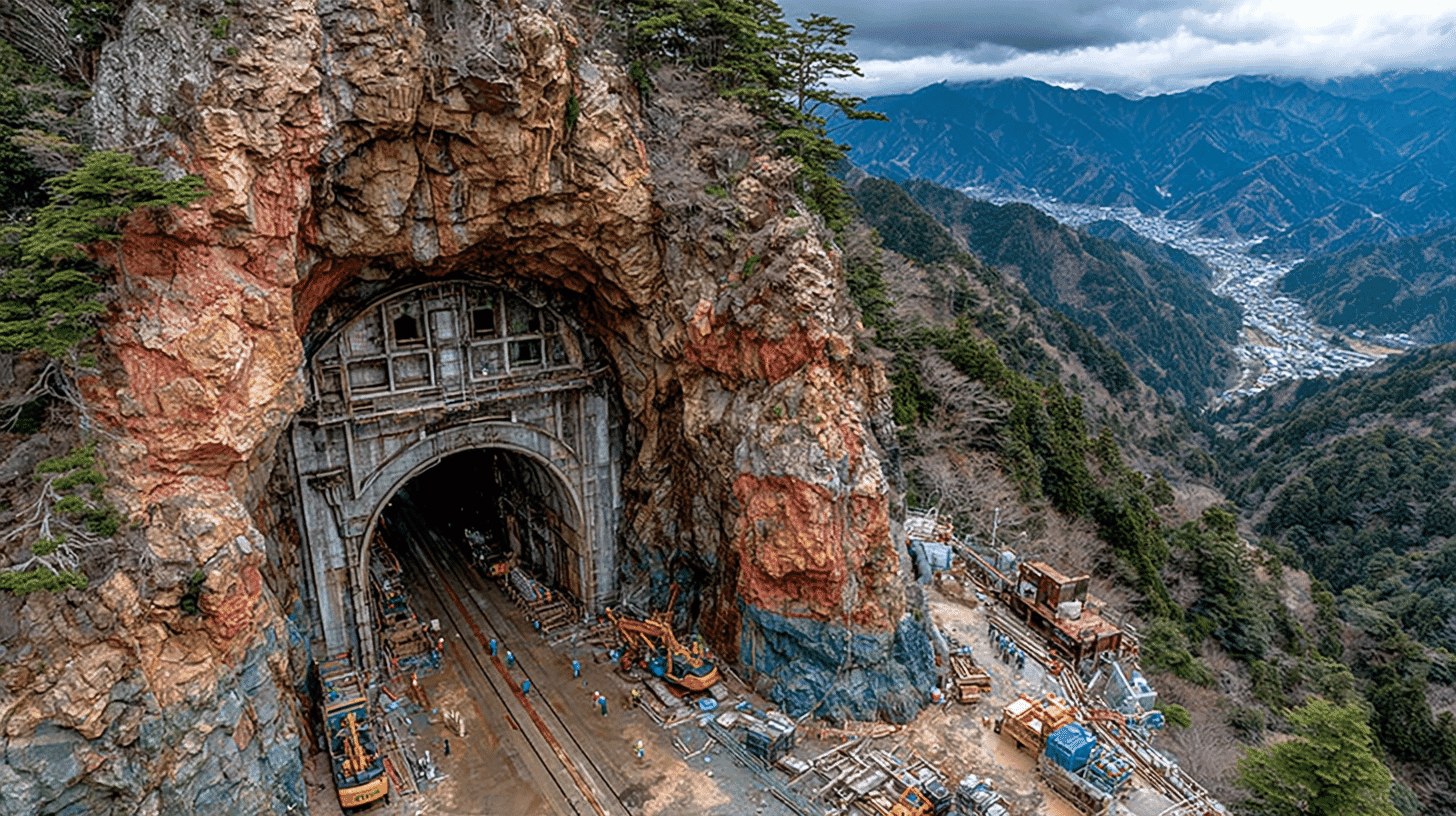
The Chuo Shinkansen maglev, the "dream super express" meant to link Tokyo and Nagoya in 40 minutes, has hit another wall. In a project costing ¥11 trillion (about $72 billion), with about 90% of its 286 km running through tunnels, the bedrock deep underground has turned out to be more fragile than expected, pushing back completion of three tunnel sections by five years. Where is superconducting maglev technology headed?
What Is the Chuo Shinkansen?
The Chuo Shinkansen is an intercity high-speed railway being built by JR Central, the world's first to use superconducting magnetic levitation (SCMaglev). Superconducting magnets lift the train about 10 cm, and it runs at up to 505 km/h. The plan is to link Shinagawa Station in Tokyo with Nagoya in as little as 40 minutes, and eventually Osaka in about 67 minutes.
More than half a century has passed since basic research began in 1962 and the basic plan was drawn up in 1973. Construction between Shinagawa and Nagoya was formally approved in 2014, with an initial target of opening in 2027. But environmental disputes over the Southern Alps Tunnel in Shizuoka Prefecture and difficulties at construction sites elsewhere have pushed the opening back to "2035 or later."
A Five-Year Delay at Three Tunnels
On February 12, 2026, JR Central announced that completion of three mountain tunnel sections running from Sagamihara in Kanagawa Prefecture to Uenohara in Yamanashi Prefecture would be pushed back by about five years. Excavation had revealed more sections of crumbly rock than expected, making additional auxiliary methods and lining unavoidable.
The specifics are as follows.
Tsukui Tunnel East Section (about 3.4 km): from end of March 2026 to "around spring 2031" Tsukui Tunnel West Section (about 2.9 km): from end of June 2026 to "around spring 2031" Fujino Tunnel (about 10.5 km): from end of March 2026 to "around summer 2031"
JR Central says this "will not affect the opening of the Shinagawa-Nagoya section, expected in 2035 or later." It declined to disclose the additional construction cost, saying it "may relate to future contracts." The company says it has already briefed some local residents and Sagamihara City.
Why Is Geology Such a Serious Problem?
About 86 to 90% of the Chuo Shinkansen's 286 km runs through tunnels. That secures a straight route for speeds above 500 km/h, but it also means cutting through the complex geology of the Japanese archipelago.
Mountain tunnels generally use NATM (the New Austrian Tunneling Method), which reinforces the excavated walls with sprayed concrete and bolts and uses the rock's own bearing capacity. But when the geology is weaker than expected, extra reinforcement is needed and schedules can stretch considerably.
The route crosses four major mountain ranges: the Tanzawa Mountains, the Kanto Mountains, the Southern Alps and the Central Alps. The Southern Alps Tunnel in particular, about 25 km long with up to about 1,400 m of overburden, is one of the most difficult projects in Japan. JR Central has taken careful measures, such as high-speed long-distance advance boring that probes geology up to 1,000 m ahead and digging pilot tunnels parallel to the main tunnel. Even so, deep underground geology cannot be fully predicted, and some things are only known by digging.
The Tsukui and Fujino area also runs beneath the Kanto Mountains on the way from the Tokyo area toward Yamanashi, a region known for complex fault zones and fracture zones.
A Budget That Keeps Growing
Delays naturally mean rising costs. When construction began in 2014, the Shinagawa-Nagoya section was estimated at about ¥5.5 trillion (about $36 billion). In 2021 this was revised up to ¥7.04 trillion (about $46 billion).
Then in October 2025, JR Central announced an even more shocking figure: total costs were expected to reach about ¥11 trillion (about $72 billion), double the original estimate. The increase includes extra costs from difficult tunnel excavation, stronger earthquake measures, soaring material prices and additional reinforcement revealed by geological surveys.
The project is basically funded by JR Central itself. However, to bring forward the extension to Osaka, the government has lent ¥3 trillion at low interest through its Fiscal Investment and Loan Program, so it is not entirely a private project.
Not Just Shizuoka: A Structural Problem
Delays to the maglev have long been framed as "because Shizuoka Prefecture won't allow construction." Former governor Heita Kawakatsu refused to allow work on the Shizuoka section of the Southern Alps Tunnel (about 8.9 km), citing concerns about water resources in the Oi River. Dialogue progressed under a new governor from 2024, and agreement on water resources is close, but issues of environmental protection and disposal of excavated soil remain.
But that is not the whole story. Reports in July 2025 revealed that 31 of the 84 construction sections between Shinagawa and Nagoya had exceeded the 2027 target schedule. Shield tunneling in urban areas has been repeatedly halted by machine problems, and at one point the Shinagawa section had excavated only about 124 m of its 9.2 km. In Mizunami, Gifu Prefecture, falling groundwater levels and ground subsidence thought to be caused by tunnel work have also been reported.
In other words, the five-year delay at the Tsukui and Fujino tunnels is only one part of the structural problems facing the project as a whole.
The Technological Significance of Superconducting Maglev
While problems pile up, the superconducting maglev technology itself keeps advancing. On the 43 km test line in Yamanashi Prefecture, running tests with L0 Series trains have continued since 2013, and in 2015 it set a world speed record of 603 km/h. In 2025 a new intermediate car, M10, of the improved L0 Series was introduced to reduce environmental impact and manufacturing costs.
Superconducting maglev levitates and propels the train through electromagnetic force between superconducting magnets on the train and coils on the ground. With no wheels or pantographs, it has very few wearing parts, so maintenance costs could in theory be lower than for high-speed rail. And while the Tokaido Shinkansen runs through the expected source region of a massive Nankai Trough earthquake, the maglev takes an inland route, giving it strategic value in securing transport redundancy in a disaster.
Globally, China is also developing high-temperature superconducting maglev trains in the 600 km/h class, and several routes, including Guangzhou-Shenzhen, are under consideration. Whether Japan's maglev technology can lead in practical use depends on the progress of construction.
When Will It Open?
In its October 2025 announcement, JR Central used "2035" as a provisional opening date for financial calculations, but it has not been officially fixed. Some involved see "2036 as the realistic earliest date."
Even if the Shinagawa-Nagoya section opens in 2035-36, the full line to Osaka would open in 2045 or later, about 20 years behind the original plan.
Still, the chance of the project being cancelled is extremely low. The Tokaido Shinkansen has been running for more than 60 years and is congested, with up to 12 Nozomi trains per hour in each direction. Major renovation to deal with aging will inevitably require long suspensions, and the need for the maglev as a bypass remains high. In the Third National Spatial Strategy approved by the Cabinet in 2023, the maglev is also positioned as a national project forming a "Japan Central Corridor."
The Bigger Picture
The fight against "nature that cannot be fully predicted," the Earth's internal structure, is not easy however excellent the technology.
The five-year delay is another reminder of how often the "unexpected" happens in giant infrastructure projects. This is not just a Japanese story: megaprojects worldwide, such as Britain's HS2 and California's high-speed rail, face similar problems.
In Japan, too, reactions are divided, from resignation ("another delay") to support ("we still need the maglev") to fundamental doubts ("the plan was unrealistic from the start").
[Developments after publication] Construction itself is moving forward at many sites. In March 2026, assembly of the shield machine for the Second Metropolitan Tunnel was completed, and a safety prayer and groundbreaking ceremony was held for Yamanashi Prefecture Station (provisional name). According to progress JR Central published in July 2026, in the First Metropolitan Tunnel, on the roughly 4.2 km stretch from the Higashi-Yurigaoka emergency exit to the Katahira emergency exit in Kawasaki, excavation had reached about 2.7 km as of July 13. The work is in deep underground space more than 40 m below the surface, and the shield machine was assembled at the bottom of a launch shaft dug about 90 m deep. In Shizuoka Prefecture, open-house briefings began in May 2026 in eight cities and two towns along the Oi River and in Shizuoka City (as of August 2026).
Has your country faced unexpected delays or cost overruns in giant transport infrastructure? What do you think about the gap between "dream technology" and reality?
References
- https://news.yahoo.co.jp/articles/05d7e752d61ddb482f67676cc472943855ad6db3
- https://company.jr-central.co.jp/chuoshinkansen/
- https://linear-chuo-shinkansen.jr-central.co.jp/plan/
- https://www.nikkei.com/article/DGXZQOUD034K20T00C25A9000000/
- https://www.railwaygazette.com/infrastructure/chuo-shinkansen-completion-delayed-until-2034/66398.article




Global Discussion
16 comments