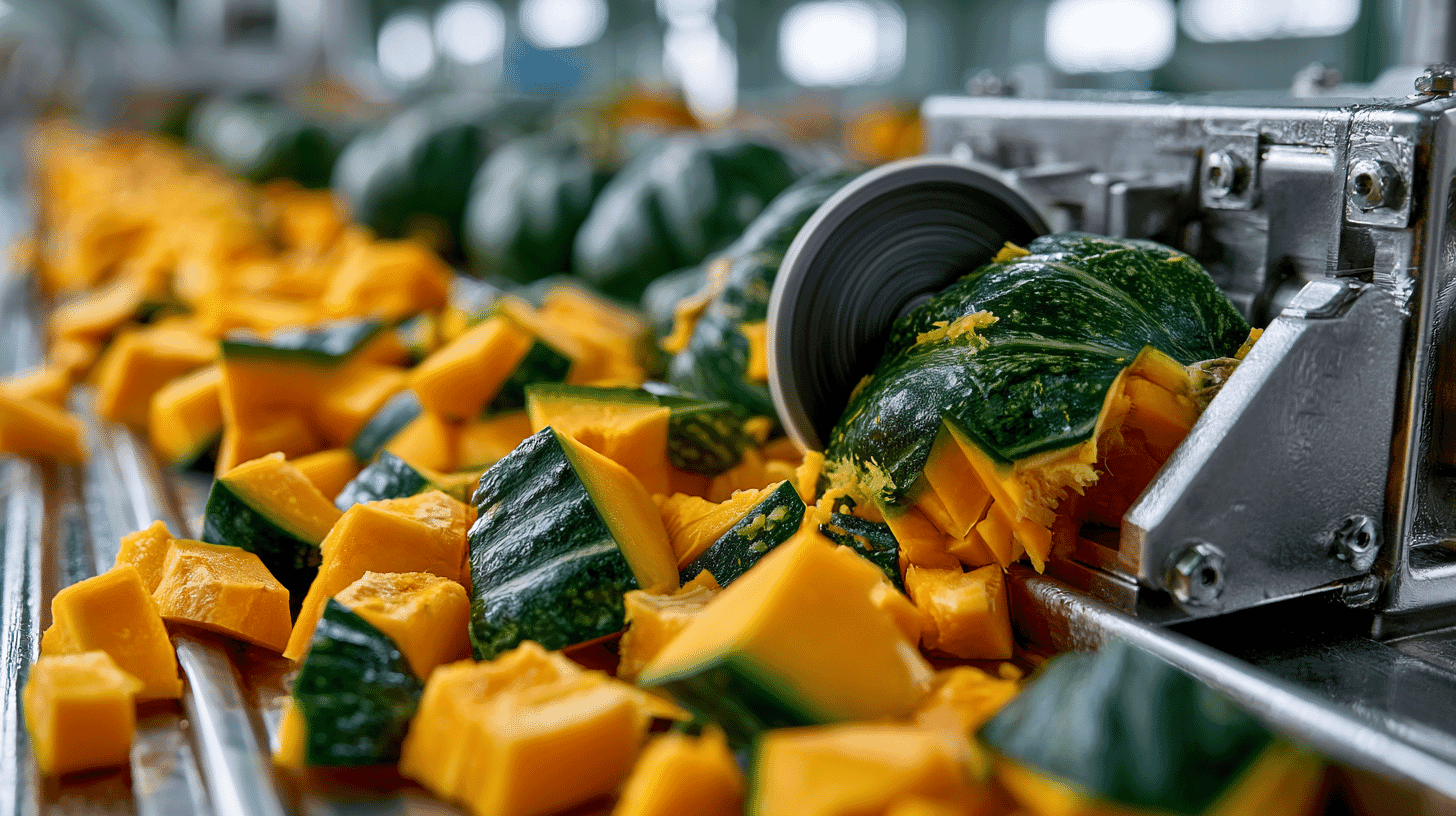
🎃 There's a machine in Hokkaido that does something no other machine on Earth can do: it cuts vegetables into deliberately irregular chunks. Not neat cubes. Not uniform slices. Angular, no-two-quite-alike pieces, and all on purpose. It's the world's only "rangiri" machine, and the story of how a small custom-machinery shop built it, then decided to make almost every part itself, is a quiet lesson in how Japan's smaller manufacturers stay alive.
The cut that's meant to look random
Rangiri (乱切り) translates roughly as "random cut," but there's nothing careless about it. You hold the vegetable, slice diagonally, roll it a quarter-turn, then cut again at the same angle. Cut, roll, cut, roll. The pieces come out irregular in shape but close to equal in size, and that's the whole point: the angled faces expose more surface area, so the vegetable cooks through evenly and drinks up the broth. It's the default cut for nikujaga (meat-and-potato stew), Japanese curry, and simmered dishes across the country. The technique isn't Japan's alone, either: Chinese kitchens use the same rolling diagonal, called gundao, and Western culinary schools teach it as the oblique or roll cut. Every home cook learns the rhythm eventually. It is, in other words, a hand skill.
Which is exactly what makes it a strange thing to hand to a machine.
Half of Japan's pumpkins, and a skin like armor
Hokkaido grows close to half of all the kabocha in Japan, about 48% of the 2023 harvest, making it the country's number-one producer by a wide margin. Kabocha is the dense, sweet Japanese winter squash that's increasingly familiar abroad as "kabocha squash." It is also a genuinely difficult vegetable to cut. The skin is thick and hard, closer to a shell than a peel, and slicing it by hand is slow, heavy work with a real risk of cut fingers.

Source: Wikimedia Commons (CC0)
So when a prefectural research lab, the Industrial Technology Center of the Hokkaido Research Organization, went looking for someone who could build a machine to rangiri a pumpkin, it turned to a local company in Ishikari called Synthemec. The firm had grown out of a single lathe that the current president's grandfather set up in 1950 to machine ship parts. Over the decades it became a maker of one-off automation machines, each built to a single customer's exact need under a company motto that every device is "the only one of its kind in the world." Custom, one-at-a-time work was the whole business.
Teaching a machine to be "randomly consistent"
There were two walls to climb.
The first was the paradox baked into rangiri itself: shapes that are irregular but sizes that are uniform, produced by a rolling, rotating motion. The second wall was larger, and easy to miss. The global food-cutting industry is engineered to do the exact opposite of rangiri. Urschel, the Indiana company founded in 1910 and the world's leading maker of food-cutting machines, together with Europe's specialists like Belgium's FAM and Germany's Kronen, has spent more than a century chasing "uniform," "consistent," "minimal waste": flawless cubes, dices, and slices. The entire discipline is built to eliminate irregularity. Nobody had written the playbook for engineering irregularity on purpose.
Synthemec spent three years on it and finished the machine in 2012. The answer was a custom circular blade moving along a cutting trajectory the company designed itself, one that used the pumpkin's oval shape to carve out identically shaped truncated-pyramid pieces. The numbers were serious: a yield above 95%, roughly 500 kilograms an hour (about 250 pumpkins), up to five times faster than hand-cutting, run by a single operator. In 2013 it earned an Excellence Award in the Japanese government's Monozukuri Nippon Grand Award, which honors manufacturing craft. Around the core machine, Synthemec also built the rest of the line: halving, seed-and-pith removal, coring and peeling, and a dedicated unit to shave off "gambe," the hard warty knots on kabocha skin.
The decision that changed the factory
Building the machine was one thing. Keeping it alive was another.
Customers who bought the machine kept coming back for replacement blades. Some blades were made in-house, others were outsourced, and outsourcing meant waiting on another company's schedule, which pushed delivery dates around. So Synthemec made a call that looked expensive at the time: bring everything in-house. It installed four electric-discharge machines to cut the blades itself. Today a single operator runs that line, and blade output has quadrupled.
Welding came next. In 2022 the company stood up a dedicated welding shop with three specialists to build the machine frames, then internalized the wiring inside the machines with another three-person team. Setting up production lines the company had never had before, including hiring the skilled people to run them, was a bold bet, president Shuhei Matsumoto, who took over in 2024, told the Nikkan Kogyo Shimbun. Over the long run, he said, the results follow.
From "it depends on someone else" to three months
Today Synthemec does nearly everything under one roof: design, parts machining, assembly, wiring, electrical control, and after-sales service. The payoff is measured in time. Back when welding and blades depended on outside firms, delivery dates slipped. Now a single pumpkin rangiri machine can go out the door in as little as three months.
And the world's-only status hasn't budged. No one else is racing to build a machine that rangiri-cuts a pumpkin, because the market is tiny. That, oddly, is the strength of the position.
Why the niche is the strategy
Synthemec, with about 86 employees and revenue north of ¥1 billion (roughly $6.4 million), isn't trying to out-scale Urschel. It's doing the thing the giants won't bother with: a machine for one specific, culturally shaped cut, for one hard-skinned vegetable, serving a market that will never be large. It's niche, Matsumoto has said, but the people who need it definitely exist, and that's where a small shop gets to show what it can do. Being the only occupant of a corner this narrow is a durable advantage, and owning the whole process means no rival can undercut the three-month lead time.
There's a small irony underneath all of it. The world's machinery makers spent a hundred years learning to erase irregularity: perfect cubes, identical slices. A factory in Hokkaido went the other way and built a machine to produce irregularity on purpose, because that's what a simmering pot of nikujaga actually needs.
Rangiri is a tiny, almost invisible piece of Japanese home cooking, the kind of everyday craft that turns out to be surprisingly hard to hand off to a machine. Is there a cutting technique, a texture, or a bit of hand-skill in your country's food that machines still can't quite replace?




Global Discussion
3 comments