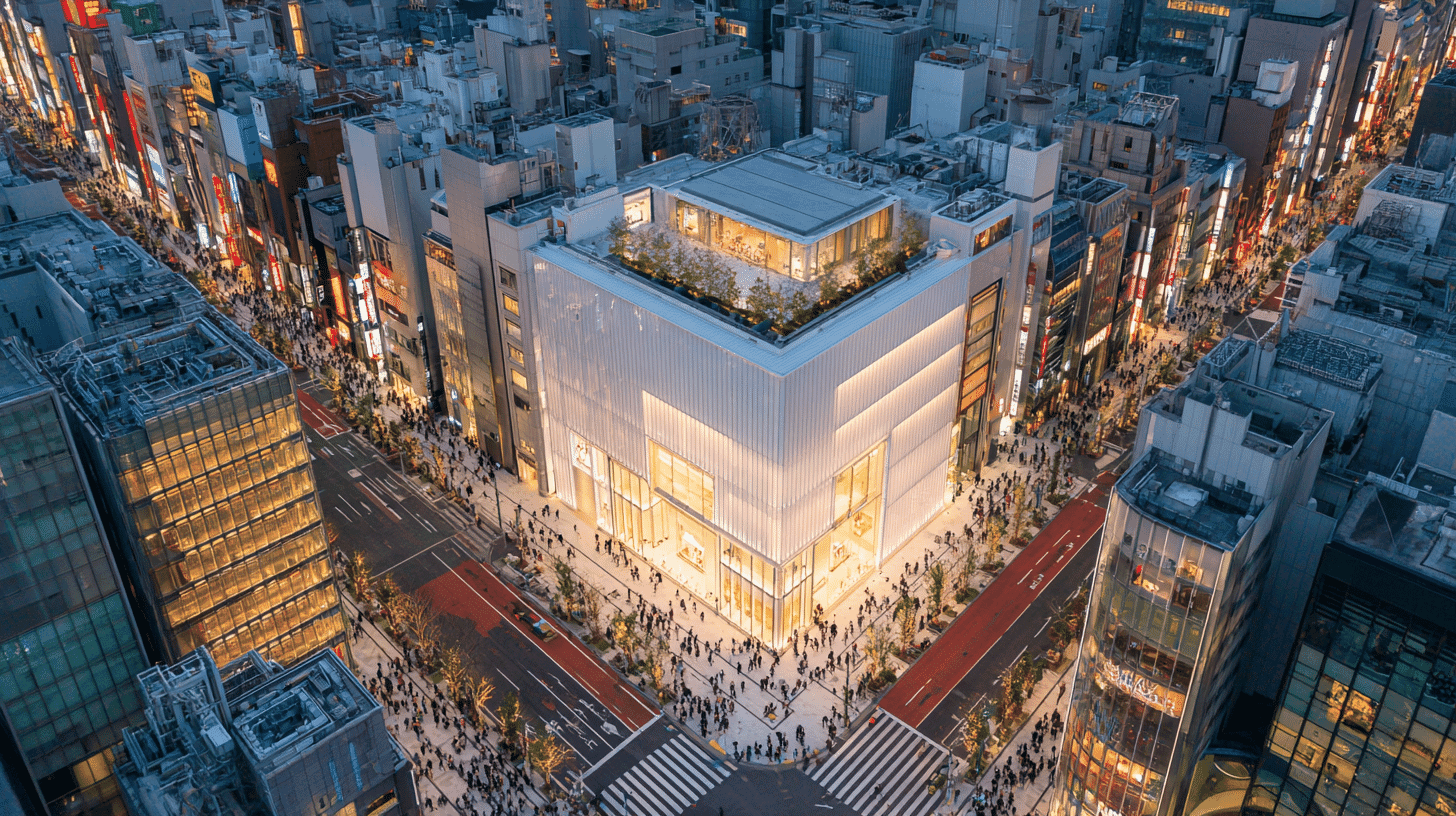
Japan's apparel industry is in the middle of a structural shift. Fast Retailing's market capitalization has reached roughly 27 trillion yen, and its domestic Uniqlo business has passed one trillion yen in revenue, the first time any apparel company has sold that much inside Japan alone. A single brand now holds something like a tenth of the domestic market.
Alongside it, how are Onward Holdings, World, and Sanyo Shokai, the companies that once led Japanese fashion, trying to survive?
Just How Big Fast Retailing Has Become
For the fiscal year ended August 2025, consolidated revenue came to 3.4005 trillion yen, up 9.6 percent, with operating profit of 564.2 billion yen and net profit of 433 billion yen. Overseas Uniqlo led the way at 1.9102 trillion yen, while domestic Uniqlo cleared the trillion-yen line for the first time at 1.026 trillion yen, up 10.1 percent. On July 9 the company raised its guidance for the year ending August 2026 to revenue of 3.97 trillion yen, operating profit of 730 billion yen, and net profit of 500 billion yen: its third upgrade of the year, after three consecutive quarters with revenue above one trillion yen. Through the first nine months, revenue was 3.0651 trillion yen, up 17.1 percent, and operating profit 614.3 billion yen, up 36.2 percent, lifting the operating margin from 17.8 to 21.2 percent.
It is not, however, the world's largest. Spain's Inditex, which runs ZARA, still leads apparel's vertically integrated retailers. Fast Retailing's current forecast puts it about 8 percent ahead of H&M, which would move it into second place. On market cap it also sits second, behind Inditex at roughly 31 trillion yen. It is the undisputed champion at home and a challenger abroad, both at once.
Growth rests on functional fabrics like Heattech and Airism, a supply chain the company controls from planning through to the shop floor, and quality that outruns the price. It did not win on cheapness, and it did not win on how fast trends turn over, which is precisely what separates it from both the ZARA and H&M models.
Domestic Uniqlo has been closing stores rather than opening them, yet now sells about 1.1 billion yen per store per year and 42 million yen per employee. With discounting held down and overheads cut, its operating margin reached 15.5 percent in the year ended August 2025.
The Structural Problems Legacy Brands Carry
The challenges facing the old guard are layered. Department stores, their main channel, have been shrinking. Brand customer bases have aged and stopped reaching younger shoppers. Sprawling brand portfolios complicate the supply chain and hurt inventory efficiency. E-commerce and data came late.
Onward Holdings, once the king of department store apparel with Kumikyoku and 23-ku, went through heavy store closures and brand pruning in the early 2020s. Sanyo Shokai lost much of its scale when its Burberry license ended.
Both, though, appear to have bottomed out. Onward posted revenue of 236.8 billion yen for the year ended February 2026, up 13.6 percent, with net profit of 10 billion yen, up 18.5 percent, as inventory-focused restructuring began to pay off and lines like the made-to-order suit brand Kashiyama grew at double digits. Sanyo Shokai reported revenue of 58.4 billion yen, operating profit of 1.3 billion yen, and net profit of 4.1 billion yen for the same period, with an equity ratio in the 67 percent range and a long-term target of 100 billion yen in revenue at a 10 percent operating margin. Less a crisis, more a deliberate shrink toward profitability.
The "Trading Company Transformation"
What the legacy players are attempting is an exit from the model of making your own brands and selling them through department stores. Licensing businesses that secure Japanese rights to foreign labels. Expansion into furniture, homeware, and cosmetics. Owned e-commerce and direct-to-consumer channels. Sustainability lines and resale operations. Laid out together, the portfolio starts to look less like an apparel maker and more like a trading house.
Whether it works depends on whether they can put existing brand equity to use, turn customer data into actual product decisions, make production flexible, and buy their way into new categories. Which, awkwardly, describes the ground Uniqlo has spent more than a decade preparing.
Polarization and New Competition
The market looks set to split between volume players led by Uniqlo and premium players chasing added value. The middle of the price range is exposed unless it can articulate a difference.
Pressure comes from above and below. China's SHEIN is eating the low end, and resale platforms like Mercari are cutting into demand for new clothes outright. Fast Retailing has its own soft spot: GU revenue rose but profit fell in the year ended August 2025, exposing how hard the trend business is to read.
It is easy to say that legacy brands need bold change unbound by past success. The real question is narrower: what each company chooses to keep as its strength.
Does a similarly dominant player exist in your country's apparel market? How are local brands finding ways to survive around it?
References
- https://www.fastretailing.com/jp/ir/news/2607091800.html (Fast Retailing Q3 FY2026 results summary)
- https://www.fastretailing.com/jp/ir/
- https://www.onward-hd.co.jp/ir/
- https://www.world.co.jp/ir/
- https://www.sanyo-shokai.co.jp/ir/





Global Discussion
15 comments