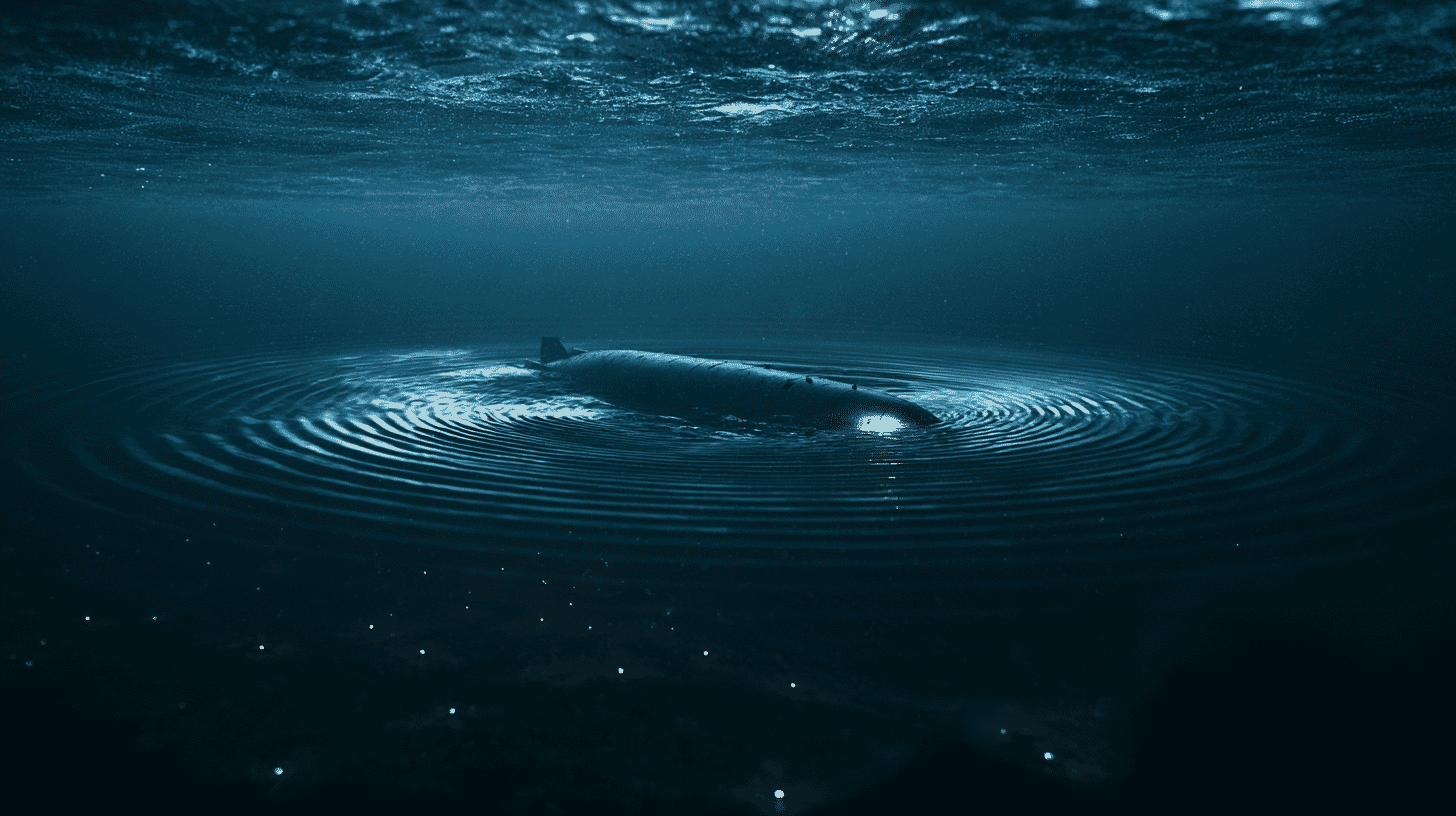
🌊 Underwater, light and radio barely travel. Only sound carries far.
Which is why the ocean is still interpreted by ear, by a small number of specialists, one recording at a time. NEC has just taken a Japanese government research contract to hand that job to an AI, and the model it wants to build would serve a marine biologist as readily as a warship.
Sound gets through. There are not enough people to read it
Go deep enough and the tools that make the surface world legible stop working. Cameras see nothing useful, and radar and radio are absorbed almost immediately. There are ways to read magnetic or gravitational anomalies, but their reach is short. Sound keeps going, bending through temperature layers and bouncing off the seabed and the surface, carrying for kilometres.
So the ocean gets listened to. Sonar transmits and catches what comes back; hydrophones simply listen. Both produce underwater acoustic data, and as NEC describes the state of the field, that data is then handed to experienced analysts who apply advanced signal processing and years of accumulated judgement to work out what made the noise. The company is blunt about where this breaks down: the volume is enormous, the analysis demands sustained time and concentration, and accuracy has a ceiling.
The obstacle: there is no answer key
On August 18, 2026, NEC announced it had won a contract titled "Research on Underwater Acoustic Foundation Models Using Self-Supervised Learning (Part 1)." The customer is the Defense Innovation Science and Technology Institute, part of Japan's defence procurement agency, and the work sits under a programme called Innovative Breakthrough Research. What a large language model does for text, this is meant to do for underwater sound. NEC says the model will be built by fiscal 2027. The contract value was not disclosed.
Modern AI normally learns from data a human has already tagged: this is a cat, this is not a cat. Underwater acoustics has almost none of that. Establishing what actually produced a given recording often requires being in the same water at the same moment, and a great deal of what is known sits behind classification or commercial confidentiality.
Self-supervised learning is the way around it. Rather than asking a model to match human tags, you mask part of a recording and make it predict what was removed. Do that across enough hours of ocean and the model absorbs the statistical shape of underwater sound without anyone telling it what anything is. Labels are then needed only at the end, in small quantities, to aim the model at a particular job.
Machine learning is not new to this field, though. Work on classifying ship sounds with self-supervised learning appeared in the Journal of the Acoustical Society of America in 2023, and Google has released SurfPerch, a pretrained model built for hydrophone recordings. The gap NEC is describing is the absence of a general-purpose foundation model, not the absence of AI.
NEC brings two things to that. One is the large-scale pretraining experience behind cotomi, its in-house AI technology. The other, by the company's own account, is more than 90 years of continuous sonar work, from the pre-war Imperial Navy through to the Maritime Self-Defense Force. The press release lists a Maritime Security Division as the point of contact, which suggests this is not a side project.
The institute opened in Ebisu in October 2024, and the agency says in its own materials that it was modelled on America's DARPA and DIU. It recruits programme managers from outside the ministry, sets deliberately hard targets, and tolerates failure. For a Japanese defence organisation, saying out loud that failure is permitted is itself new.
One signal, three different customers
Sonar detection, underwater acoustic communication and ocean observation look like three separate industries. Go one layer down and they are the same physics problem. In each case a signal arrives stretched, refracted, echoed off two boundaries, and buried in noise from waves, engines, rain and animals. Whether you want to identify a contact or measure a water column, the first task never changes: pull structure out of a channel that is actively destroying it.
A model that has learned the ocean's acoustic grammar is therefore a shared foundation rather than three parallel investments. The applications NEC lists run from defence to marine life and resource surveys, environmental monitoring, and higher-precision earthquake prediction. The company's shorthand for the destination is a digital twin of the ocean: a continuously updated picture of what is happening inside a body of water, rather than a snapshot from whenever a survey vessel last passed through.
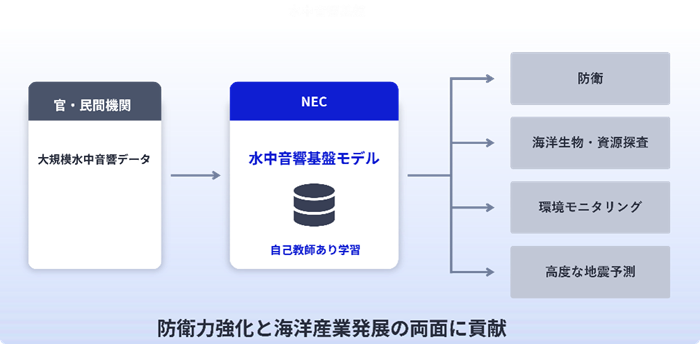
Source: NEC press release
The obvious place to put this is on a robot
Japan's defence procurement agency already has several uncrewed underwater vehicle (UUV) lines running. The long-endurance UUV is a cylinder roughly 10 metres long, with mission packages that swap in between nose and tail. A separate research programme on UUV control began in fiscal 2023. And on the civil side of the same agency, ocean-observation UUVs are under study, including one aimed at surveying seabed topography and acoustic conditions.
Radio does not reach a submerged UUV. Acoustic communication exists, but its data rate is orders of magnitude lower. Streaming raw acoustics back to a mothership and waiting for a person to interpret them is not a workable arrangement. Any understanding has to happen onboard, in real time, on a limited power budget. A compact general model that can separate the interesting from the ignorable is the difference between a robot that records everything for later and a robot that decides for itself what is worth recording.
Buy hulls, lay grids, or bet on interpretation
The United States is buying hulls. In the shipbuilding plan it published in May 2026, the Navy moved Boeing's Orca extra-large UUV out of experimentation and into planned fleet acquisition. The line covers $135.8 million for two vehicles in fiscal 2027, a Future Years Defense Program total of roughly $1.13 billion, and 16 vehicles through fiscal 2031. Procurement of 47 medium uncrewed surface vessels runs alongside it. Allied programmes point the same way, with Australia's Ghost Shark and Britain's XV Excalibur both past the paper stage.
China is building infrastructure. Researchers at CSIS's Asia Maritime Transparency Initiative have documented fixed and floating sensor platforms between Hainan Island and the Paracels. They form part of what Beijing calls the Blue Ocean Information Network. Chinese sources present it as a system for environmental monitoring and communications. Outside analysts describe a layered architecture reaching from seabed arrays to satellites, and US Navy officers have taken to calling the broader effort an underwater great wall.
Japan is not going to outspend either. What it has instead is data, and a listening estate that already exists for entirely civilian reasons. S-net puts 150 seafloor observation stations along the Japan Trench; DONET has 51 in the Nankai Trough, and its sensor suite includes hydrophones. N-net, covering the western end of the Nankai Trough, was completed in June 2025. As raw material for training, that is a good hand.
The bet embedded in this contract is that if the undersea contest ultimately turns on who understands the ocean fastest, the interpretation layer may matter more than the platform count. It is a reasonable bet. It is not yet a proven one.
Two pillars, one contract
Japan's Fourth Basic Plan on Ocean Policy, approved by the Cabinet on April 28, 2023, rests on two pillars: comprehensive maritime security, and a sustainable ocean. On December 22 that year the government adopted an AUV Strategy aimed at growing a domestic autonomous underwater vehicle industry by 2030, with NEC among the companies on the Cabinet Office's public-private platform. This contract lands on the seam between the two, which is presumably the point.
The seam is also where the difficulty is. "Collected through public-private partnerships" is a single clause in a press release and a genuinely hard problem in practice. Acoustic recordings are sensitive in ways ordinary training data is not, since they can reveal vessel signatures, fishing grounds and the movements of allies. Civil institutions holding long ocean records may not be eager to see them absorbed into a model funded by a defence agency, and dual-use research still draws careful debate in Japan. Whether that data actually flows will decide more than any architecture choice.
This is Part 1 of a research commission, not a system heading to sea. World-leading is NEC's stated ambition rather than an achieved result, and while some outlets have reported the project as a world first, NEC does not describe it that way.
Even so, the underlying idea is a good one. The ocean has been under-listened-to not for want of microphones but for want of anyone able to make sense of the recordings. In Japan that argument is being advanced through a defence research programme, with earthquake prediction and marine life surveys listed beside it as equally serious goals. Where you live, does defence money in ocean science sit comfortably, or does it complicate the conversation?
References
- https://jpn.nec.com/press/202608/20260818_02.html
- https://www.nec.com/en/press/202608/global_20260818_02.html
- https://newswitch.jp/p/50051
- https://www.mod.go.jp/atla/disti.html
- https://www.mod.go.jp/atla/research/ats2025/pdf_oral_matl/1111_1120_s04.pdf
- https://www8.cao.go.jp/ocean/policies/auv/call_for_participants/pdf/06/03_shiryou_2_4.pdf
- https://www.mowlas.bosai.go.jp/network/
- https://www.bosai.go.jp/info/press/2025/20250603.html
- https://www8.cao.go.jp/ocean/policies/auv/auv_strategy/strategy_index.html
- https://www.armyrecognition.com/news/navy-news/2026/u-s-navy-funds-16-boeing-orca-drone-submarines-for-china-focused-pacific-combat-operations
- https://amti.csis.org/exploring-chinas-unmanned-ocean-network/







Global Discussion
4 comments