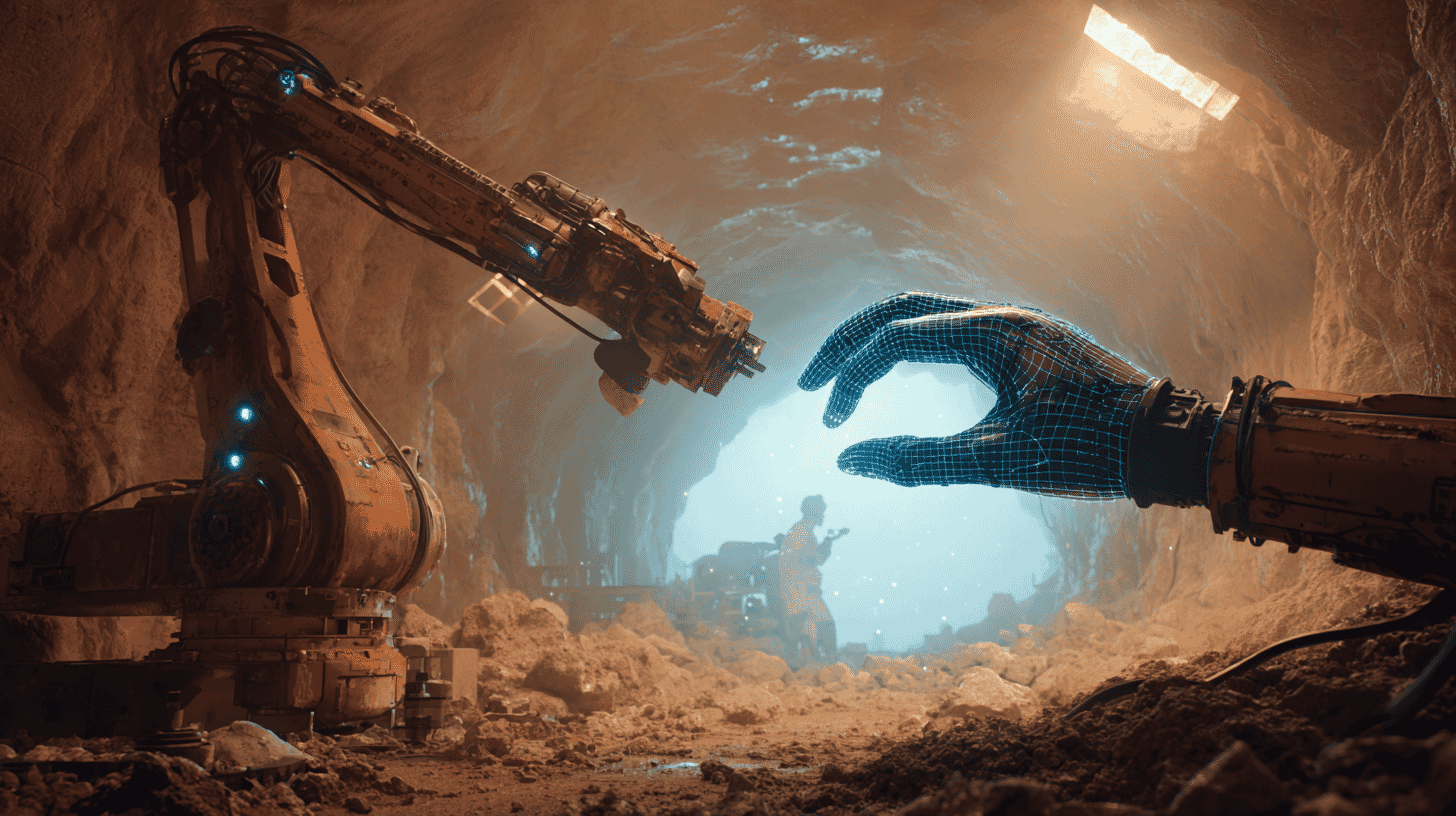
🔧 Remote control of dangerous tunnel work through "touch" is now a reality. Explosive loading—once performed by 5 workers risking cave-ins— can now be done by 1 operator from 50 meters away, feeling every sensation as if they were right there. Technology straight out of mecha anime is transforming real construction sites.
What is Real Haptics?
"Real Haptics" is a haptic feedback technology developed by Keio University's Haptics Research Center. This technology enables the real-time transmission of tactile sensations—hardness, softness, elasticity—felt by a robot when touching objects to a remote operator.
Established in 2014, the Haptics Research Center, led by Distinguished Professor Kohei Onishi and Associate Professor Takahiro Nozaki, has been advancing the industrial application of this technology. While conventional remote-controlled robots only provided video and audio feedback, Real Haptics adds the "sense of touch," enabling delicate manipulation tasks.
The Dangerous Reality of Mountain Tunnel Construction
One of the most hazardous tasks in mountain tunnel construction is explosive loading and wiring at the "face" (excavation surface). The face is constantly at risk of "spalling"—sudden rock falls—and most serious accidents in tunnel construction occur in this area.
This work involves loading explosives into "blast holes" approximately 5cm in diameter and 1 meter deep, then connecting detonator wires. Since workers handle dangerous explosives, precise force control is essential, and until now, this could only be done manually. While heavy machinery operations like steel support installation have been progressively automated, explosive loading remained resistant to unmanned operation due to its technical complexity.
Development History of the Automated Explosive Loading System
Obayashi Corporation and Keio University began research and development using Real Haptics in 2021, supported by NEDO's (New Energy and Industrial Technology Development Organization) "Public-Private Collaboration Program for Young Researchers."
In September 2023, they successfully demonstrated the automated explosive loading system's proof of concept in laboratory tests. In 2024, field tests at a tunnel construction site in Nagano Prefecture achieved successful explosive loading and blasting operations via remote control from both 30 meters and 320 meters outside the tunnel.
In January 2026, a "primer supply device" was newly installed in the system, achieving complete unmanned operation with no workers entering the face area. What previously required 5 workers can now be performed by 1 operator from an operator room 50 meters away.
How the System Works
The automated explosive loading system consists of a loading robot mounted on the arm of a drill jumbo (boring machine). A remote controller in the operator room and the loading robot at the face are linked via Real Haptics, enabling bidirectional transmission of tactile sensations.
Operators perform tasks while viewing monitor footage of the blast hole area. The sensation of the robot arm gripping explosives, the resistance when inserting them into holes—all of this is transmitted to the operator's hands in real-time. This enables distinguishing subtle differences, such as whether a rod has bumped against a hole or merely grazed it.
The newly installed primer supply device uses a belt conveyor system to sequentially supply multiple detonator explosives. Anti-tangling mechanisms for wires have also been added, enabling continuous loading into multiple blast holes.
Future Prospects and Applications
Obayashi Corporation and Keio University plan to advance the following developments:
Simultaneous operation with multiple loading robots, coordination with autonomous heavy machinery, and automation of wire connection work. Furthermore, by enabling autonomous learning of each task, they aim to achieve fully unmanned tunnel excavation operations in the future.
The application of Real Haptics technology extends beyond tunnel construction. In demonstrations with hydraulic construction machinery, operator force has been amplified 2,000 times, enabling heavy equipment to "gently grasp" fragile objects. Applications in telemedicine, rescue robot operation at disaster sites, and various other fields are anticipated.
Impact on the Construction Industry
Japan's construction industry faces severe labor shortages and an aging workforce. According to the Ministry of Land, Infrastructure, Transport and Tourism, approximately 30% of construction workers are 55 or older, while only about 10% are under 29. Unmanned operation of dangerous tasks is expected to play a crucial role in attracting younger workers and preserving experienced technicians' expertise.
Real Haptics technology offers more than mere "task replacement"—it has the potential to extend human senses and enable safer, more efficient work methods. The "digitization of touch" is truly pioneering the future of construction sites.
In Japan, innovative technologies like this are being introduced to improve construction site safety and address labor shortages. How advanced is the unmanned operation and remote control of dangerous work in your country? We'd love to hear about the state of technology adoption in your construction industry.
References
Reactions in Japan
I witnessed numerous spalling accidents during my career. Those moments still haunt me. If this technology had existed 10 years earlier, lives might have been saved. Nothing but gratitude for technological progress.
Digitally transmitting touch sensation? That's totally like Gundam's Mobile Trace System. Reality is finally catching up to anime.
Born from NEDO's young researcher support program. Want to cite this as a successful industry-academia collaboration case in my thesis. Been following Prof. Nozaki's research at Keio, didn't realize it had come this far.
Easy for major firms like Obayashi. Small-medium contractors like us can't afford this, so our workers will keep doing dangerous work the old way.
Bidirectional force transmission with 2000x force amplification achieved. Impressive bilateral control precision. Need to read the papers.
Watched the actual loading footage and was amazed by how delicate the robot movements are. Handling explosives with such smooth motion is incredible.
Safety improvements are welcome, but 5 workers becoming 1 means 4 jobs disappear. As a union, we need to think about balancing labor savings with job security.
Packing explosives right takes years of intuition. Can machines really transmit that subtle feel? I guess that's just how times change.
I interviewed for a Real Haptics article before. When you actually experience it, you genuinely feel like you're touching something. Promising applications in healthcare and nursing care too.
Fatal collapse accidents have occurred in Linear Chuo Shinkansen construction. Rapid adoption of such technology is essential for safely advancing national projects.
Was scared of dangerous work before joining, but with technology like this, the construction industry might not be so bad. Getting excited about my site assignment now.
Operating from 320m outside the tunnel—what about network latency and connection drop risks? What happens if connection is lost while handling explosives?
Happy to see my alma mater's research being implemented in society. Didn't quite get it when I saw their presentation at Shin-Kawasaki campus, but it's actually making a difference.
Haptic feedback is used in game controllers too, but industrial precision at this level is amazing. Looking forward to mutual development with gaming tech.
Accidents happen even with safety measures per MHLW guidelines. Technology that fundamentally removes people from danger is true safety management.
Safety standards at Southeast Asian sites are often looser than Japan. If this technology gets exported, it could save workers' lives worldwide.
It says they'll use autonomous learning for full automation. Then even operators won't be needed. After labor reduction comes unmanned operation.
As remote operation advances, people with physical disabilities could work in construction. Worth noting from an accessible employment perspective.
US mining engineer here. Blasting is one of our most dangerous operations too. Surprised Japan is leading in this field, but would definitely consider adoption.
As a haptic engineering researcher in Germany, I'm impressed by the maturity of Japan's Real Haptics technology. Similar research exists in Europe, but industrial application hasn't progressed this far.
China has lots of tunnel construction too, but we have much to learn from Japan on safety. This technology could be useful for Belt and Road infrastructure projects.
Safety standards at Indian construction sites are still developing. Technology like this could save lives. But cost is a concern.
Remote operation is fairly advanced in Australian mining, but we haven't achieved haptic feedback. For handling explosives, this is groundbreaking.
UAE has many large-scale infrastructure projects. Worker safety is our top priority, and Japan's technological innovations like this are very instructive.
Sweden emphasizes worker rights and safety. While 5 workers becoming 1 is efficient, reassigning the other 4 is equally important.
Tunnel construction accidents are common in Brazil too. Would like to discuss technology transfer possibilities with Japanese companies.
I teach robotics at an Irish university. The bilateral control precision of Real Haptics is textbook-worthy material.
Similar technology is being developed in Korea, but Japan seems to have beaten us to practical application. Good motivation for us.
Remote operation technology is used in French nuclear facilities. Adding haptic feedback could apply to work in radiation environments too.
Vietnam's infrastructure is being developed with Japanese ODA. Hope safety technologies like this will be introduced together.
New Zealand has many earthquakes and tunnels. Unmanned technology in unstable geological environments is truly appreciated.
As a Polish construction worker, glad technology protects us from danger, but also worried about job displacement.
Many lives are lost annually in construction accidents in Mexico. Cost is an issue, but you can't put a price on human life.
Canadian mining technician here. If we can operate remotely in extreme cold, working conditions would vastly improve. Looking forward to Japanese tech.
Infrastructure development is urgent in Nigeria, but safety often gets neglected. Want to learn both Japan's technology and safety culture.
This technology could work for Singapore's subway construction too. Looking forward to improved safety in tunnel work within tight urban spaces.