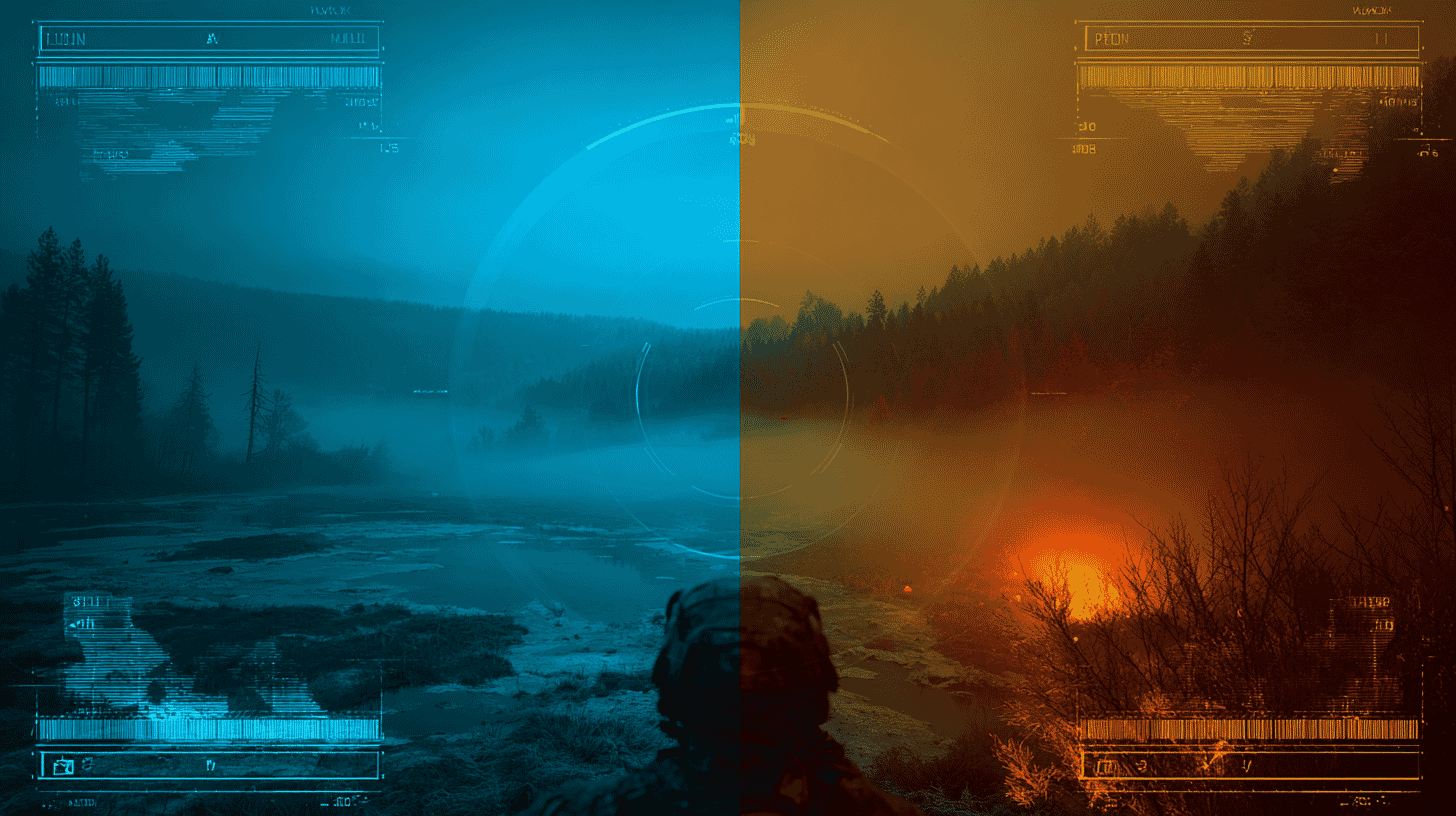
A sensor that can detect temperature differences smaller than 0.05°C, with over 1 million pixels, reading two invisible wavelengths at once. Fujitsu has delivered exactly that to Japan's defense agency. The applications run from battlefield surveillance to wildfire detection and satellite-based environmental monitoring, and the market it enters has been dominated by the West for decades.
What Fujitsu Built
On March 27, 2026, Fujitsu announced it had developed and delivered the world's first dual-band infrared sensor with over 1 million pixels, built using Type-II Superlattice (T2SL) technology. The sensor was created as a research prototype for Japan's Acquisition, Technology & Logistics Agency (ATLA), the defense ministry's procurement and R&D arm.
So what exactly is T2SL? Traditional infrared sensors often use a material called MCT (mercury cadmium telluride), which works well but relies on toxic mercury and can be difficult to manufacture consistently. T2SL takes a different approach: it stacks ultra-thin layers of two semiconductor materials, indium arsenide (InAs) and gallium antimonide (GaSb), at the nanometer scale to create a "superlattice" crystal structure. By adjusting the thickness of these layers, engineers can precisely tune which wavelengths of infrared light the sensor detects.
Fujitsu's breakthrough involves three simultaneous achievements:
Dual-band detection: The sensor captures both mid-wave infrared (MWIR, 3–5 μm) and long-wave infrared (LWIR, 8–14 μm) at the same time using a single pixel element. MWIR excels at spotting hot objects and works well in humid environments, while LWIR is better at detecting room-temperature objects and can see through fog and smoke. Combining both wavelengths allows the sensor to identify targets that would be invisible to single-band systems, lost in background noise.
Ultra-high sensitivity: The sensor can detect temperature differences of 0.05°C or less, fine enough to pick up the residual warmth of a vehicle whose engine has just stopped.
Megapixel resolution: With over 1 million pixels, the sensor can capture sharp images at much greater distances than the VGA-class sensors (640×480, roughly 310,000 pixels) that were previously state-of-the-art for T2SL systems. That is more than a threefold jump.
From Battlefields to Disaster Zones
Defense and security: Military forces worldwide rely on infrared sensors for nighttime surveillance, target identification, and missile guidance. A dual-band megapixel sensor can identify camouflaged targets and operate in conditions (fog, smoke, sandstorms) where visible cameras and even single-band IR sensors struggle.
Disaster response: Japan, a country frequently struck by earthquakes, typhoons, and tsunamis, sees enormous potential in using such sensors for disaster monitoring. After the 2024 Noto Peninsula earthquake, the need for technologies that can find trapped survivors, day or night, became painfully clear. Fujitsu's own announcement lists exactly these uses: detecting people left behind after a disaster, spotting wildfires in their early stages, and tracking the progression of a tsunami.
Environmental monitoring: Mounted on satellites or aircraft, the sensor could precisely measure greenhouse gas distribution, ocean surface temperatures, and crop health across vast areas. JAXA (Japan's space agency) has been collaborating with Sumitomo Electric Industries on T2SL technology specifically for satellite applications.
Infrastructure inspection: Aging bridges, tunnels, and pipelines can develop internal cracks and voids that are invisible to the eye. These defects create subtle surface temperature variations that an ultra-sensitive dual-band infrared sensor could detect non-destructively.
Fujitsu has announced plans to commercialize the sensor technology from fiscal year 2026 onward, selling products to both surveillance and observation camera markets.
How It Stacks Up Globally
The cooled infrared sensor market has long been dominated by a handful of Western defense contractors.
Teledyne FLIR (United States) is among the global leaders in thermal imaging. The company operates as a vertically integrated manufacturer, designing and producing everything from readout integrated circuits and T2SL focal plane arrays to microbolometers and complete camera systems, across defense, industrial and automotive lines. Its scale and production volume are hard to match.
L3Harris Technologies (United States) supplies a dual-band infrared imaging engine to the U.S. military and has provided sensor technology for the F-35 Joint Strike Fighter's Distributed Aperture System, one of the most advanced military sensor programs in existence.
Leonardo DRS (Italy/United States) won a subcontract in late 2025 to supply infrared sensor payloads for the U.S. Space Development Agency's Tranche 3 missile-tracking satellite constellation, a program that underscores how central space-based infrared sensing has become to missile defense.
Compared to these established players, Fujitsu's edge lies in combining dual-band capability, ultra-high sensitivity, and megapixel resolution in a single sensor. By the company's own account, that combination is a world first. The challenge ahead is clear: Western competitors have decades of production experience, massive government contracts, and proven reliability. Fujitsu must bridge the gap between a successful research prototype and commercial-scale manufacturing.
Japan's Turn Toward Dual-Use Technology
Fujitsu's sensor development reflects a broader transformation in Japan's approach to defense technology.
For decades, Japan maintained a rigid separation between military and civilian research, partly due to post-WWII pacifist principles and partly because of cultural reluctance within academia and industry to engage with defense work. That wall has been crumbling rapidly.
In 2023, Japan's Ministry of Defense published "Defense Technology Guidelines 2023," explicitly stating its intention to leverage dual-use technologies for defense capability enhancement.
The Takaichi administration, which took office in October 2025, has made dual-use technology a centerpiece of its economic security strategy. The Japan Growth Strategy Council designated 17 strategic fields, among them AI and semiconductors, aerospace, cybersecurity and the defense industry itself, as priority areas for public and private investment.
The security clearance law formally, the Act on the Protection and Utilization of Critical Economic Security Information passed on May 10, 2024 and took full effect on May 16, 2025. It created an institutional framework for public-private information sharing on sensitive technologies, removing a long-standing barrier to defense-industry collaboration.
Japan's approach mirrors what the United States has done through DARPA (Defense Advanced Research Projects Agency) for decades. Technologies originally developed for military purposes, including the internet and GPS, became some of the most transformative civilian innovations in history. Japan is now deliberately building similar pathways for defense-to-civilian technology transfer, known in Japanese defense policy circles as "spin-off" (防衛技術のスピンオフ).
Fujitsu's infrared sensor is a textbook example: developed for defense surveillance, it has natural applications in disaster monitoring, environmental observation, and infrastructure inspection that could benefit society far beyond the military sphere.
Where "Seeing the Invisible" Goes Next
From a defense agency research prototype to disaster response, environmental monitoring, infrastructure inspection and space: the potential spread is wide. Whether a laboratory success translates into commercial competitiveness against entrenched Western giants is the open question, and mass production plus international distribution are the hurdles.
What makes this bigger than one sensor is what it represents: Japan deliberately dismantling decades-old barriers between defense and civilian innovation. How does your country approach the transfer of military technology to civilian use? Which countries do you think lead in infrared sensor technology? We'd love to hear your perspective.
References
- https://prtimes.jp/main/html/rd/p/000000550.000093942.html
- https://global.fujitsu/ja-jp/pr/news/2026/03/27-01
- https://www.japanindustrynews.com/2026/03/fujitsu-unveils-advanced-infrared-sensor-for-defense-and-disaster-monitoring/
- https://www.aero.jaxa.jp/spsite/rensai/column/53.html
- https://www.teledyne.com/en-us/news/Pages/teledyne-flir-oem-advances-state-of-the-art-in-infrared-imaging.aspx









Global Discussion
15 comments