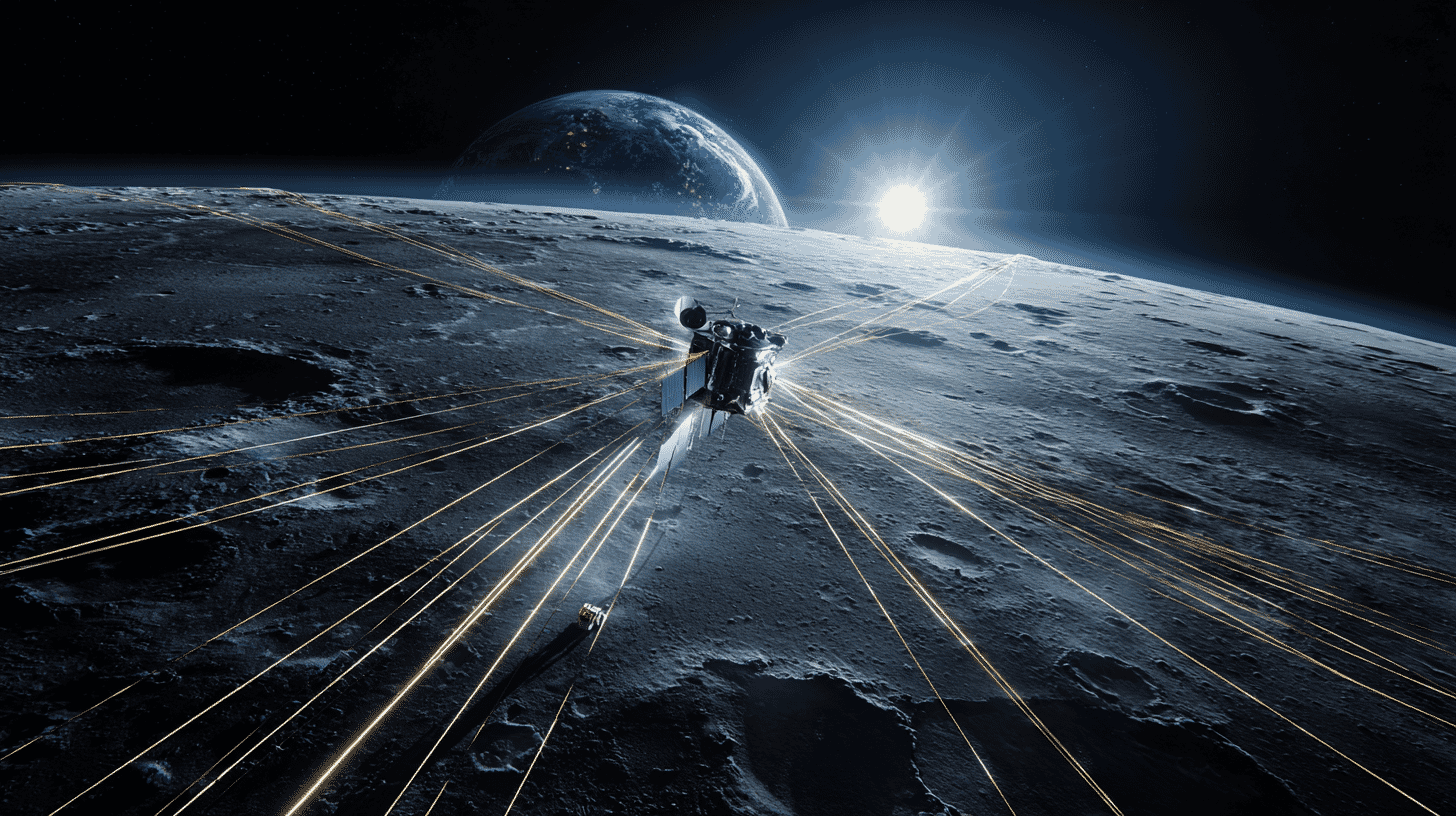
What if the Moon had its own GPS and cell service? A Japanese startup is betting that as lunar activity ramps up, the biggest business won't be landing on the Moon; it'll be keeping everyone connected once they get there. ispace has announced "Lunar Connect," a plan to build communication and positioning infrastructure around the Moon, targeting a market worth $2.8 billion annually by the 2040s.
From Delivery Company to Moon Infrastructure Provider
On March 27, 2026, at a strategy briefing in Tokyo's Nihonbashi district, ispace dropped a bombshell: the company is no longer just about landing things on the Moon. It's getting into the business of providing communication and positioning services for lunar operations, a fundamental shift from a "space trucking" model to becoming a provider of critical infrastructure.
Think of it this way. Right now, the Moon has zero communication infrastructure. When a rover lands on the lunar surface, it has to beam signals directly back to Earth, a brittle, one-to-one link. On the far side of the Moon, where Earth isn't visible, communication is impossible without relay satellites. There's no GPS, no way to pinpoint where things are. As more robots, rovers, and eventually humans arrive on the Moon, this infrastructure gap becomes a deal-breaker.
That's the gap ispace wants to fill.
What "Lunar Connect" Actually Means
The service has two core components.
First, communication: providing stable, high-speed data links between the lunar surface, lunar orbit, and Earth. ispace's satellites orbiting the Moon would relay data from landers and rovers back to ground stations on Earth, essentially acting as a switchboard in the sky.
Second, positioning: giving lunar hardware precise location data, latitude, longitude, and time, like a lunar GPS. Without this, coordinating multiple vehicles, planning routes, or even knowing exactly where you landed becomes guesswork.
Down the road, ispace plans to expand into remote sensing and Space Situational Awareness (SSA), turning its orbital satellites into multi-purpose platforms that can observe the lunar surface and track objects in cislunar space.
Crucially, the service aims to comply with LunaNet, the international communication and navigation framework being developed jointly by NASA, ESA, and JAXA. This means ispace's satellites wouldn't operate in isolation, they'd be interoperable with systems built by other countries, plugging into a global lunar network.
The KDDI Partnership: Ground Stations Matter
Collecting data in lunar orbit is only half the equation. You still need ground stations on Earth to receive it. For this, ispace has signed a basic agreement with KDDI, one of Japan's largest telecom carriers.
KDDI was selected in November 2024 as a contractor for the Space Strategy Fund's "Earth-Moon Communication System Development" project and is already evaluating ground station networks and the feasibility of lunar mobile communication. The two companies will jointly develop the ground infrastructure needed to receive high-bandwidth data from the Moon.
The pairing of a space startup with a major telecom carrier is a model worth watching. It addresses one of the most overlooked challenges in lunar communication: the Earth-side infrastructure.
A $2.8 Billion Market and the Shift to Recurring Revenue
ispace estimates the market for lunar communication and data services will grow to approximately 450 billion yen (about $2.8 billion) annually by the 2040s. This includes communication, positioning, observation, and SSA services.
The business model shift is perhaps even more significant than the technology itself. ispace's traditional transport business is project-based, revenue comes in lumps when a mission launches, and if it fails, revenue is zero. Communication services, by contrast, are subscription-like: once satellites are in orbit, they generate recurring revenue from multiple customers over years.
It's the difference between being a trucking company and being a telecom company. ispace is betting its future on the latter.
The plan calls for at least five lunar orbiting satellites by 2030. The first deployment, dubbed Mission 2.5, could happen as early as 2027, using launch services from U.S.-based Argo Space Corp.
The ULTRA Lander: Merging Japan and U.S. Development
The same briefing revealed another major decision: ispace is merging its two separate lunar lander programs into a single unified model called "ULTRA", a name drawn from the Latin word for "beyond."
Previously, ispace's U.S. subsidiary was developing the APEX 1.0 lander, while the Japanese headquarters was working on a Series 3 lander. These were separate designs for different missions. Now they'll be combined into one platform with a payload capacity of approximately 200 kg (440 lbs).
The immediate trigger was engine trouble. The "VoidRunner" engine being developed by U.S.-based Agile Space Industries for the APEX 1.0 failed to meet performance requirements. ispace terminated that contract and will switch to an alternative engine with proven spaceflight heritage.
But ispace framed the merger as more than just damage control. With lunar development accelerating globally, the U.S. has issued executive orders targeting a Moon base and lunar nuclear reactor by 2030, ispace argued that concentrating resources on a single, higher-quality lander platform serves customers better than maintaining two parallel development tracks.
The merger reshuffles ispace's mission timeline. The next lunar landing is now targeted for 2028 (new Mission 3, led by the Japan office with METI SBIR funding), while the NASA CLPS mission with Team Draper (new Mission 5) moves to 2030.
Where ispace Fits in the Artemis Ecosystem
To understand ispace's play, you need to see it within NASA's Artemis program, the massive effort to return humans to the Moon.
Artemis II successfully completed a crewed lunar flyby in April 2026. Artemis III, now planned for mid-2027, will test docking between the Orion spacecraft and commercial lunar landers from SpaceX and Blue Origin in Earth orbit. The first crewed lunar landing since Apollo is targeted for Artemis IV in early 2028, with NASA planning semiannual landings thereafter and aiming to establish a continuous human presence on the Moon by 2032.
The budget for a permanent Moon base is estimated at around $20 billion over seven years, and NASA plans to begin installing power, communication, and mobility systems by 2029.
ispace participates in this ecosystem through Team Draper, which holds NASA's CLPS task order CP-12. The mission, now rescheduled as ispace's new Mission 5, will deliver NASA science payloads to Schrödinger Basin on the lunar far side, near the south pole.
[Update, July 2026: NASA and Draper subsequently ended the CP-12 contract by mutual agreement, and ispace's U.S. subsidiary expects its subcontract with Draper to end as well. The 2030 U.S. mission that CP-12 anchored is now under review; ispace says it is pursuing NASA's next-generation CLPS 2.0 framework instead.] Two relay satellites will be deployed in lunar orbit to enable communication from this remote location.
As Artemis scales up, demand for lunar communication and positioning infrastructure will explode. Every crewed habitat, every rover route, every resource survey needs reliable connectivity and precise location data. ispace's Lunar Connect service is positioned to capture a slice of that demand.
The Challenges Are Real
There's no sugarcoating the difficulties ahead.
ispace has attempted two lunar landings, Mission 1 in 2023 and Mission 2 in 2025, and both failed to achieve soft landing. The company successfully demonstrated transportation to lunar orbit and validated attitude and guidance control systems, but the critical final minutes of descent remain unmastered.
Operating communication satellites in lunar orbit is a different discipline from building landers, and ispace has limited experience in that domain.
Financially, ispace, listed on the Tokyo Stock Exchange Growth Market with about 350 employees, faces the challenge of running multiple ambitious programs simultaneously without the capital reserves of SpaceX or Blue Origin.
That said, the company brings genuine assets to the table: two proven demonstrations of lunar orbit insertion, a three-continent operational footprint (Japan, Luxembourg, U.S.), NASA CLPS contract status, and institutional partnerships with KDDI and JAXA.
The Competitive Landscape
ispace isn't alone in the lunar communication space. NASA is building LunaNet directly. ESA is studying its Moonlight initiative for a lunar communication constellation. Nokia has been testing a 4G network on the lunar surface with NASA support.
Among commercial lunar landers, Intuitive Machines has already achieved a successful Moon landing, and Firefly Aerospace's Blue Ghost reached the surface in 2025.
ispace's differentiation will depend on three factors: LunaNet-compliant interoperability, its KDDI-backed ground station network in the Asia-Pacific region, and its ability to offer both landers and communication satellites from a single provider, a vertically integrated lunar service model.
In Japan, ispace's pivot is sparking both excitement and skepticism. Some question whether a company that hasn't yet achieved a successful landing should be announcing infrastructure ambitions. Others see it as exactly the kind of bold, long-term vision that space startups need to survive.
Does your country have companies working on lunar communication or infrastructure? What do you think about private companies building the Moon's basic services? Share your thoughts!








Global Discussion
15 comments