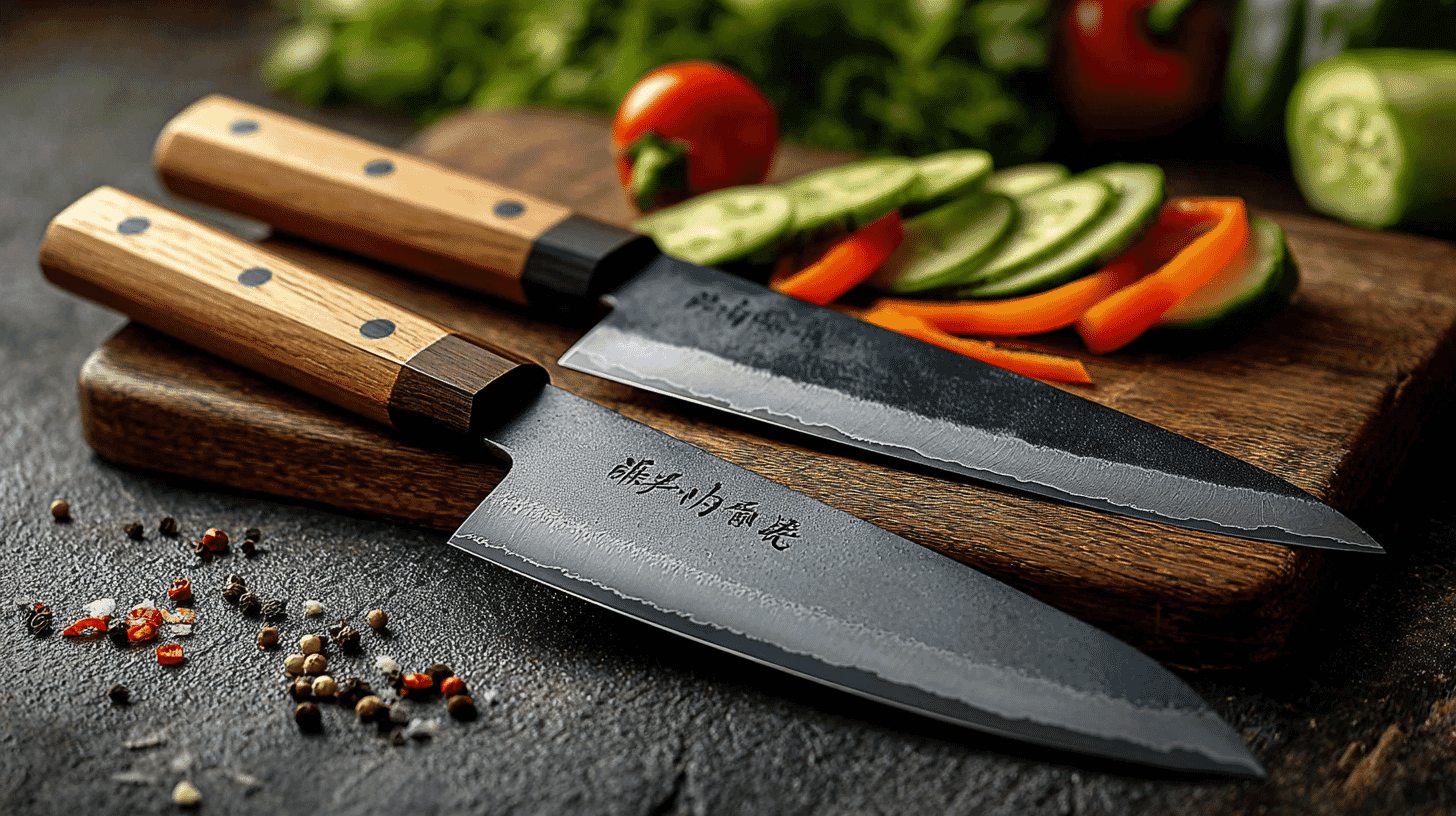
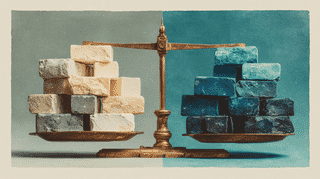
🔪 Ask how a Japanese kitchen knife differs from a German one and the usual answer is harder steel, a thinner blade and a sharper edge. The makers' own spec sheets still show a clear gap in hardness. The gap in edge angle is murkier than the rule of thumb suggests.
On November 10, 2026, the Nikkan Kogyo Shimbun, a Japanese industry daily, ran a feature on Seki in Gifu Prefecture, a town described as one of the world's three great cutlery centers alongside Solingen in Germany and Sheffield in England. That "big three" is an informal label, not an official ranking. According to the paper, about half of the workshops employ nine people or fewer, closures continue for lack of successors, and blade workshops in Gifu fell from 887 in 1980 to 98 in 2022. Demand from abroad is strong, though: not a few foreign visitors come to Seki directly to buy knives.
Exports quadrupled, led by pricier knives
Japan's kitchen knife exports reached a record of about 11.8 billion yen (about $74 million) in 2021, up 28.6 percent from the previous year and more than four times the 2000 level, according to Nagoya Customs figures reported by the Nikkei. Nearly half, about 6.1 billion yen (about $38 million), shipped from the Nagoya Customs area that includes Seki. The growth came from expensive knives sold to North America and Western Europe. Dollar amounts in this article use 159.6 yen to the dollar, the rate on November 17, 2026.
In 2024, Gifu accounted for 55.1 percent of the kitchen knives shipped in Japan by value, about 15.87 billion yen (about $99 million), according to the 2025 Economic Structure Survey by the internal affairs and economy ministries. Niigata, home of the Sanjo knife trade, came second at 25.4 percent.
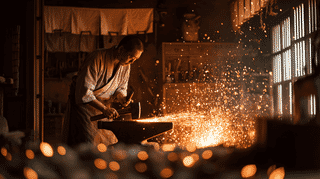
Seki's blade industry traces back to swordmaking in the 14th century. For a stranger corner of Japanese sword history, see our piece on the swords forged from a meteorite.
Hardness and edge angle, by the numbers
Germany's Zwilling, through its Japanese subsidiary, set up its own factory in Seki in 2004 and makes its MIYABI line there, which allows a comparison within one company. On Zwilling's US site, the Seki-made MIYABI Kaizen II gyuto lists a hardness of HRC 60 to 62. The German-made Zwilling Pro chef's knife lists HRC 55 to 58.
MIYABI lists an edge angle of 9.5 to 12 degrees but does not say whether that is per side. Wüsthof, a maker based in Solingen, grinds its knives to 14.5 degrees per side and says most other makers' kitchen knives sit at about 20 degrees per side. Going by published figures, at least, German knives are not uniformly blunt-angled.
| Japanese example | German example | |
|---|---|---|
| Hardness | MIYABI Kaizen II (made in Seki): HRC 60 to 62 | Zwilling Pro (made in Germany): HRC 55 to 58 |
| Edge angle | MIYABI Kaizen II: 9.5 to 12 degrees (per side not specified) | Wüsthof: 14.5 degrees per side |
| Bevel | Traditional yanagiba, deba and usuba are single-bevel | Double-bevel |
Harder isn't automatically better. Tojiro, a knife maker in Tsubame-Sanjo, Niigata, explains that a hard, keen edge cuts beautifully but becomes brittle under sideways force, so it chips more easily. The company puts the sensible range for kitchen knives at about HRC 52 to 62. By that measure, the Seki-made MIYABI trades some toughness for sharpness, while the German-made Zwilling Pro gives up some hardness to resist chipping.
Single-bevel washoku knives and the everyday santoku
Most Western knives are sharpened on both faces. Many traditional Japanese knives are sharpened on one. Tojiro lists the yanagiba (the Kansai-style sashimi knife), the deba (a thick, heavy knife for breaking down fish) and the usuba (a thin vegetable knife) as single-bevel. According to the company, a single bevel lets a cook fillet fish close to the bone and leaves a cleaner cut face. The usuba is also the knife for katsuramuki, peeling a daikon radish into one long thin sheet. Because the edge is on one side only, single-bevel knives come in right-handed and left-handed versions.
Tojiro still recommends a double-bevel knife as the all-purpose first knife for a home kitchen. The classic choice is the santoku, which combines the strengths of the nakiri and the gyuto and handles vegetables, meat and fish alike. The square nakiri, once found in almost every home, has largely given way to the santoku, the company says. Some "Japanese knives" sold abroad are Western shapes finished in Japan: Zwilling describes MIYABI as combining the sharp cut of a Japanese knife with a European blade shape.
White paper, blue paper, stainless: what the steel changes
Shirogami (white paper) and Aogami (blue paper) are carbon steels in the Yasugi steel line of Proterial, the company known as Hitachi Metals until January 4, 2023. A research note from Niigata's prefectural industrial technology institute describes white paper as a premium blade steel with few harmful impurities, and blue paper as white paper with chromium and tungsten added for better heat treatment and wear resistance. White paper No. 1 contains 1.25 to 1.35 percent carbon.
Tojiro's materials guide puts white paper at about HRC 60 and blue paper at about HRC 64, and is frank about the catch: white paper steel is harder and sharper than stainless but brittle and prone to chipping, and it rusts. Its saving grace is that it is easy to sharpen on a stone. Stainless VG10 (about HRC 58 in Tojiro's guide) resists rust and is easier to look after. Powder steels reach about HRC 64, as hard as blue paper. Many modern blades wrap a hard core in softer layers; the MIYABI Kaizen II puts an FC61 steel core inside 48 layers of Damascus steel.
Where the knives are made
Seki, for all its fame, is not on Japan's national list of traditional crafts for blades. That list includes seven forged-blade crafts: Echizen (Fukui), Sakai (Osaka), Shinshu (Nagano), Echigo Yoita and Echigo Sanjo (Niigata), Banshu Miki (Hyogo) and Tosa (Kochi). Miki makes mainly carpenters' tools such as saws and planes.
- Sakai splits the work between smiths, who forge, and sharpeners, who set the edge. The city is said to supply about 90 percent of Japan's professional washoku knives. Sakai Denshokan, the city's traditional industries hall, displays and sells knives and has a museum on the history of knifemaking.
- Echizen traces its forging back about 700 years and still uses techniques such as nimai-hirogi, in which two blades are forged stacked together. At Takefu Knife Village, a shared workshop of 13 knife companies, visitors can watch smiths and sharpeners for free.
- Seki holds its Knife Festival every autumn; in 2026 it ran on October 10 and 11. Its Seki Traditional Swordsmith Museum is closed for renovation from September 7, 2026 to March 31, 2027 (planned, as of November 2026), though the forge remains open for use.
Care, and getting a knife home
Tojiro advises holding the blade at 10 to 15 degrees to the stone and says one medium stone (#600 to #2000) covers most home sharpening; a coarse stone (#80 to #400) is only for repairing chips. Sharpening once or twice a month keeps a good edge. Wash off salt and acid promptly and never leave a knife soaking in a basin. As for the dishwasher, this isn't really a Japan-versus-Germany question: Zwilling's Japanese arm says even dishwasher-safe knives last longer washed by hand, and wooden handles should never go in.
Under Article 22 of Japan's Swords and Firearms Control Law, no one may carry a blade longer than 6 centimeters (about 2.4 inches) without a work-related or other legitimate reason. Some scissors and folding knives up to 8 centimeters are exempt. Violations carry up to two years in prison or a fine of up to 300,000 yen (about $1,880). Kagoshima prefectural police list taking a newly bought knife home as an example of a legitimate reason, but the law itself says nothing about packaging, so keep the knife boxed and go straight to your hotel or the airport. Carrying a concealed blade without good reason can also fall under the Minor Offenses Act, whatever its length. For flights, Japan's transport ministry asks passengers to keep knives out of carry-on bags and put them in checked baggage. Check your airline's rules and your home country's customs rules too.
Germany, for its part, has protected the name Solingen by law since 1938. The current Solingen Regulation, from 1994, allows the name only on blades made in all essential steps in Solingen or neighboring Haan. Meanwhile, a German company makes its Japanese-style line in Seki. So which kind is in your kitchen drawer, and does anyone in your country still care where a blade was forged?
References
- https://newswitch.jp/p/50788
- https://www.nikkei.com/article/DGXZQOUF290O20Z20C22A8000000/
- https://www.meti.go.jp/statistics/tyo/kkj/seizo_result.html
- https://www.zwilling.com/jp/about-us/our-story/article-brand-story-miyabi.html
- https://www.zwilling.com/us/miyabi-kaizen-ii-6.5-inch-gyutoh-34681-163/34681-163-0.html
- https://www.zwilling.com/us/zwilling-pro-8-inch-chefs-knife-38401-203/38401-203-0.html
- https://www.wusthof.com/blog/what-is-petec
- https://en.wikipedia.org/wiki/W%C3%BCsthof
- https://tojiro.net/reading/8751/
- https://tojiro.net/reading/7371/
- https://tojiro.net/reading/8758/
- https://tojiro.net/reading/7359/
- https://www.pref.niigata.lg.jp/uploaded/attachment/430811.pdf
- https://www.pref.niigata.lg.jp/uploaded/attachment/430808.pdf
- https://disclosure2dl.edinet-fsa.go.jp/searchdocument/pdf/S100Q5A2.pdf
- https://www.bunka.go.jp/seisaku/bunkashingikai/bunkazai/kikaku/r07_r08/05/pdf/94408301_03.pdf
- https://web.pref.hyogo.lg.jp/ac02/kids_ind_le.html
- https://osaka-info.jp/local_journey/unknown-osaka/sakai-houchou/
- https://fuku-iro.jp/omiyage/detail_10542.html
- https://www.kankou-gifu.jp/event/detail_989.html
- https://www.kankou-gifu.jp/spot/detail_1179.html
- https://tojiro.net/support/maintenance/
- https://tojiro.net/reading/8761/
- https://www.zwilling.com/jp/magazine/product-guide-knives/knife-use-care.html
- https://laws.e-gov.go.jp/law/333AC0000000006
- https://www.pref.kagoshima.jp/ja09/police/oshirase/index/hamono_keitai.html
- https://www.mlit.go.jp/report/press/content/001320934.pdf
- https://www.wipo.int/edocs/mdocs/geoind/en/wipo_ds_vrs_08/wipo_ds_vrs_08_www_102737.pdf
- https://www.gesetze-im-internet.de/solingenv/BJNR383300994.html

Global Discussion
4 comments