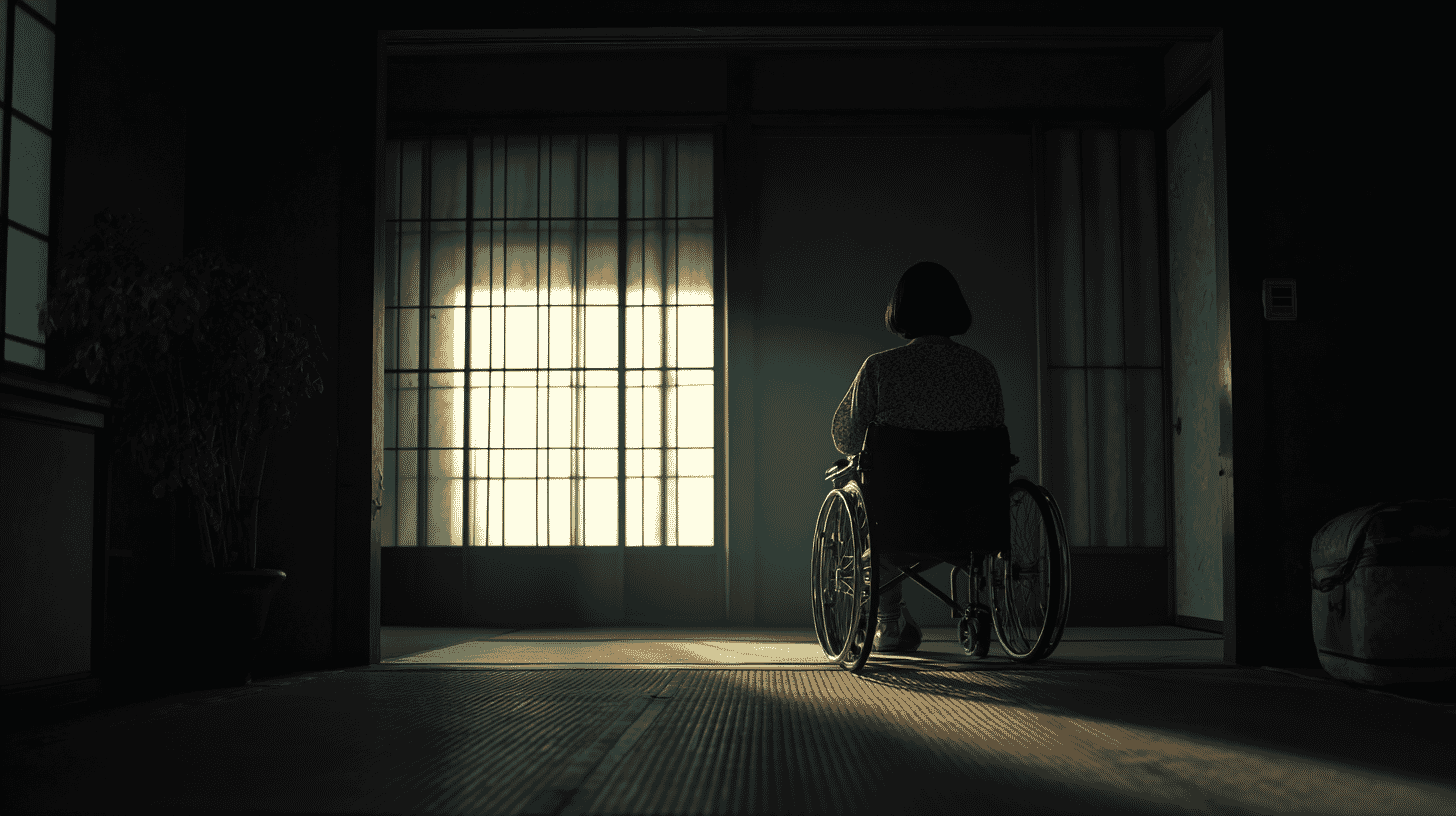
A mother who spent 29 years caring for her severely disabled daughter, alone, took her child's life. "I didn't intend for only my daughter to die. I meant to die too." This is a murder case. But should this mother alone bear the weight of it? In Japan, tragedies like this keep repeating.
What Happened in Mobara, Chiba
Early on the morning of March 8, 2026, a 58-year-old mother was arrested in Mobara City, Chiba Prefecture, on suspicion of murdering her 29-year-old daughter.
The daughter had been born with a severe congenital physical disability and had been bedridden her entire life. For 29 years, the mother cared for her at home while also arranging for her to attend a welfare facility during the day. No one else lived with them.
The mother killed her daughter at home, then attempted to take her own life and survived. She told a nearby resident that she had killed her daughter, and a neighbor called police at around 6:25 a.m.
During questioning, she said she had despaired of her bedridden daughter's future and attempted what Japanese calls muri-shinjū: a caregiver taking the life of the person in their care and then their own, driven by despair rather than malice.
Twenty-nine years. More than 10,000 days. What must those days have looked like for this mother?
A Repeating Tragedy: Japan's Dark Reality of "Caregiver Murder"
This case is far from isolated.
In Japan, approximately 40 cases of murder or attempted murder-suicide linked to caregiving difficulties are reported each year. Between 1998 and 2015, researchers documented 716 fatal cases, and the numbers have not fallen even after Japan introduced its Long-Term Care Insurance system in 2000.
A year earlier, in March 2025, another verdict drew attention. In Yasu City, Shiga Prefecture, an 82-year-old father who had spent 34 years caring for his son, left with severe after-effects by a traffic accident, took the son's life with his consent. On March 10, 2025, the Otsu District Court handed down three years in prison suspended for four, against a prosecution request of four years. The judge said that even with consent, taking a life cannot be permitted, while weighing the father's decades of devoted care and the anxiety about the future that came with his own age and illness.
In 2006, a case in Fushimi Ward, Kyoto, became a landmark. A 54-year-old son caring for his mother, who had dementia, applied for welfare assistance three times and was turned away each time. Financially and emotionally cornered, he killed his mother and attempted to take his own life. At trial, even the prosecution laid out the defendant's circumstances in detail, an unusual move, and the courtroom was reported to be in tears. The sentence was two years and six months, suspended for three years. The presiding judge added a remarkable statement:
"It is not only the defendant who is being judged here. The very systems of long-term care insurance and public welfare are on trial."
Yet this man, who had vowed to rebuild his life after the compassionate verdict, died by suicide eight years later. Among his belongings were a small amount of loose change, two umbilical cords, his own and his mother's, and a note asking that they be cremated together.
"Just Ask for Help" Is Advice Only the Privileged Can Give
Every time a case like this makes the news, the same chorus of responses follows:
They should have consulted the local authority. They should have used welfare services. They should have asked someone for help.
The advice is not wrong. But it comes from people who still have the capacity to ask.
Japan has a deeply ingrained value: meiwaku wo kakete wa ikenai, you must not be a burden to others. Many people cannot bring themselves to speak up even when struggling, because asking for help itself feels shameful. The man in the Kyoto case had been raised on his father's teaching that you must never live in a way that burdens others. He followed it so faithfully that after being turned away three times, he could not push back again.
The isolation of caregivers is not a sign of personal weakness. It is a problem created by the very structure of Japanese society.
Research analyzing caregiver killings found that about 37% occurred in households where only the caregiver and the care recipient lived. In roughly 29%, the burden fell on one person. And in about 31%, the caregivers themselves had disabilities or mental health conditions. The people providing support were the ones who needed it.
What Is Government, What Is Society, For?
Japan's Long-Term Care Insurance system launched in 2000 with a stated ideal: kaigo no shakai-ka, the socialization of caregiving. Care was no longer to be a burden carried by families alone, but shared across society.
But what is the reality?
In the 2022 Comprehensive Survey of Living Conditions, 45.9% of primary caregivers lived with the person they cared for. That is down from 54.4% in the 2019 survey, but it remains the largest single category, and among co-resident pairs, 63.5% now involve two people both aged 65 or over. Special nursing homes have long waiting lists. Home care services remain thin at night and in the early morning, a gap flagged for years. And caring for a disabled child falls outside the long-term care insurance framework entirely, which widens the gap further.
In the Mobara case, the mother had been sending her daughter to a care facility. She was not disconnected from the system. Yet 29 years of pressure still drove her to the breaking point. The system existed and did not reach her.
What are governments and societies for, if not to share the burdens no individual can carry alone? In Japan, the phrase ji-jo, kyo-jo, kō-jo, self-help, mutual help, public help, is often invoked, and it is usually read in exactly that order: figure it out yourself first. But the role of public assistance is to catch the people who have already reached the limits of self-help. When it does not, society has failed.
Who Should Bear This Guilt?
Legally, this is a murder case. The mother committed a crime. The fact that a life was taken cannot be undone.
But is it truly justice to place the full weight of guilt on a woman who spent 29 years caring for her daughter alone, lost hope for the future, and tried to die alongside her child?
In similar past cases, courts have said repeatedly, in one form or another, that it is not only the defendant on trial but society itself. Those words are the judiciary acknowledging its own limits. The law can judge people. It cannot save people who have been driven to despair. That takes a functioning society.
Each time a caregiver killing occurs, society grieves, pays attention for a while, and forgets. Breaking that cycle takes systemic reform and a shift in public awareness, not individual effort.
Part of the guilt this mother carries undeniably belongs to society as well.
What About in Your Country?
In Japan, tragedies surrounding caregiving show no sign of stopping. Behind them sit a culture that says do not be a burden, a social structure that places caregiving squarely on families, and people who fall through the cracks.
How does your country support families who need long-term care? When caregivers are pushed to the brink, what safety nets does your society offer? How does your society reach out to those who cannot bring themselves to say "help me"?
We'd love to hear about the experiences and perspectives from your country.
Note: The details of the Mobara, Chiba case described here are based on news reports available as of March 9, 2026. The full facts regarding the suspect's motives and the circumstances of the case will be established through the ongoing investigation and eventual trial, and the information now available may not reflect the complete picture.
If caregiving has brought you to a breaking point, help exists. In Japan, your municipal Community General Support Center and the Ministry of Health, Labour and Welfare's mental health line (0570-064-556) both take calls. Elsewhere, local crisis and carer support lines can help. Please do not carry it alone.









Global Discussion
15 comments