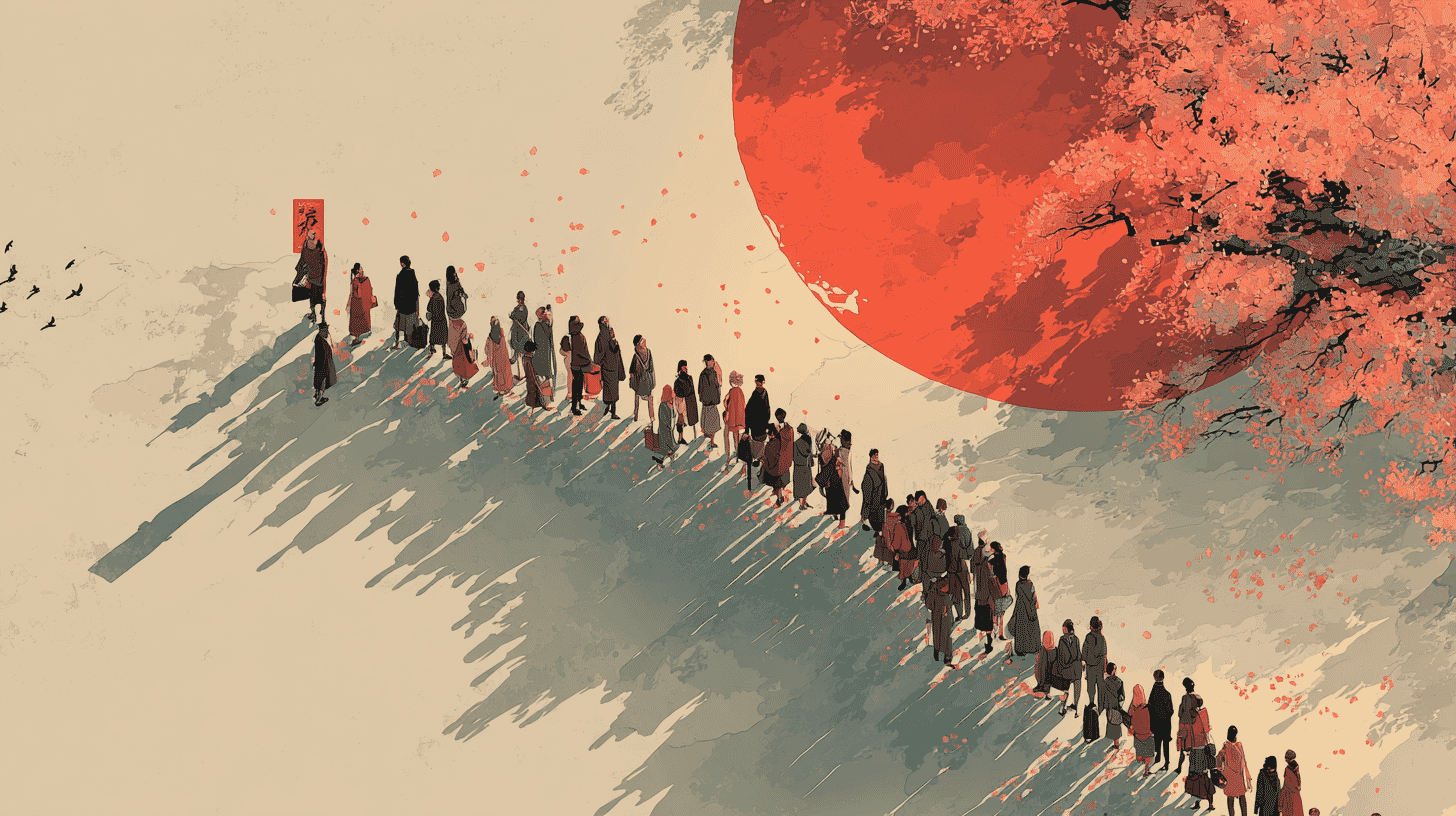
Becoming a Japanese citizen got considerably harder on April 1, 2026. Japan's Ministry of Justice doubled the effective residency requirement for naturalization from five years to ten, and expanded tax verification from one year to five. No law was changed: it is all being done through an adjustment to how applications are screened. Here is what that means for foreigners living in Japan, why it is happening now, and how Japan compares with the rest of the world.
What Changed on April 1
On March 27, 2026, Japan's Ministry of Justice announced that naturalization screening will be tightened starting April 1. The changes are substantial.
Under the previous system, foreigners could apply for Japanese citizenship after living in the country for at least 5 consecutive years. Starting in April, the practical requirement jumps to 10 years of continuous residency.
The paperwork grows too. Applicants must now submit five years of tax payment certificates, up from one, and two years of social insurance payment records. That mirrors what permanent residency applications already demand.
So becoming a Japanese citizen now takes the same level of proof as merely getting permission to stay indefinitely, even though citizenship carries far greater rights and responsibilities.
The "Inversion Problem" Behind the Change
The driving force behind this tightening is what policymakers call the "inversion phenomenon" between permanent residency and naturalization.
In Japan's immigration system, obtaining permanent residency has traditionally required 10 or more years of continuous residence. Permanent residents can live and work freely in Japan but cannot vote, run for office, or hold certain government positions.
Naturalization, which grants voting rights, eligibility for public office and a Japanese passport, previously required only five years. The bigger prize had the lower bar, which struck many as illogical.
The Japan Innovation Party (Nippon Ishin no Kai) formally raised this concern in a September 2025 policy proposal. In November 2025, Prime Minister Sanae Takaichi instructed Justice Minister Hiroshi Hiraguchi to review the requirements, and a government and ruling-party consultation in December settled the direction. The changes were folded into the comprehensive package on accepting foreign nationals and building an orderly inclusive society, which the government adopted in January 2026.
No Law Changed. Is That Legal?
Perhaps the most controversial aspect of this policy shift is how it's being implemented.
Japan's Nationality Act (Article 5) clearly states that one requirement for naturalization is "having continuously maintained a domicile in Japan for 5 years or more." That text remains unchanged. The Ministry of Justice's position is that the 5-year figure represents merely the minimum threshold, and that exercising greater discretion in approving applications is within the Justice Minister's legal authority.
Legal scholars, however, are divided. Critics argue that doubling the effective requirement through administrative discretion, without parliamentary debate, undermines the legislative process. If the government wanted 10 years, they should have gone through the Diet (parliament) to amend the law properly.
Defenders counter that naturalization has always been a discretionary act. Even before this change, unwritten requirements like Japanese language proficiency were enforced in practice despite not appearing in the statute. The 5-year provision, they argue, was never meant as a guarantee of approval.
Achieving the practical effect of a law change without the political difficulty of changing the law raises questions about accountability and transparency that are unlikely to go away.
The Contradiction: "Come Work Here, But Don't Expect Citizenship"
Japan's immigration policy is pulling in two directions simultaneously, and the tension is hard to ignore.
On one hand, the government is expanding foreign worker programs. The "Ikusei Shuro" (Development Employment) system, legislated in 2024 to replace the much-criticized Technical Intern Training Program, is due to start in 2027. Specified Skilled Worker categories keep expanding. At the end of 2025 the foreign resident population reached 4.12 million, passing four million for the first time.
On the other hand, naturalization now requires ten years. The government says it intends to add Japanese language proficiency and income thresholds to permanent residency, though as of 2026 no levels have been fixed. From April 2027, permanent residents who fail to pay taxes or social insurance premiums could have their status revoked.
The government frames this as "orderly coexistence", welcoming foreign workers while demanding compliance with social obligations. But for many foreigners, the message reads differently: "We want your labor, but becoming one of us will take twice as long."
That gap matters in a global talent market where skilled workers compare destinations before they commit.
How Does Japan Compare Internationally?
Japan's new 10-year standard places it among the strictest naturalization regimes in the developed world.
United States: 5 years as a permanent resident (3 years if married to a U.S. citizen). Dual citizenship is effectively tolerated.
Canada: 1,095 days (approximately 3 years) of physical presence within a 5-year window. Time spent on temporary visas can partially count. One of the most accessible paths globally.
Germany: Underwent a dramatic shift in 2024, reducing the requirement from 8 years to 5 years and allowing dual citizenship for the first time. A fast-track 3-year option was introduced but then abolished in October 2025 under a new government, returning to a 5-year minimum.
Australia: 4 years of lawful residence, with at least 1 year as a permanent resident.
Switzerland: 10 years of residence, plus additional cantonal and communal requirements. Generally considered Europe's strictest.
Japan (new): 10 years in principle. And unlike most countries listed above, Japan generally does not allow dual citizenship, meaning applicants must renounce their original nationality.
The global trend has been moving toward making naturalization easier to encourage integration. Germany's 2024 reform was explicitly designed to increase citizenship uptake. Japan is moving in the opposite direction, making it one of the few developed nations actively raising the bar.
By the Numbers
Ministry of Justice figures show 12,248 naturalization applications in 2024, 8,863 approvals and 639 rejections. In 2025 all three rose: 14,103 applications, 9,258 approvals, 666 rejections.
Those applications and approvals are not the same cohort, since a decision typically takes about a year, and the Ministry itself cautions against dividing one by the other to produce an approval rate. Rejections run to roughly 600 to 900 a year, so most applications that are formally accepted do eventually succeed.
Still, against a foreign resident population of 4.12 million, roughly nine thousand naturalizations a year is a small number. Under the new requirements, applications may fall as people are pushed to apply later.
The screening infrastructure is tightening too. From June 14, 2026, Japan begins issuing a "specified residence card" that merges the residence card with the My Number national ID card. From 2027 onward the government plans to strengthen data sharing between national and local authorities on tax and social insurance payments, closing the gaps that once made non-payment hard to spot.
What Comes Next
The new standard applies to any decision made on or after April 1, which means it can reach applications already filed. For foreigners who had been preparing under the old rules, the timing is brutal. Immigration lawyers and administrative scriveners (gyoseishoshi) had spent months telling clients to file before the window closed.
Japan's challenge going forward is reconciling its desperate need for workers with increasingly restrictive pathways to belonging. In a world where skilled workers can choose between countries, and Germany, Canada, and Australia are actively making citizenship easier, Japan's message of "work here for a decade before we'll even consider making you one of us" may prove costly.
The question isn't just whether this policy is fair. It's whether Japan can afford it.
In Japan, it now takes 10 years of residency to apply for citizenship, and you must give up your original nationality. What are the requirements in your country? Does your country allow dual citizenship? We'd love to hear how your country handles naturalization, share your thoughts in the comments!









Global Discussion
13 comments