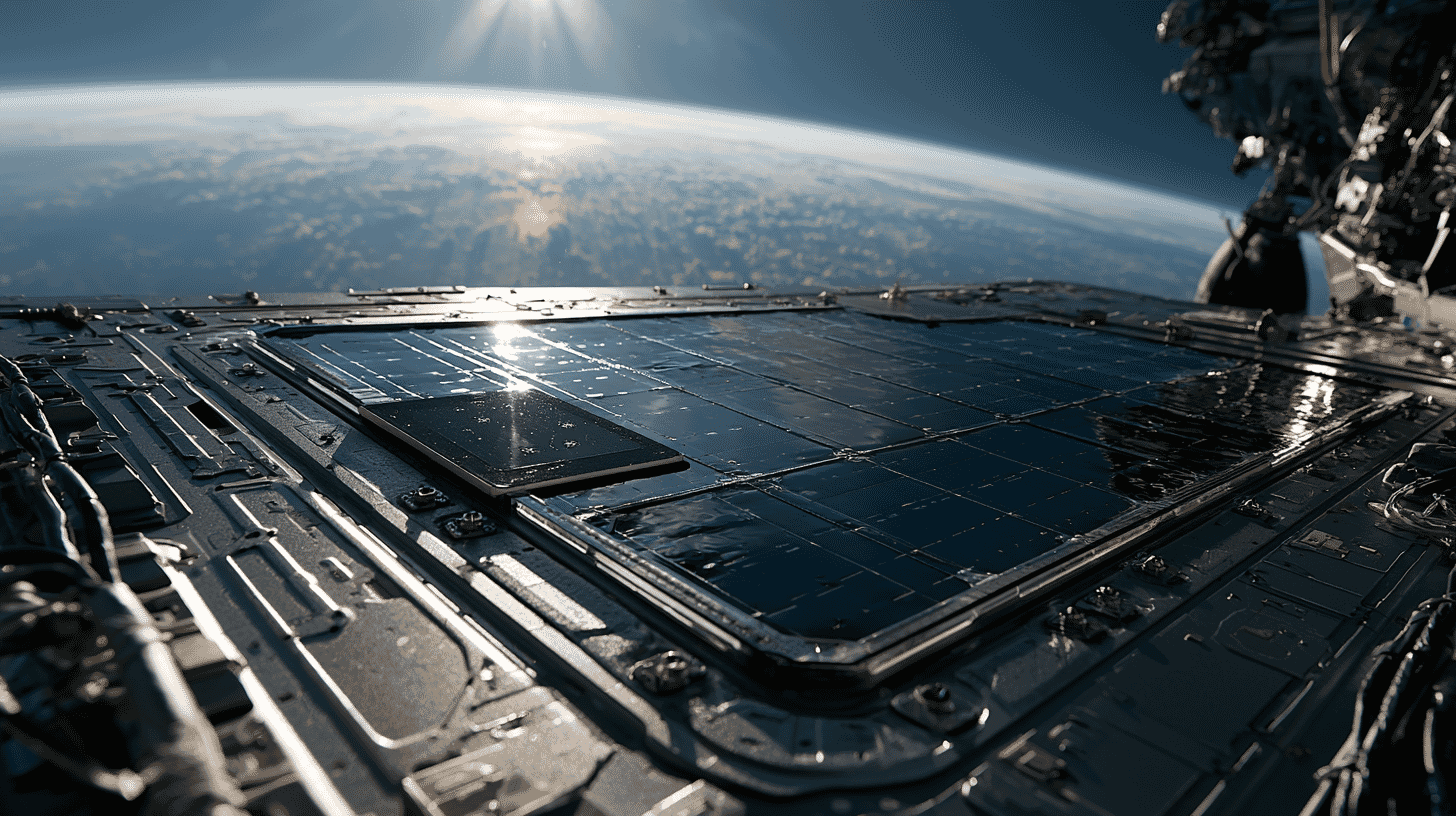
🛰️ On the night of May 26, a Japanese spacecraft burned up over the South Pacific, exactly as planned. But before it did, it spent its final three months alone in orbit doing something no resupply ship had done before: unfolding panels, bouncing a signal back to Earth, and quietly measuring how a sheet of Japanese-made perovskite held up against the radiation of open space.
From "Kounotori" to a flying laboratory
For more than a decade, Japan's contribution to the International Space Station had a gentle name: Kounotori, "the white stork." Between 2009 and 2020, nine of these uncrewed cargo ships hauled water, food, and equipment up to the ISS. HTV-X1 is their successor: bigger, and built to do far more than deliver groceries.
The raw numbers tell part of it. Where Kounotori carried about 4 tonnes of cargo in 49 cubic meters, HTV-X carries 5.82 tonnes in 78, roughly one and a half times the room, with a launch mass near 16 tonnes. But the real upgrade is what happens after the delivery. HTV-X can stay docked to the ISS for up to six months, then fly on its own for as long as a year and a half, turning itself into an orbital experiment platform.
HTV-X1 lifted off on October 26, 2025, atop the seventh H3 rocket. Four days later, JAXA astronaut Kimiya Yui, then aboard the station, reached out with the ISS's Canadarm2 robotic arm, captured it, and berthed it the same day. Inside were more than four tonnes of pressurized cargo for the crew, fresh Japanese produce among it. After about four months attached to the station, HTV-X1 undocked on March 7, 2026, loaded with trash, and began the part of the mission that interests engineers most.
Why bother testing solar cells in space?
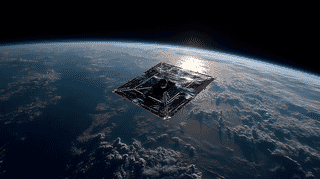
Over roughly three months of solo flight, HTV-X1 ran three technology demonstrations: releasing a microsatellite (H-SSOD), estimating its own attitude by laser ranging (Mt. FUJI), and unfolding a lightweight panel (DELIGHT/SDX). The one that reaches furthest beyond Japan rode on that panel: a device called SDX, short for Space solar cell Demonstration system on HTV-X.
Bolted to the spacecraft were two kinds of next-generation cells: an ultra-high-efficiency triple-junction cell (a "PHOENIX"-type design) and a domestically made perovskite cell developed by Ricoh. JAXA exposed them to raw space in orbit and recorded their current-voltage behavior: how much power they made, and how well they survived.
Perovskite has been written about endlessly as a rooftop technology: thin, light, printable. But the case for using it on the ground and the case for using it in orbit rest on different fears. On Earth, perovskite's enemies are moisture, heat, and UV. In space none of those matter much; the thing that slowly kills solar cells up there is radiation, and conventional satellite cells degrade under it over time. Perovskite, held together by ionic bonds, turns out to be unusually radiation-tolerant. It also generates well in low light and, once made flexible, could be far lighter than today's rigid satellite arrays. In an industry where every kilogram on the rocket costs real money, "lighter" matters.
JAXA didn't stumble into this. The agency first approached perovskite's inventors at Toin University of Yokohama back in 2014 to test radiation tolerance; Ricoh joined in 2017 through JAXA's Space Exploration Innovation Hub, with the express goal of hardening the cells for orbit. HTV-X1 was the payoff: their space-hardened perovskite actually flew and sent data home. JAXA hasn't released the detailed results yet; analysis of that data is the next step.
The signal that came back
DELIGHT, riding on the same panel, looked further down the road. HTV-X1 unfolded the deployable lightweight panel and filmed how it behaved: how a large, flimsy structure actually opens and holds its shape in microgravity. Mounted on the panel was a flat, lightweight antenna, and the team measured how cleanly it could pick up a radio signal beamed from a ground station.
That sounds modest until you know what it's for. It's a building block for one of the more audacious ideas in energy: space-based solar power, where vast panels in orbit collect sunlight around the clock and send it down to Earth. You can't build something that big without first learning how huge, thin structures unfold and function in space. DELIGHT was a rehearsal.
Mt. FUJI, the second demonstration, was nearly pure physics. A small reflector on the hull let ground stations fire lasers at it and measure not just where HTV-X1 was, but how it was tumbling. It was the first time, JAXA says, that satellite laser ranging has been used to estimate a spacecraft's attitude motion quantitatively this way. The likely use is cleaning up space junk, where you have to know exactly how a dead satellite is spinning before you can catch it. The third demonstration, H-SSOD, released a university microsatellite, "Tenkou-2," built by Nihon University, on March 12, 2026, from an altitude of about 500 km. That is well above the ISS at roughly 400 km, so the little craft gets a longer life before it falls back.
Toward the Moon, and beyond
The pieces point somewhere. Lightweight, radiation-hardy solar cells are exactly what you want where launch mass is precious and resupply is impossible: lunar bases, Mars-bound probes, spacecraft headed for the dim outer planets, where every photon counts and perovskite's low-light performance earns its keep. And the space-based solar power that DELIGHT inches toward is, in the long run, an environmental technology as much as a space one.
There's a quieter strategic shift in here too. Some observers note that with HTV-X, Japan is trying to grow from being a "delivery service" for the ISS into something closer to an on-orbit utility, a platform others can rent to test hardware, deploy satellites, and run experiments. A cargo ship that spends its retirement as a flying lab is a different kind of business.
HTV-X1 is gone now, scattered as harmless fragments across an empty stretch of the South Pacific, a controlled ending chosen so nothing fell near shipping lanes or homes. But the data it gathered in those last weeks, on panels that unfold, antennas that listen, and a thin Japanese solar film that shrugged off cosmic radiation, is only starting to be read.
Reentry began at about 11:09 p.m. Japan time on May 26, when the craft passed roughly 120 km in altitude; splashdown in the target zone is estimated to have followed by about 12:09 a.m. on the 27th. JAXA announced that same day that both the cargo and technology-demonstration missions were complete.
Japan is treating its next-generation solar cells as something to prove not just on rooftops, but in orbit. Is your country's space agency chasing the same thing?
References
- https://news.yahoo.co.jp/articles/e00fe7b05a62e174dfb635b2d3bc59c918cd5fc8 (sorae)
- https://space-connect.jp/htvx1-re-entry/ (SPACE CONNECT)
- https://jp.ricoh.com/release/2025/1027_2 (Ricoh)
- https://humans-in-space.jaxa.jp/news/detail/004742.html (JAXA)
- https://www.isas.jaxa.jp/home/research-portal/gateway/2026/0423/ (JAXA ISAS)







Global Discussion
4 comments