🛰 Japan's most famous space probe was supposed to be finished five and a half years ago. On July 5, it proved otherwise.
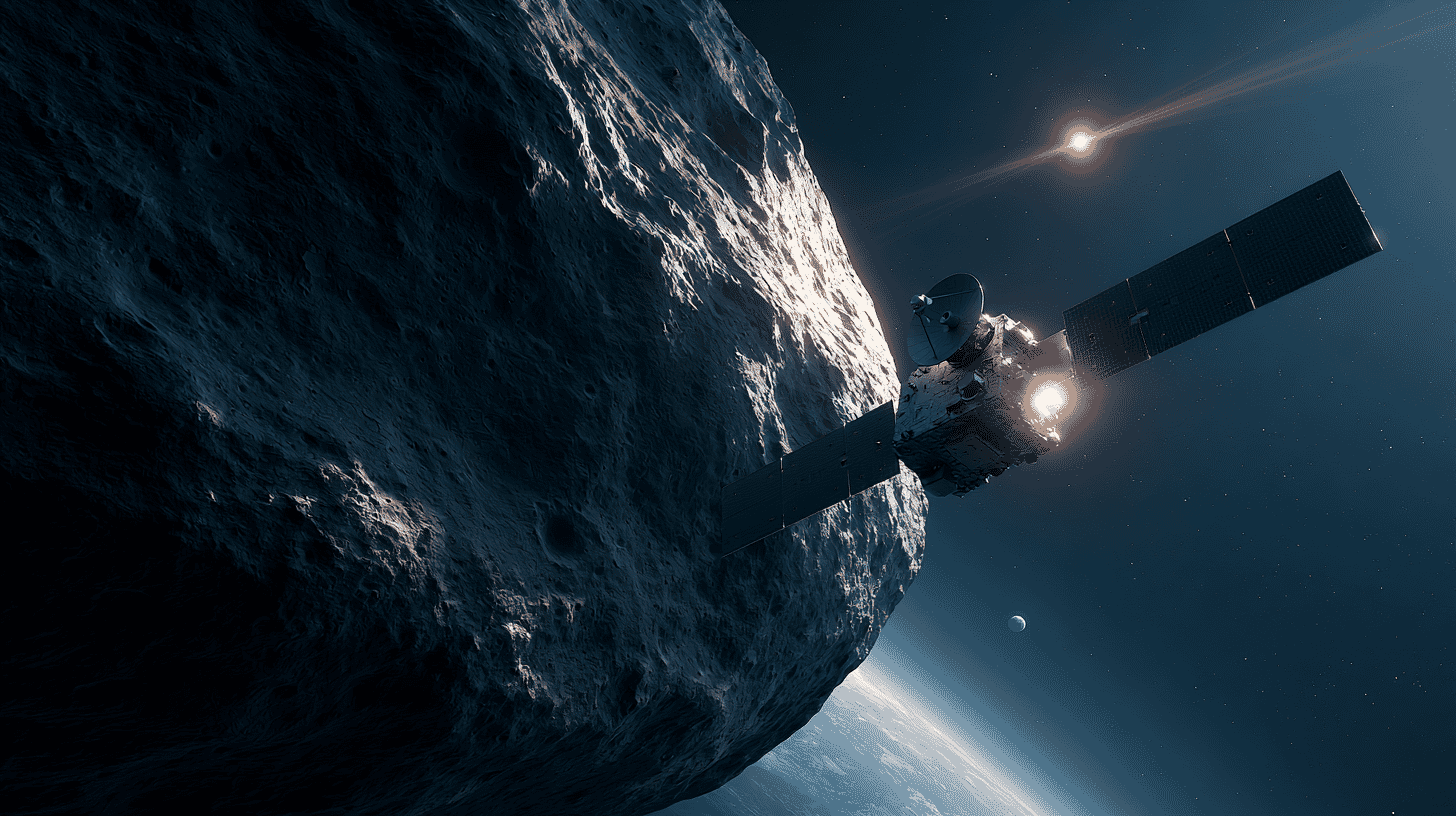
At around 6:30 p.m. Japan time, JAXA's Hayabusa2 threaded past asteroid Torifune at roughly 5 kilometers per second, passing just 800 meters from the center of a rock it had never seen up close. About 100 million kilometers from Earth, the veteran probe pulled off its first major operation since it dropped off samples from asteroid Ryugu in December 2020. And it did it with hardware its own engineers openly admit is running on borrowed time.
The flyby itself lasted an instant. The bigger story is why this spacecraft is still out there at all.
What actually happened on July 5
Hayabusa2 doesn't carry the long-range telescopes that dedicated flyby probes use. It was built to arrive at an asteroid and linger, the way it did at Ryugu. So to get anything useful out of a high-speed pass, it had to get dangerously close, close enough that a miscalculation could have ended the mission against a rock several hundred meters across.
It didn't miss. JAXA confirmed the spacecraft made its closest approach and passed safely, using a blend of camera-based and radio navigation sharpened with new guidance software. Most flybys in spaceflight happen hundreds or thousands of kilometers out. Slipping under a kilometer puts this one in world-leading territory.

Source: JAXA (Illustration: Akihiro Ikeshita)
What no one has seen yet is Torifune itself. The asteroid only grows larger than a single pixel in the probe's camera starting about a minute before closest approach, and the images take hours to a full day to reach Earth. "I want to check what kind of data we got," team lead Yuya Mimasu said on JAXA's official livestream, in the cautious tone of an engineer who knows the analysis is only beginning.
Update: On July 6, JAXA released the frame ONC-T captured one second before closest approach. Torifune looked nothing like the pre-flyby shape models: two lobes joined at a narrow neck, a form Mimasu compared to a snowman and most likely a contact binary. Boulders are visible on the surface, pointing to a pile of rubble rather than one solid block. All four science instruments (ONC-T, TIR, NIRS3, LIDAR) returned data, and the exact miss distance is still being worked out.
Why a "finished" probe is still flying
Here's the part that surprises people. When Hayabusa2 released its sample capsule over the Australian outback in December 2020, its main job was complete, but nearly half of its xenon fuel was still in the tank.
Rather than let a working spacecraft drift, JAXA rolled it into an extended mission called Hayabusa2# (pronounced "sharp"). The name is an acronym, Small Hazardous Asteroid Reconnaissance Probe, and also a bit of attitude: in English, sharp suggests doing something bold with hardware you already own.
That "already own" is the whole point. Building and launching a deep-space probe costs years and a fortune. Reusing one that is already out there with fuel in the tank delivers fresh science for a fraction of the price. The catch is age. Hayabusa2 launched in December 2014. Eleven-plus years later, three of its four ion engines have degraded badly, and the last working one is showing warning signs too. The craft is well past its design life.
Mimasu has called the extension an extra inning for a spacecraft everyone expected to retire. Every clean operation now is a bonus.
Torifune was never the destination
For all the drama of the flyby, Torifune is a waypoint, not the goal. It's a near-Earth asteroid, elongated, roughly 700 meters along its long axis, spinning once every five hours. Long thought to be a rare, ancient "L-type" body, it now looks like an S-type, the same family as Itokawa, the asteroid Japan's first Hayabusa visited. Confirming that is worth the trip on its own.
But the real prize is still five years away. After two Earth swingbys in December 2027 and June 2028 to reshape its orbit, Hayabusa2 is due to rendezvous in July 2031 with an asteroid called 1998 KY26. That target changed shape while the mission was being planned. Observations in 1998 pegged it at roughly 30 meters across, turning once every 10.7 minutes. When large ground-based telescopes revisited it in 2024 and 2025, those numbers fell to about 11 meters and a rotation of roughly five minutes: one third the size, spinning nearly twice as fast, and barely bigger than the spacecraft going to meet it. It turns so fast that centrifugal force wins out over its own feeble gravity. No spacecraft has ever matched orbits with something this small and frantic. If Hayabusa2 pulls it off, it's a world first, though the revision has forced a rethink of plans to fire a projectile at the surface or touch down.
This isn't just a stunt. Asteroids in the tens-of-meters range are the ones that slip through undetected and strike Earth every few centuries, flattening forests or worse. We know almost nothing about how they're built: solid rock, or a loose pile of rubble held together by a whisper of gravity? The answer decides how you would ever deflect one. Torifune's flyby proved Hayabusa2 can aim with the precision a deflection mission would demand.
The world has started reusing its space probes
Japan isn't alone in giving a retired probe a second life. NASA is doing something strikingly similar, and the comparison is instructive.
In September 2023, NASA's OSIRIS-REx dropped off samples from asteroid Bennu, its version of the Ryugu return. The spacecraft, still healthy and fueled, was promptly rechristened OSIRIS-APEX and pointed at Apophis, a stadium-sized asteroid that will pass within about 32,000 kilometers of Earth on April 13, 2029, closer than some of our own satellites. There the probe will settle into an 18-month study and even fire its thrusters at the surface to blow away dust and peek underneath.
The parallel is hard to miss. Two sample-return missions, two probes with fuel to spare, both redirected toward near-Earth asteroids that matter for planetary defense, the international effort to spot and, if necessary, nudge aside a rock on a collision course.
The two missions split the work rather than duplicate it. OSIRIS-APEX will park alongside a large, well-known hazard. Hayabusa2 is going after the small, fast, poorly understood end of the spectrum. There's even a name for the capability Japan is testing: "first recon," the idea of scrambling a probe that's already in space to intercept a newly discovered threat on short notice.
The American footing, however, shifts year to year. The administration's fiscal 2026 budget request listed OSIRIS-APEX for cancellation; in October 2025 NASA reversed course and Congress set aside roughly $20 million to keep it operating. The annual scramble hasn't gone away.
Europe is moving in the same direction. ESA formally committed to its Ramses probe at the November 2025 ministerial council and signed the spacecraft construction contract in February 2026, aiming for a spring 2028 launch and arrival at Apophis in February 2029, two months ahead of the flyby. It isn't purely European hardware, either: JAXA supplies the solar arrays and an infrared imager, and the launch rides on a Japanese H3. Three probes from Japan, the U.S., and Europe converging on the same problem is its own kind of statement.
A fleeting pass, a long game
The Torifune images will trickle in over the coming days, and researchers will spend far longer than that unpacking them. But in a sense the mission already succeeded the moment the probe slipped past unharmed. Seiji Sugita, a planetary scientist at the University of Tokyo, called the flyby an important result for "space disaster prevention," treating asteroid defense as a branch of the same field that plans for earthquakes and floods.
A probe used to have one mission and one ending. Now the good ones get a second act, chasing questions their builders hadn't set out to answer. Hayabusa2, limping along on one tired engine, is writing the playbook for it.
In Japan, a probe named by schoolchildren after a boat from mythology has become a source of pride across generations. How much do asteroid missions and planetary defense make the news where you live, and would you tune in to watch a spacecraft thread a needle 100 million kilometers away?
References
- https://news.yahoo.co.jp/articles/9b28fb718388627e0402d7bc5468e82d39040eb5
- https://www.isas.jaxa.jp/missions/spacecraft/current/hayabusa2.html
- https://www.hayabusa2.jaxa.jp/topics/20260624_torifune/
- https://osirisrex.arizona.edu/osiris-apex
- https://www.planetary.org/space-missions/osiris-apex
- https://www.jaxa.jp/press/2026/07/20260706-3_j.html
- https://www.nature.com/articles/s41467-025-63697-4
- https://www.esa.int/Space_Safety/Planetary_Defence/Ramses_ESA_s_mission_to_asteroid_Apophis







Global Discussion
4 comments