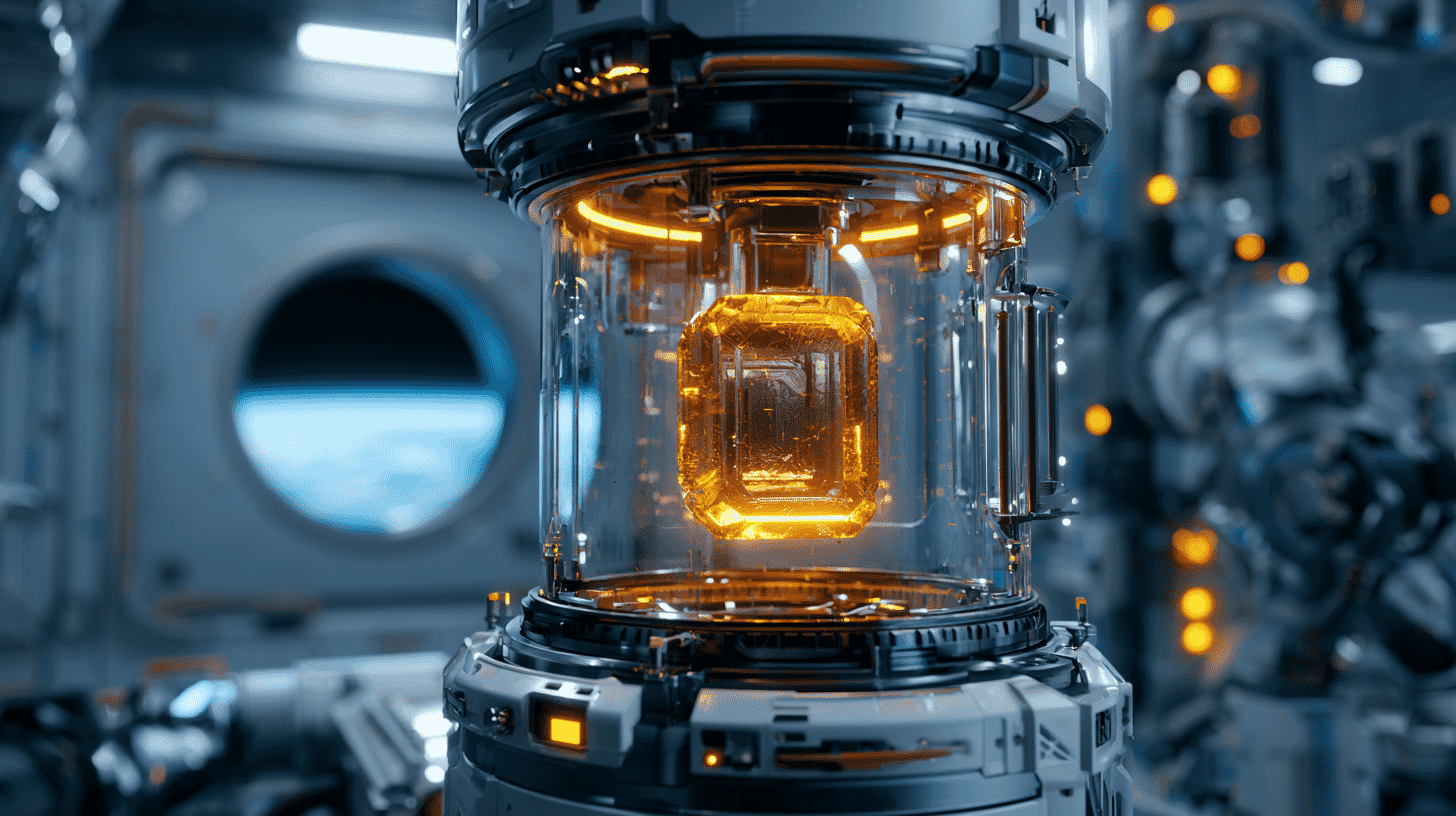
🛰️ Space seems like the last place you'd want to build something as fragile as a semiconductor. It's brutally expensive to reach, awkward to work in, and soaked in radiation. Yet a Japanese chemical giant just signed a deal to do exactly that, and its reasoning turns the whole problem inside out. Down here, gravity is ruining our best chips. Up there, that problem disappears.
Why gravity is the enemy of a flawless crystal
On June 25, 2026, Resonac, one of the world's biggest makers of semiconductor materials, announced a memorandum of understanding (MOU) with two startups, BEAM Technologies and Nippon LEO (Nihon Teikido Shachu), to build a business making semiconductors in low Earth orbit (LEO). The target: real production sometime after 2030.
The chips in question aren't the silicon ones in your laptop. They're compound semiconductors, made by fusing two or more elements, and far harder to grow cleanly than plain silicon. They run the laser diodes that shuttle data around AI datacenters, the power modules inside electric vehicles, the LiDAR sensors in self-driving cars, and the high-frequency guts of 5G and 6G phones. The research firm IMARC Group, which Resonac cites, puts the global market at $122.8 billion (roughly ¥18 trillion) in 2024, climbing to $177.0 billion (roughly ¥26 trillion) by 2033.
On Earth, growing a perfect crystal is sabotaged by gravity in three ways. Heat sets up convection currents that stir impurities in and scatter the dopants unevenly. The crystal's own weight presses down and warps its internal lattice, seeding the defects that limit how much voltage a finished device can take. And because the molten material sits in a container, the walls of that crucible bleed contamination into it, dragging down electrical performance.
In microgravity, all three largely vanish. No convection, no sedimentation, no weight bearing down. What's left is the chance to grow crystals purer and more uniform than any ground-based factory can manage. Resonac calls it an "ultimate environment."

Source: Resonac
Japan's odd trio: a materials giant, a lab spinout, and a station builder
The intriguing thing about this project is who's in it.
Resonac is the heavyweight, created in 2023 from the merger of Showa Denko and Hitachi Chemical, and a world leader in the "back-end" materials that package and protect finished chips. BEAM Technologies is a 2022 spinout from RIKEN, Japan's flagship national research institute; using its own crystal-growth methods it has pushed compound semiconductors such as AlGaN to world-class output, and it just closed about ¥220 million (~$1.4 million) in seed funding. Nippon LEO, founded in 2024, is building the "Japan Module," a slice of orbital infrastructure backed by a JAXA strategic fund, meant to dock with a commercial space station after 2030.
That timing is the whole point. The International Space Station is due to retire around 2030, and after that, low Earth orbit becomes a private-sector market. Japan wants a foothold there, and its pitch is to lead with what it does best: materials.
This isn't Resonac's first move off the planet, either. In 2025 it signed a separate MOU with the US company Axiom Space and began testing a chip-sealing resin on the ISS, a material designed to shield chips from the "soft errors" that cosmic rays cause when they flip bits at random. The through-line is a shift in ambition: from protecting chips in space to actually making them there.
The US and China are chasing the same orbit
Japan isn't alone, and the three big players are going about it in strikingly different ways.
In the United States, NASA has bankrolled in-space production for years through its In-Space Production Applications program. A cluster of private firms has grown up around it. United Semiconductors grows exotic crystals in orbit; Redwire built an autonomous chip-making platform, MSTIC, that flew to the ISS; and Space Forge, a British company now expanding into Florida, takes a wholly different tack: small, returnable satellites that go up, manufacture, and come back. Its first craft, ForgeStar-1, launched in June 2025 and struck plasma in orbit that December, a commercial first, but it carries no return mechanism and will burn up on reentry. The returnable version starts with ForgeStar-2. CEO Joshua Western estimates the seed crystals from a single flight could eventually yield 100 million chips. Much of this rides the political tailwind of the CHIPS Act and the push to re-shore American chip supply.
China's approach is more state-directed. Its Tiangong station, completed in 2022, runs materials-science racks that already grow semiconductor crystals and metallic glasses, and Chinese teams have logged hundreds of "containerless" levitation experiments since 2020. Beijing has also tested homegrown chips in orbit: the terrestrial chip rivalry, extended into space.
Against that backdrop, Japan's bet is narrower and more deliberate: not chips in general, but compound semiconductors specifically, played through a materials company's strengths and a home-grown orbital platform.
The catch: this is a memo, not a factory
It's worth staying grounded. What Resonac announced is an MOU, an agreement to explore, not a production line. The target is "after 2030," which in space terms is both soon and very far away.
The hard questions are all about money. Lifting mass to orbit and hauling product back is a punishing overhead. For space-grown chips to pencil out, customers would have to pay a premium big enough to swallow the launch bill. Western's 100-million-chip figure is extrapolated from the assumption that each space-grown seed can be copied for about ten generations before quality decays, a business case on paper. The underlying science of microgravity manufacturing is still young. None of the three countries has yet proven the economics at commercial scale.
What's real is the direction of travel. For years the semiconductor race has been about shrinking transistors: 3nm, 2nm, and onward. In-space manufacturing is a different axis entirely: not smaller, but grown cleaner, somewhere gravity can't reach. Whether it becomes an industry or an expensive footnote, Japan, the US and China have all decided it's worth finding out.
In Japan, "made in space" is starting to sound less like science fiction and more like a supply-chain strategy. Is anyone in your country talking about manufacturing in orbit, and would you trust a chip that was grown off the planet?
References
- https://www.resonac.com/jp/news/2026/06/25/3869.html
- https://eetimes.itmedia.co.jp/ee/articles/2607/01/news049.html
- https://prtimes.jp/main/html/rd/p/000000004.000147216.html
- https://spacenews.com/space-forge-and-united-semiconductors-to-collaborate-on-space-based-semiconductor-manufacturing/
- https://www.factoriesinspace.com/united-semiconductors
- https://spaceodysseyhub.com/articles/china-tiangong-space-station-2026







Global Discussion
0 comments