
🛰️ Space is turning into a place that needs delivery vans, tow trucks, and gas stations. Newly launched satellites need a ride to their final orbit. Dead ones need hauling out of the way. Aging ones need refueling. An entire logistics industry is forming tens of thousands of kilometers above our heads, and on June 10, Japan's Mitsubishi Electric announced it was joining in. The twist: it's arriving late, to a race the United States already dominates and China is treating as a strategic asset. The interesting question isn't whether Japan can build the hardware. It's how you enter a contest you're already behind in.
The orbital economy needs movers
For decades, a satellite's life was simple in one cruel respect: a rocket dropped it off, and that was the last help it ever got. Wrong orbit? Too bad. Out of fuel? It became junk. That model is breaking down. With tens of thousands of satellites heading up this decade, operators increasingly want what every other industry takes for granted: a way to shuffle cargo around after delivery, top up the tank, and clear away the wreckage.
The machine at the center of all this is the orbital transfer vehicle, or OTV: a small, nimble spacecraft that picks up a payload in one orbit and carries it to another. Analysts put the OTV market at roughly $2 billion in 2026, climbing past $5 billion by the early 2030s. North America accounts for close to half of it. That lopsided map is the backdrop for Japan's move.
What Japan just put on the table
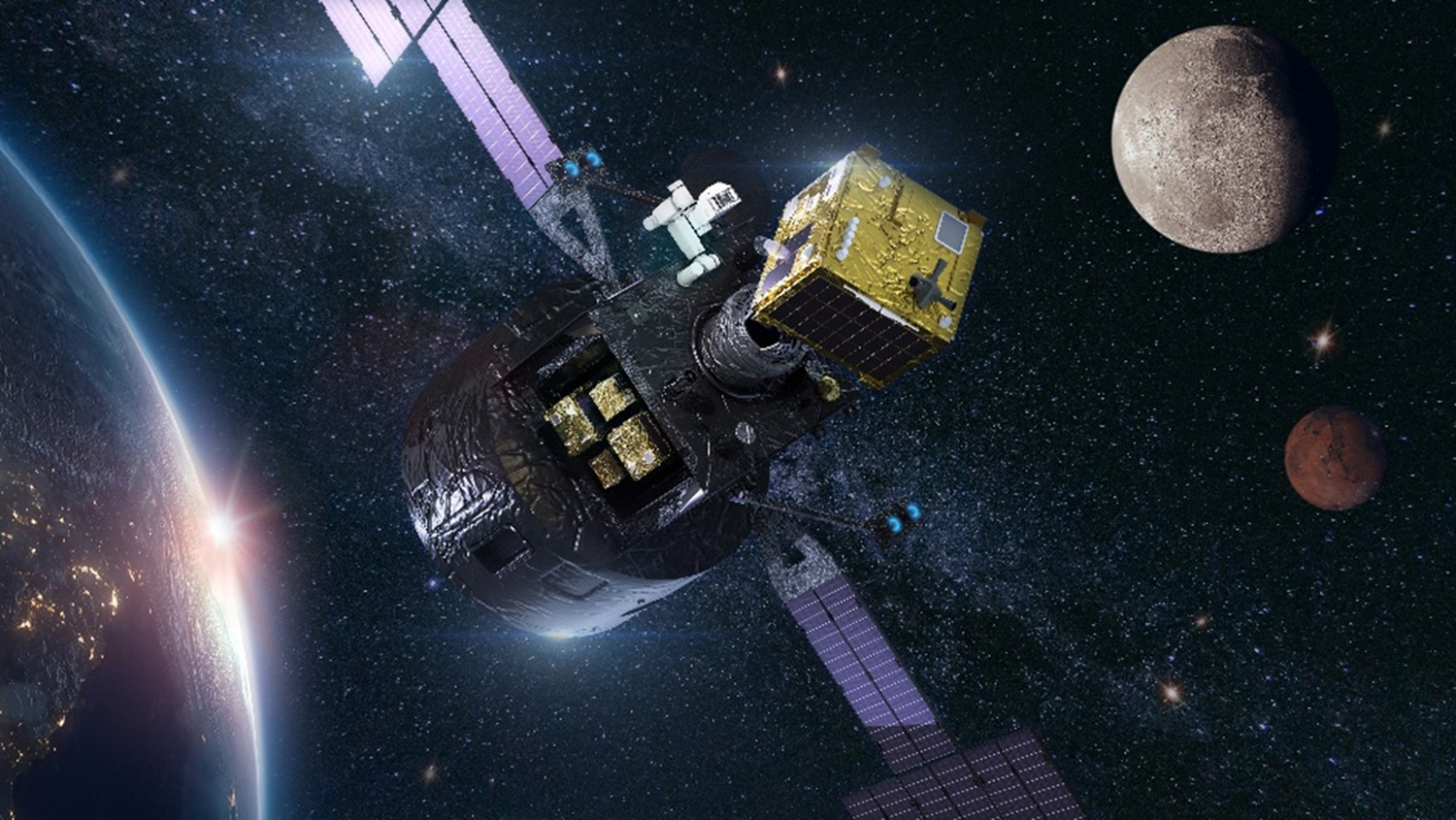
Mitsubishi Electric said it had been chosen as the lead organization for an OTV project under JAXA's Space Strategy Fund, a pot of government money pooled across several ministries and meant to push Japanese companies into frontier space markets. The plan is a vehicle that can ferry satellites and other cargo between orbits, load and release them in space, and do so without being locked to one fixed route or one customer.
Source: Mitsubishi Electric
Two technical pieces sit at the core. The first is trajectory planning that squeezes propellant use, the orbital version of plotting the most fuel-efficient delivery route across a city. The second is autonomous RPOD, short for rendezvous, proximity operations and docking. Using what Mitsubishi calls "physical AI", software that controls real movement in the physical world, plus robotics, the craft is meant to approach, grab, and let go of its cargo on its own, rather than being flown by a human on a joystick from the ground. For now this is a development-and-demonstration program. Japan is proving the idea works, not selling rides.
America already owns the fast lane
To see what Japan is up against, look at Impulse Space. Founded in 2021 by Tom Mueller, the engineer behind the engines that power SpaceX's Falcon 9, it has flown its Mira vehicle, a dishwasher-sized craft that carries up to 300 kilograms of payload, three times between November 2023 and November 2025. Its bigger Helios stage is sold as "same-day delivery" to high orbit, with a first flight now slated for 2027: five tons and up hauled from low orbit to geostationary in under 24 hours, against the six to nine months that gentler electric propulsion can take.
Impulse is not short of customers, either. It has a multi-launch agreement with satellite operator SES, NASA contracts to study cheaper paths to hard-to-reach orbits, and a 2026 demonstration with defense company Anduril to maneuver autonomously around objects in geostationary orbit. America's pitch is speed, price, and a launch system, SpaceX, that nobody else can rival on sheer cadence. That is the wall Japan is staring at. The US also already has an operating example: Northrop Grumman's Mission Extension Vehicles have docked with and prolonged the life of working communications satellites.
China's tow trucks come with a shadow
China is in the race too, but its version means something else. In early 2022, a spacecraft called Shijian-21 crept up on a dead Chinese navigation satellite, docked with it, and dragged it to a "graveyard" orbit thousands of kilometers above the crowded geostationary belt. Between June and July 2025, another craft, Shijian-25, is believed to have closed in on Shijian-21, docked, and refueled it in orbit. China never confirmed it; commercial space-tracking firms inferred the docking from optical data, with two US surveillance satellites watching from either side.
On paper, this is housekeeping: tidying debris, stretching satellite lifespans. But the exact same skills, sidling up to another spacecraft, grabbing it, moving it, are what you would need to disable an adversary's satellite. Western analysts treat China's program as dual-use, and its lack of transparency feeds the unease. Orbital logistics, it turns out, is also turning into a contest with real military stakes.
Japan's bet: the unglamorous superpower of docking
So Mitsubishi isn't trying to out-muscle Impulse on cost or out-sneak China on stealth. Its edge is something less flashy and much harder to fake: a long track record of making spacecraft meet in orbit, gently and precisely, again and again.
For more than a decade, Japan's Kounotori cargo freighter (the HTV) guided itself to within arm's reach of the International Space Station so the crew could grapple it: automated, accurate rendezvous, repeated mission after mission. Its successor, HTV-X, carries that lineage forward. Add the pinpoint touchdown of the SLIM Moon lander and the navigation work behind the Mars-moons MMX mission, and you get a company that has spent years building real credibility in the one thing space logistics actually hinges on: precise, autonomous close-up operations. The fuel-efficient routing and self-docking cargo handling Mitsubishi is now promising are extensions of that pedigree, not a leap out of nowhere.
There's a second layer. Japan is already home to Astroscale, a Tokyo company widely regarded as a world leader in the servicing half of this market, the one that pulled off the first close approach to a real, uncooperative chunk of large debris. Put the two together and Japan's strategy sharpens into view: not a frontal charge at the bulk-transport business the US owns, but a play for the harder, servicing-flavored end of orbital logistics, where careful proximity work counts for more than raw speed or rock-bottom price.
Who gets to run the roads of space?
The stakes run deeper than one company's product line. Whoever builds the trucks, tugs, and fuel depots of orbit helps decide who can operate up there, how cheaply, and on whose terms. Which is why three very different bets are on the table at once: speed and price, military leverage, and hard-won technical credibility.
Whether a big, methodical company like Mitsubishi can move at startup pace is a fair question, and government money only carries a project so far. But "late and careful" has worked out for Japanese industry before.
In Japan, the conversation about space is shifting from launching things to managing what's already up there. How is your country thinking about the traffic jam forming overhead?
Note: after months docked together, Shijian-25 and Shijian-21 separated, and trackers reported the pair had exited proximity operations by mid-January 2026.







Global Discussion
3 comments