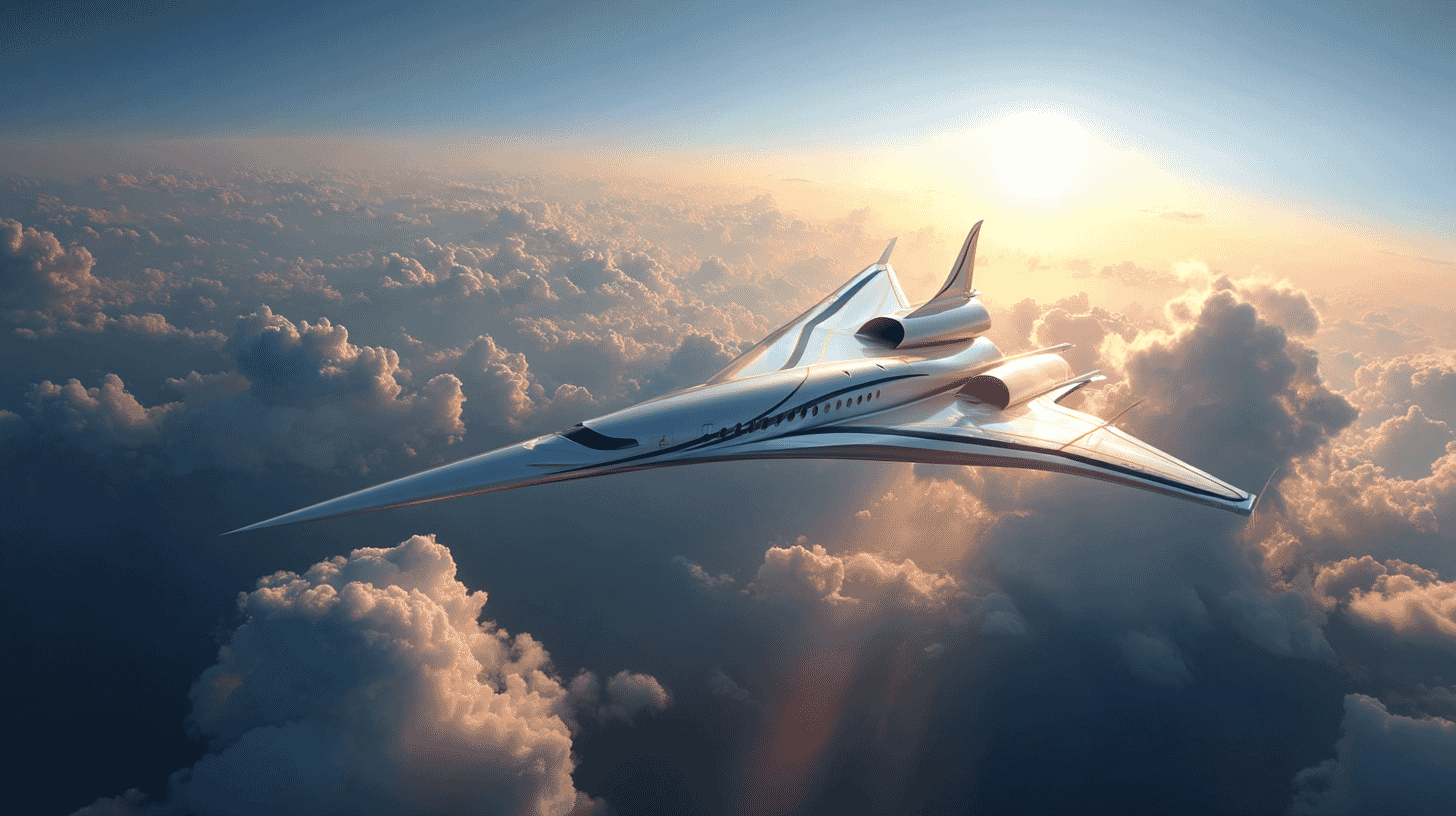
It's been over 20 years since Concorde retired in 2003. The dream of supersonic passenger travel, grounded by "thunderous" sonic booms, is being revived by Japanese technology. JAXA's "quiet supersonic aircraft" is designed to reduce sonic boom noise by more than half. With flight tests scheduled for 2028, the full picture is now emerging.
JAXA's Vision for a "Quiet Supersonic Aircraft"
In January 2026, JAXA (Japan Aerospace Exploration Agency) unveiled the latest concept images of its next-generation supersonic passenger aircraft. The design is based on conceptual work funded by NASA and others, enhanced with JAXA's proprietary "Robust Low-Boom Design Technology." The aircraft is envisioned as a small supersonic airliner carrying approximately 50 passengers.
The concept images reveal a distinctively elongated, needle-like nose and wings with complex curved surfaces. This isn't mere aesthetics, it's a scientifically calculated shape designed to control airflow and transform the ground-level sound from a thunderous "boom" into a muffled "thump."
Why Concorde Failed
When thinking of supersonic passenger aircraft, many recall Concorde, the Anglo-French marvel that operated from 1976 to 2003. Flying at Mach 2, Concorde could cross the Atlantic from Paris or London to New York in just 3.5 hours.
However, Concorde faced a fatal flaw. The "sonic boom", shockwaves generated during supersonic flight, created explosive sounds on the ground, leading to bans on supersonic flight over land. Combined with poor fuel efficiency, Concorde's routes were limited to oceanic crossings like the transatlantic route, and it ultimately retired without achieving commercial success.
Understanding Sonic Booms
When an aircraft exceeds the speed of sound, shockwaves form around various parts of the airframe. As these waves propagate through the atmosphere, they merge and create a sudden pressure variation known as an "N-wave" at ground level. To human ears, this sounds like a nearby lightning strike or a large firework explosion.
Crucially, sonic booms occur not just when breaking the sound barrier, but continuously throughout supersonic flight. A strip-shaped area called a "boom carpet" forms beneath the flight path, where the shockwave constantly reaches the ground.
Japan's Unique "Robust Low-Boom Design Technology"
JAXA began supersonic aircraft research in 1997 and has achieved several major milestones since then.
In 2005, JAXA conducted flight tests of the small supersonic experimental aircraft "NEXST-1" in Australia, demonstrating a 13% reduction in aerodynamic drag compared to Concorde. In 2015, the "D-SEND (Drop test for Simplified Evaluation of Non-symmetrically Distributed sonic boom)" project conducted flight tests in Sweden, becoming the first in the world to demonstrate technology capable of reducing sonic boom intensity to half that of Concorde.
The current "Re-BooT (Robust Low-Boom Supersonic Transport Design Technology Demonstration)" project advances this technology further. While previous approaches focused on reducing sonic booms directly beneath the flight path, Robust Low-Boom Design Technology achieves noise reduction across the entire boom carpet, including off-track positions and during acceleration climbs. This technology is patented domestically and internationally, representing a significant advantage for JAXA.
Flight Tests Planned for 2028
The Re-BooT project plans to conduct flight tests around 2028. The demonstrator will be an unmanned aircraft approximately 10 meters in length. While it won't carry an actual engine, its shape will allow evaluation of sonic boom waveforms equivalent to those of a passenger aircraft.
During testing, the demonstrator will be carried by a piloted "mother aircraft" to an altitude of approximately 13 kilometers before separation. The demonstrator will then accelerate to supersonic speeds through gravity, flying under autonomous computer control while ground-based measurement systems record the sonic boom data.
JAXA plans to present its findings to ICAO (International Civil Aviation Organization) to contribute to the development of international noise standards for supersonic aircraft. Standards are expected to be determined at the 2031 ICAO Assembly, which would create an environment where companies can begin developing commercial aircraft.
The Global Supersonic Race
Japan isn't alone in pursuing supersonic passenger travel. In the United States, NASA and Lockheed Martin's jointly developed "X-59" completed its first flight in October 2025. Though using a different approach than JAXA, the X-59 aims for the same goal of demonstrating "quiet" sonic technology.
Update: The X-59 broke the sound barrier for the first time on June 5, 2026, reaching Mach 1.1 at about 43,400 feet on an 81-minute flight out of Edwards Air Force Base in California. A week later, on June 12, it flew at Mach 1.4 and 55,000 feet, the mission conditions it was designed for. After months of further performance testing, NASA plans to fly it over several U.S. communities and survey residents on how they perceive its quiet sonic thump. Those responses are intended to feed the same ICAO standard-setting process JAXA is aiming at.
Additionally, American startup Boom Supersonic is developing "Overture," a supersonic airliner designed for oceanic routes only, targeting commercial operations in the 2030s.
Technologies from Japan, the United States, and other nations are competing and collaborating to accelerate development toward "quiet supersonic aircraft." JAXA's Project Manager Yoshikazu Makino predicts that quiet passenger aircraft with sonic boom reduction technology could begin operations "as early as the 2040s."
The Future Supersonic Travel Promises
Current passenger aircraft cruise at approximately Mach 0.8, requiring over 12 hours to travel from Japan to Europe or North America. Supersonic aircraft could cut this to about 6 hours, energizing business and tourism while enabling faster emergency response during disasters. Flight times under 6 hours would also reduce the risk of deep vein thrombosis (economy class syndrome).
JAXA's envisioned small supersonic airliner would cruise at Mach 1.6, carry 50 passengers, and have a range exceeding 6,300 kilometers. The day when Tokyo connects to Hawaii or Singapore at supersonic speeds may not be far off.
Japan's JAXA is working to break through the "noise barrier", a challenge for the aviation industry since the Concorde era, using proprietary technology. While building cooperative relationships with NASA, Japanese innovations may contribute to setting global standards.
What discussions are happening about supersonic aircraft in your country? Would you want to travel internationally on a supersonic jet in the future?
References
- https://www.aero.jaxa.jp/research/frontier/sst/reboot.html
- https://www.aero.jaxa.jp/research/frontier/sst/
- https://fanfun.jaxa.jp/jaxas/no097/04.html
- https://www.nasa.gov/mission/quesst/
- https://www.nasa.gov/aeronautics/x-59-first-supersonic-flight/
- https://www.nasa.gov/blogs/quesst/2026/06/12/x-59-blog-061226/



Global Discussion
15 comments