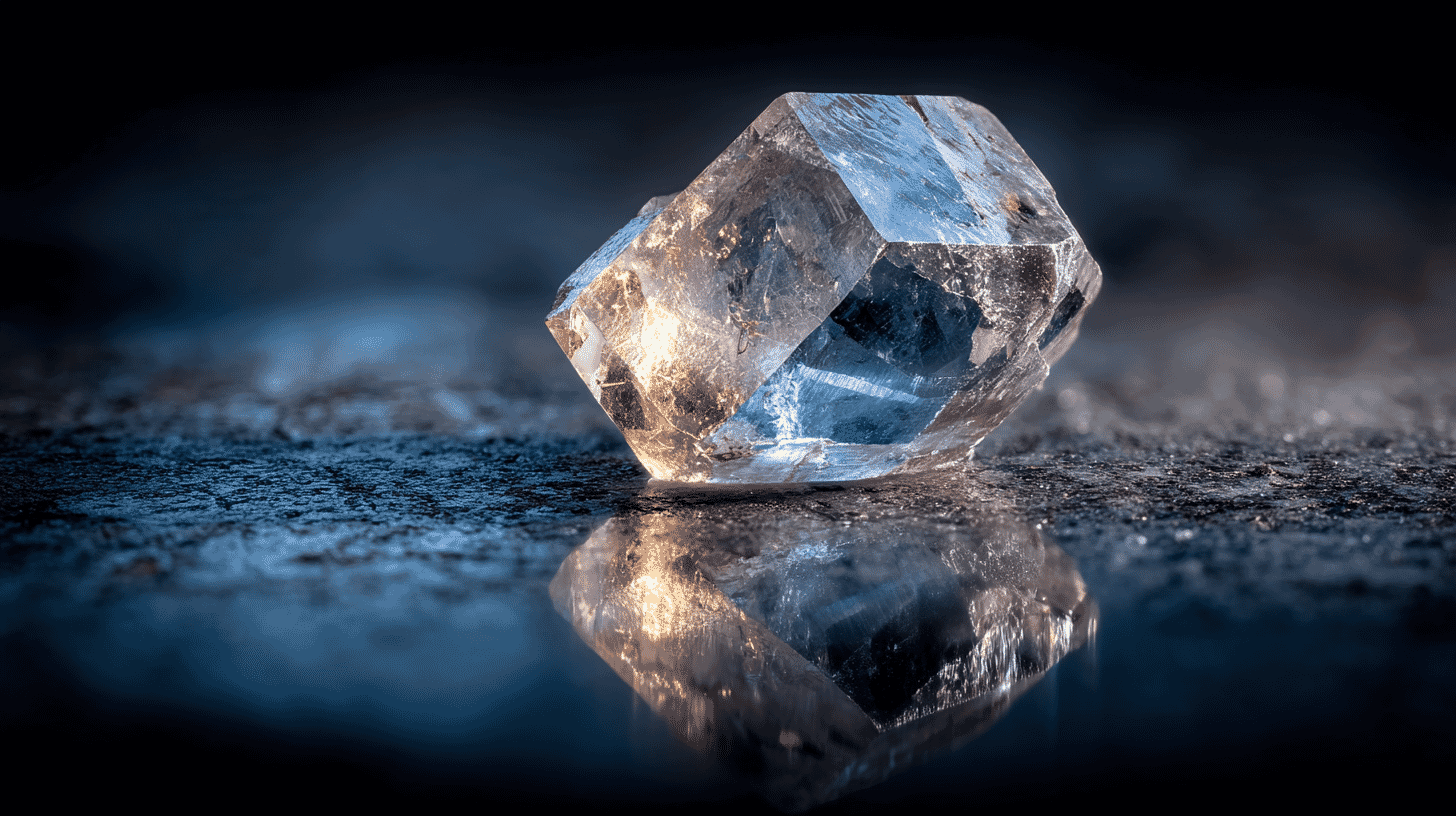
🧬 Almost every amino acid in your proteins is left-handed, even though its right-handed twin is made of the same atoms and ordinary chemistry produces the two in equal amounts. On October 5, 2026, a Japan-US team described a device that tells the two apart one molecule at a time. Two days later, the chemistry Nobel was awarded for work showing how such a bias can arise.
A mirror is all it takes
Your left and right hands have the same shape, but you can't lay one exactly on top of the other. Many molecules work the same way. Chemists call them chiral and label the two versions of an amino acid L and D.
Of the 20 amino acids that build proteins, 19 come in both forms. The odd one out, glycine, has no handedness at all. Life uses the L form almost exclusively. For sugars it is the reverse: the sugars in DNA are the D type.
Chemistry on its own shows no preference. For a long time, whenever chemists ran reactions that could make either mirror image, they got equal amounts of both. In 1857, Louis Pasteur noticed that bacteria would ferment one form of tartaric acid and leave the other untouched.
Scientists call life's one-handedness homochirality. How it started is still unknown.
A Nobel for tipping the balance
On October 7, 2026, the Royal Swedish Academy of Sciences awarded the Nobel Prize in Chemistry to Henri B. Kagan, professor emeritus at the former Université Paris-Sud, and Kenso Soai of Tokyo University of Science, "for the discovery of non-linear effects and autocatalysis in asymmetric organic synthesis." Heiner Linke, chair of the Nobel Committee for Chemistry, said the pair had answered a chemical riddle more than a century old: how one-handedness can appear on its own.
Kagan made the first decisive move in 1986. He found that a catalyst containing a mix of both mirror forms could push its product further toward one form than anyone had assumed possible.
Soai built on that. In 1995 he reported a molecule that speeds up the very reaction that makes more of itself. Starting with a 2% excess of one form, the reaction ended with an 87% excess. In 2003, starting from ingredients with no handedness at all, he showed a tiny random excess appearing and then taking over, until one form made up as much as 99.99% of the product. Run the reaction again and the other form could win instead. Chance picks the hand, and the chemistry amplifies it.
The prize does not explain why life is left-handed, and the people involved say so. The Academy's own popular-science explainer notes that the Soai reaction is artificial and differs from the chemistry of life, and that labs are now trying to do the same with amino acids and sugars. At a press conference at his university, Soai said the mystery has not been completely solved and that fascinating parts of it remain unknown.
Soai is Japan's 10th chemistry laureate and the second in a row, after Susumu Kitagawa in 2025. Ryoji Noyori shared the 2001 prize for asymmetric synthesis, so this corner of chemistry is a Japanese strength.
The answer from space that hasn't come
If the bias didn't start on Earth, perhaps it arrived from space. Meteorites carry amino acids, and earlier analyses reported L-excesses above 30% in some of them.
For common protein amino acids like alanine and serine, the authors of the new paper write that those results are now widely put down to contamination picked up on Earth. Cleaner samples, scooped straight from asteroids and sealed, told a different story. Japan's Hayabusa2 brought back material from asteroid Ryugu, and in February 2023 JAXA reported that its amino acids came in left and right forms at roughly one to one. NASA's OSIRIS-REx did the same for asteroid Bennu, and in January 2025 NASA reported an equal mix there too.

Source: NASA Goddard/OSIRIS-REx
In 2009, Danny Glavin and Jason Dworkin of NASA Goddard reported an 18.5% left-handed excess of isovaline, an amino acid that proteins don't use, in the Murchison meteorite, and ruled out contamination. Glavin told Space.com that Bennu's result felt like it had invalidated 20 years of his lab's research. Space is not short of organic chemistry, as a team led by a Japanese researcher showed when it found one of the largest sulfur-bearing organic molecules yet seen between the stars. What the cleanest samples have not shown so far is a preference for one hand.
Can a bias be a fingerprint?
If nonliving chemistry in space comes out even, then a strong tilt found somewhere else would be a clue worth chasing. That is why a tilt toward one form, which chemists call enantiomeric excess, has been proposed as a biosignature. One threshold cited in the paper is an excess of more than 20% across several amino acids.
The Soai reaction complicates this in two ways. It shows that nonliving chemistry can also build a strong tilt. And if the hand is picked by chance, life that began independently somewhere else could just as easily have gone right. Researchers developing instruments for Jupiter's moon Europa have written that any life there would likely be a separate genesis from Earth's. So a detector cannot simply check for L. It has to read both hands.
Osaka University's release also says a bias alone cannot prove life and has to be weighed with other measurements.
Reading one molecule at a time
The team behind the new device, led by associate professor Takahito Ohshiro and professor Masateru Taniguchi at SANKEN (Institute of Scientific and Industrial Research), Osaka University, worked with Georgia Institute of Technology, NASA Goddard Space Flight Center, the University of Chicago and MIT. The paper appeared in Nature Communications (vol. 17, article 10274).
The heart of it is two gold electrodes held 0.56 to 0.58 nanometers apart. When a single amino acid drifts into that gap, a faint quantum tunneling current flows, and the shape of that signal carries a signature of the molecule. Machine learning reads the waveform and decides which amino acid it is, and whether it is L or D.
The standard lab method, liquid chromatography-mass spectrometry (LC-MS), analyzes huge numbers of molecules at once in large instruments. The nanogap needs no optics, no fluorescent labels and no chiral recognition molecules to sort the two forms, so it is easier to shrink.
In lab tests on purified amino acids, individual L and D forms were told apart with over 80% accuracy. Across 19 L/D pairs the average F1 score, a standard measure of classification accuracy, was 0.876. In a blind test covering all 39 amino acids, it named both identity and handedness more than 50% of the time, well above random chance. Mixtures of four amino acids were quantified with above 66% accuracy.
Then came real samples: a 2-gram piece from inside the Murchison meteorite, which fell in Australia in 1969, provided by the Smithsonian National Museum of Natural History, and soil from two sites in Chile's Atacama Desert, a widely used stand-in for the surface of Mars. Working from a target list of 11 amino acids (glycine plus both forms of five others, without isovaline), the device picked up the main features that LC-MS found. The fine detail is weaker. For Murchison, the D/L ratio of aspartic acid matched LC-MS, but alanine and valine did not. The authors say it should be read as targeted identification, not absolute quantification. The test checked agreement with LC-MS; it was not a hunt for a cosmic bias.
"On a spacecraft" is still a plan
Osaka's release describes the work as groundwork for a compact instrument that could fly on space probes. As of October 2026, no mission has selected it. The paper mentions NASA's Enceladus Orbilander and Europa Lander, but both are mission concepts, cited only to frame requirements such as detection limits and heat tolerance.
The paper lists funding from the Japan Science and Technology Agency (JST) and NASA, and Osaka University says the work was part of NASA's PICASSO program, which supports early-stage planetary instruments. Christopher Carr of Georgia Tech, a co-author, has proposed a related concept called ELIE, the Electronic Life-detection Instrument for Enceladus/Europa, with Taniguchi and Ohshiro among his co-authors. A 2021 abstract set a target of about 1 kilogram for a flight version.
What still stands between the lab bench and a launch pad, according to Osaka's release, is a long list: complex samples full of unknown substances, contamination control, better quantification, and testing under real space conditions.
Suppose a probe one day finds amino acids on an icy moon tilted firmly to the right. What would it take to convince you that you were looking at a second origin of life rather than a chemical fluke?
References
- https://doi.org/10.1038/s41467-026-77947-6
- https://prtimes.jp/main/html/rd/p/000000006.000146621.html
- https://www.nobelprize.org/prizes/chemistry/2026/press-release/
- https://www.nobelprize.org/prizes/chemistry/2026/popular-information/
- https://www.wunc.org/2026-10-07/henri-b-kagan-and-kenso-soai-win-nobel-prize-in-chemistry
- https://www.kobe-np.co.jp/opinion/202610/0020908644.shtml
- https://www.hokkaido-np.co.jp/article/1385715/
- https://global.jaxa.jp/press/2023/02/20230224-1_e.html
- https://www.nasa.gov/news-release/nasas-asteroid-bennu-sample-reveals-mix-of-lifes-ingredients/
- https://www.space.com/the-universe/asteroids/nasa-finds-key-molecules-for-life-in-osiris-rex-asteroid-samples-heres-what-that-means
- https://www.ncbi.nlm.nih.gov/pmc/articles/PMC2667035/
- https://doi.org/10.1089/ast.2022.0119
- https://doi.org/10.1002/essoar.10506997.1
- https://science.nasa.gov/planetary-science/programs/pesto/picasso/




Global Discussion
4 comments