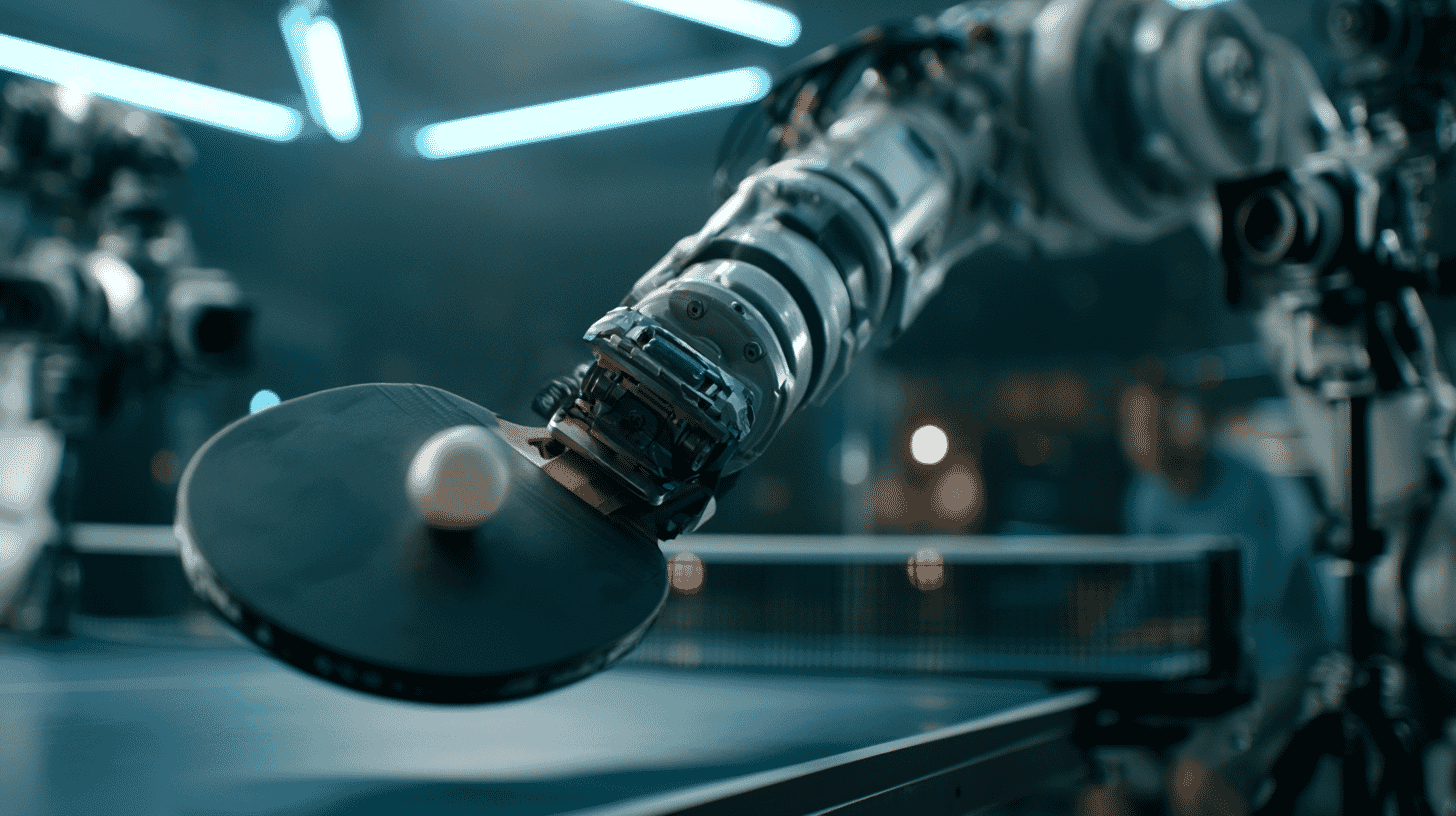
🏓 Chess. Go. StarCraft. For decades, every time an AI "beat humans," the battlefield was a board or a screen. Sony AI just moved the fight onto a table, where a robot reads the spin on a ball it has milliseconds to judge, hits it back, and beats players with national-tournament records. Not a brain game. A body game. Here's how a machine learned to keep pace with the fastest reflexes humans have.
The genius that lived inside the screen
Artificial intelligence has been superhuman in digital worlds for a long time. It cleared Atari games, then chess, then Go, then the sprawling chaos of StarCraft II. In 2022, Sony AI's own agent, Gran Turismo Sophy, beat the world's best drivers in the racing simulator Gran Turismo. But none of it ever touched the real world.
That was always the catch. Everything happened behind glass. So Sony AI's robotics team set itself a goal that is easy to say and brutal to deliver: take that kind of intelligence out of the simulation and put it in a room, against a person, with a real ball.
They chose table tennis, and the choice wasn't random. Roboticists have been chasing a ping-pong-playing machine since the first "robot table tennis" contest back in 1983. The sport packs everything hard about the physical world into a few square meters: a ball that arrives in milliseconds, spin that bends its path, and an opponent who never repeats the same shot twice. To play it, a machine has to see, predict, decide, and swing, all inside the blink of an eye.
A quiet advantage runs underneath the project. Sony AI is the research arm of Sony Group, and the cameras at the heart of this robot use image sensors from Sony Semiconductor Solutions, the same business whose chips sit inside a large share of the world's smartphone cameras.
Rallies were easy. Winning wasn't.
Here is why the table is so unforgiving for a robot. A ball can leave a paddle spinning dozens of times per second, and that spin secretly dictates where it goes. Misread it and your return sails long or dives into the net. Earlier robots could trade gentle, cooperative rallies, back and forth with nobody trying to win, but a competitive match, where the other side is actively hunting for your weakness, was another universe entirely.
The clearest marker of how hard this is came from Google DeepMind. In August 2024, its robotics team published the first robot to reach what it called a "solidly amateur" human level. Across 29 games against players of mixed ability, the robot won 45%. It beat every beginner it faced and took 55% of its games against intermediate players. But against advanced players, it lost every single match. The paper was refreshingly honest about why: the system struggled most with fast balls, hamstrung by latency: the lag between seeing and reacting.
So the wall had a name. Speed and spin, at the level where good players actually live.
Building an eye out of sensors
Sony attacked that wall from an unusual direction: hardware. Rather than leaning mainly on cleverer software, the team gave its robot, named Ace, an extraordinary set of eyes. Nine cameras track the ball's exact position in three dimensions. A separate trio of gaze-control units, built around event-based vision sensors (chips that fire only when a pixel changes, with microsecond timing), measure the ball's spin in real time. Sony AI says no other system can read the spin of an unmodified, regulation ball this fast.
Then there is the number that makes engineers blink. Ace's end-to-end latency, from seeing to deciding to moving, is 20.2 milliseconds. An elite human player's is roughly 230. Ace is not stronger or faster on the swing; its reach and pace are deliberately kept close to human. What it has is a nervous system more than ten times quicker.
The mind behind the eyes is a control system trained with model-free reinforcement learning: no library of pre-scripted shots, just a policy that learned to react by playing. (During simulation the engineers leaned on a trick they call a "privileged critic," which could peek at perfect information about the ball and grade the robot's choices against it.) All of it rides on an eight-joint arm mounted on a base that glides across the floor.
That is the split worth noticing. DeepMind tried to out-think the fast ball with policy architecture. Sony tried to out-see it with its own silicon. Same wall, opposite tools.

Image: Sony AI, via JST Science Portal
Beating the elite, but not the pros
In April 2025, in Tokyo, Ace played its milestone matches under International Table Tennis Federation rules, scored by licensed umpires from the Japan Table Tennis Association. On the far side of the net stood five elite players, each with more than a decade of experience, national-tournament records, and around 20 hours of practice a week, plus two active pros from Japan's professional league.
Against the elite five, Ace won three of five matches. It returned shots loaded with up to 450 radians per second of spin while holding its return rate above 75%, far past anything earlier competitive robots had managed. It served 16 clean aces against the elite players, who managed only 8 between them, Its own racket tip swings at up to 19.6 meters per second, roughly 70 km/h.
And then the honest part: against the two professionals, Ace lost both matches. That is the line the headlines tend to skip. Ace crossed into elite-competitive territory; it did not become unbeatable.
But the trajectory matters more than any single scoreline. The Nature paper landed on the cover of issue 8110 on April 22, 2026, yet Sony kept playing after submitting it. In December 2025, Ace beat two more elite players and, against two pros, won one match and lost the other: its first victory over a professional. By March 2026, against three new pros, it took at least one game off each of the three. The matches kept getting faster, the placement more aggressive. The curve is still bending upward.
What lives outside the table
Strip away the spectacle and the point is not really "robot beats human." It is that a machine perceived, planned, and acted at the ragged edge of human reaction time, in a real room, near a hard obstacle, against an opponent doing its best to fool it, and held its own.
That is what Sony AI keeps pointing at. The team's president, Michael Spranger, has said the aim was to prove AI doesn't only exist in virtual spaces, that you can have a physical experience with it, now. Chief scientist Peter Stone has called the result a milestone that reaches well beyond table tennis. The research points toward any setting that demands split-second sensing and control: manufacturing lines, service robots, machines that work close to people. The same techniques that returned a 450-rad/s serve are the kind you would want in a robot sharing your physical space.
It is a calmer story than "humans dethroned," and a more interesting one. For more than forty years the table was the test. Something finally passed it.
In Japan, table tennis is a schoolyard staple and a serious national sport at once, which makes a machine that can rally with you feel slightly uncanny. Where you live, would you want that robot across the net as a rival, or on your side of it, as a practice partner?
References
- https://ai.sony/news/project-ace-press-release
- https://scienceportal.jst.go.jp/newsflash/20260511_n01/
- https://www.nature.com/articles/s41586-026-10338-5
- https://ai.sony/blog/inside-project-ace-discover-the-robot-athlete-that-competes-with-professional-table-tennis-players
- https://techcrunch.com/2024/08/08/google-deepmind-develops-a-solidly-amateur-table-tennis-robot/









Global Discussion
4 comments