
💧 Here is something most people never hear until it happens to them: one of the gentlest ways to treat kidney failure comes with a hidden expiration date. Peritoneal dialysis lets patients clean their blood at home, without being tethered to a machine three days a week. But after a few years the body part it relies on simply wears out, and there is no way to fix it. A team in Japan has now grown, from iPS cells, the exact cells needed to patch it back up. So far it works in mice.
Two ways to clean the blood
When the kidneys stop filtering waste, a person needs dialysis to stay alive, and there are two main routes.
The familiar one is hemodialysis (HD), where blood is pumped out of the body, run through an external filter, and returned. In Japan it is overwhelmingly the standard: patients typically visit a clinic three times a week, four hours at a stretch, hooked to a machine.
The less visible option is peritoneal dialysis (PD). Instead of an external filter, it uses a membrane the patient already has: the peritoneum, the thin lining that wraps the abdominal organs. A soft tube delivers a special fluid into the abdominal cavity; waste products and excess water seep across the peritoneum into that fluid, which is later drained away. The appeal is freedom. PD can be done at home, often overnight while sleeping, with far fewer clinic visits. It also tends to preserve whatever kidney function a patient has left. For someone who wants to keep working or caring for a family, that difference is enormous.
Why peritoneal dialysis has a use-by date
The catch is the membrane itself. The peritoneum was never designed to be bathed in dialysis fluid day after day. That fluid is deliberately sugary and concentrated to pull waste across, and over the years the constant chemical irritation takes a toll.
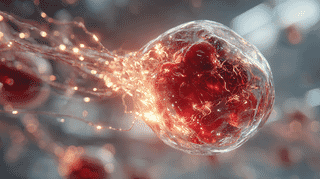
The key players here are peritoneal mesothelial cells, a single flat layer of cells that coats the peritoneum's surface. They are not just a passive lining. They keep organs sliding smoothly against one another, control inflammation, and maintain the membrane's ability to filter. Under long-term dialysis, these cells are gradually stripped away and the tissue beneath them thickens and scars, a process called fibrosis. As the mesothelial layer is lost, the peritoneum leaks and stops filtering properly. Eventually it fails, and the patient has no choice but to switch to hemodialysis.
In rare cases the scarring turns severe, a dangerous complication called encapsulating peritoneal sclerosis, in which the thickened membrane wraps and constricts the intestines. It is uncommon, but it is exactly the kind of outcome that makes doctors cautious about keeping anyone on PD indefinitely.
Researchers have long suspected that if you could simply resupply fresh mesothelial cells, you might slow or reverse this decline. The problem was sourcing them. Harvesting a patient's own mesothelial cells means invasive surgery, and the cells are notoriously hard to grow in large numbers once you have them. That bottleneck stalled the idea for decades.
What the Japanese team actually built
This is where iPS cells enter. Induced pluripotent stem cells, the technology Kyoto University's Shinya Yamanaka won a Nobel Prize for, can be coaxed into becoming almost any cell type in the body, and they multiply readily. If you could steer them into mesothelial cells, the sourcing problem would dissolve.
That is what a group from Showa Medical University (formerly Showa University) in Tokyo and Kansai Medical University in Osaka set out to do. In a paper published in the journal Stem Cell Research & Therapy in April 2026, with Tadashi Kato as lead author, they described a step-by-step recipe that nudges human iPS cells down the developmental path toward what they call induced peritoneal mesothelial-like cells, or iPMCs.
The results are encouraging on several fronts. The cells took on the cobblestone shape characteristic of real mesothelial cells and switched on the right marker genes. When the researchers scratched a gap in a sheet of these cells in a dish, the cells crawled in and closed the wound within about two days, exactly the repair behavior you'd want. In a filtration test, the cell layer let urea and potassium (the wastes dialysis needs to remove) pass through while holding back albumin, an important blood protein that should stay put. In other words, the lab-made cells behaved like a real peritoneal filter.
The team then moved to a mouse model in which the peritoneum had been chemically damaged. Injecting the iPMCs into the abdominal cavity partially restored the membrane's filtering performance, and the cells homed specifically to the injured spots. It is a genuine proof of concept: cells grown from scratch, put back into a living animal, doing part of the job of the tissue they were meant to replace.
The group has also secured a Japanese patent on the differentiation method, and the work was funded in part by Baxter and its kidney-care spinoff Vantive alongside government science grants, a sign industry sees practical potential here rather than a lab curiosity.
Why this matters well beyond Japan
Kidney failure is one of the most universal chronic conditions there is. Worldwide, several million people depend on dialysis or a transplant to survive, and the number keeps climbing as populations age and diabetes spreads. Anything that makes the gentler, home-based form of dialysis last longer would ripple across every health system on the planet.
There is a distinctly Japanese wrinkle, too. Despite PD's advantages, Japan uses it strikingly little. The Japanese Society for Dialysis Therapy counted 337,414 dialysis patients at the end of 2024. Of those, 10,774 were on peritoneal dialysis, 3.2 percent including patients who combine it with hemodialysis. The rest were on hemodialysis (33.2 percent) or hemodiafiltration (63.3 percent). That is far below the share seen in places that have pushed PD hard, and it reflects a mix of clinic economics, physician training, and the fact that Japan built out a dense network of hemodialysis centers decades ago. Part of the reluctance to expand PD is precisely the durability problem: no one wants to start a patient on a therapy known to give out. Fix the wear-and-tear, and the whole calculation changes.
The cells could pay off even before any transplant reaches a patient. Because human mesothelial cells have been so hard to obtain, scientists have struggled to study how dialysis fluids damage the peritoneum in the first place. A limitless supply of lab-grown ones gives researchers a proper human model to test gentler dialysis solutions and screen protective drugs. That alone could improve care long before cell therapy is ready.
Still early, and the researchers say so
It is worth being clear-eyed about the stage this is at, because the team itself is. The experiments were done in cells and in mice, not in people. By the authors' own account, the lab-grown cells were only partially matured toward a true mesothelial identity, and the mouse model captured the peritoneum's loss of filtering function without fully reproducing the slow inflammation and scarring that real long-term dialysis inflicts. They frame the work as a foundation for future therapy, not a finished treatment.
That honesty stands out in a landmark year for Japanese regenerative medicine: the country's first iPS-based products, for severe heart failure and Parkinson's disease, cleared regulatory approval in March 2026. Peritoneal repair is nowhere near that finish line. But the gap between "we can't even get these cells" and "we can grow them and they work in an animal" is the hardest one to cross, and this study crosses it.
In Japan, dialysis almost always means the hemodialysis machine and three trips to the clinic a week; the home-based alternative remains a niche most patients never try. What about where you live? Is hemodialysis or peritoneal dialysis the default, and is doing dialysis at home something people around you actually do?
References
- Kato T, et al. "Generation of functional mesothelial cells from human iPSCs that restore peritoneal integrity in experimental peritoneal injury." Stem Cell Research & Therapy, 17:210 (2026). https://link.springer.com/article/10.1186/s13287-026-05037-x
- Japanese Society for Dialysis Therapy, 2024 annual dialysis statistics. https://docs.jsdt.or.jp/overview/








Global Discussion
4 comments