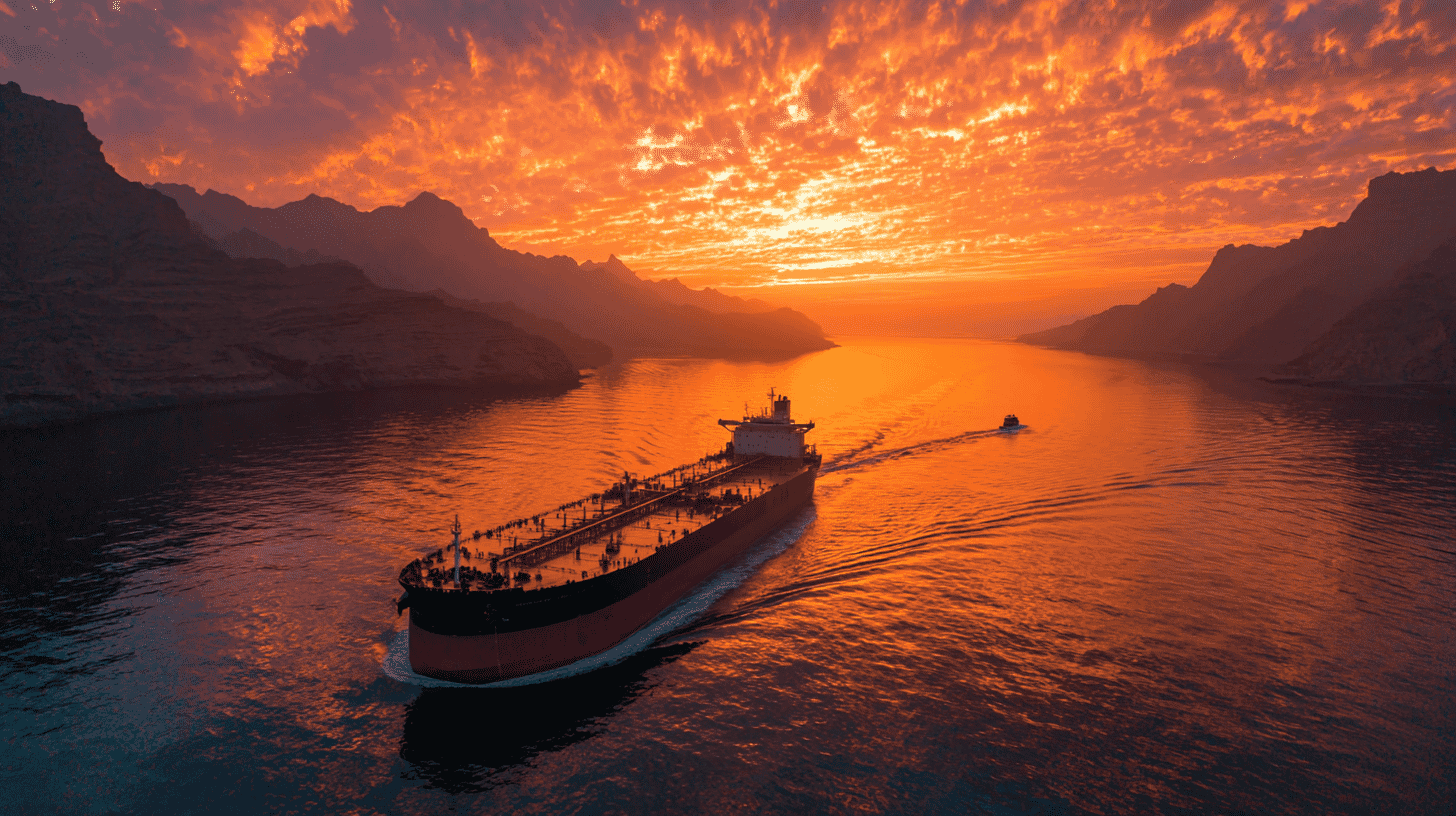
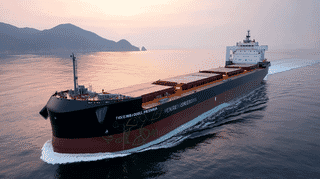
After 62 days stranded in the Persian Gulf, a Japanese supertanker just slipped through the blockaded Strait of Hormuz. On April 28, the VLCC Idemitsu Maru, loaded with 2 million barrels of Saudi crude, sailed into the open waters of the Gulf of Oman. She passed through Iran's newly designated "safe route", and crucially, paid no transit fee. This is the first Japan-bound crude tanker to escape the Persian Gulf since the US-Iran war began in late February. And in a twist of fate, the company that owns this ship is the same one that broke a different oil blockade against Iran 73 years ago.
What Happened: 62 Days of Waiting, Then a Breakthrough
According to ship-tracking site MarineTraffic, the Panama-flagged Very Large Crude Carrier (VLCC) Idemitsu Maru cleared the Strait of Hormuz around 6 PM Japan time on April 28. Her destination flag flipped from "FOR ORDER" to "Nagoya, JAPAN."
The Idemitsu Maru entered the Persian Gulf on February 25, just three days before the United States and Israel launched their attack on Iran. After loading 2 million barrels of crude at Saudi Arabia's Juaymah terminal, she had been sitting idle northwest of Abu Dhabi since early March. Sixty-two days of waiting.
Tasnim News, an outlet considered close to Iran's Islamic Revolutionary Guard Corps (IRGC), reported that the Idemitsu Maru transited "in coordination with the Iranian side." The vessel sailed a newly designated northern route, passing near the islands of Qeshm and Larak, and emerged safely. She is expected to reach Japan around May 18.
The most striking detail came from a senior Japanese government official: "This is the result of the Japanese government's negotiations." And then the kicker, "No transit toll was paid."
Why "Transit Tolls" Became an Issue
After the war broke out in late February, Iran began demanding transit fees from ships passing through the Strait of Hormuz. The strait straddles Iranian territorial waters and international waters, but under the UN Convention on the Law of the Sea (UNCLOS), it is classified as an international strait with the right of "innocent passage." Iran's unilateral toll demand sits in a legally gray zone.
As shipping companies worldwide watched and waited, Japanese majors NYK Line and "K" Line ordered halts to transit. Mitsui O.S.K. Lines kept its vessels holding within the Persian Gulf. Japanese-linked ships heading home found themselves trapped, and as of April 28, roughly 42 Japan-related vessels remained stranded inside the Persian Gulf, according to Land, Infrastructure, Transport and Tourism Minister Yasuyuki Kaneko.
So why did the Idemitsu Maru get through, and without paying a single yen? The answer lies in a story from 73 years ago.
The 1953 Nissho Maru Incident: Same Company, Same Iran, Different Blockade
In 1953, Japan was still rebuilding from World War II and locked out of a global oil market dominated by the British-controlled Anglo-Iranian Oil Company (AIOC, the predecessor of today's BP). That same year, Iran's Mossadegh government nationalized its oil industry. Britain responded by deploying warships to the Persian Gulf and enforcing a naval blockade. An Italian tanker had even been seized.
It was at this moment that Sazo Idemitsu, the founder of Idemitsu Kosan and a fierce advocate for Japanese economic independence from Western oil majors, made a stunning decision: he secretly dispatched the tanker Nissho Maru (II) to Iran.
On March 23, 1953, the Nissho Maru left Kobe Port disguised as bound for Saudi Arabia. Only the captain and chief engineer knew the real destination. When the ship reached the waters off Ceylon (modern-day Sri Lanka), the captain assembled the crew and announced: "We are now heading to the port of Abadan in Iran. We will load oil there."
A message from Sazo Idemitsu was then read aloud, declaring that Japan was, for the first time, securing direct access to the world's vast petroleum resources and laying the foundation for an independent national oil policy. The crew reportedly burst into cheers of "Banzai for Nissho Maru! Banzai for Idemitsu Kosan! Banzai for Japan!"
The ship cut its radio communications, entered Abadan, loaded 22,000 kiloliters of gasoline and diesel, and slipped past British naval surveillance to return safely to Kawasaki Port on May 9. Britain even filed an injunction at the Tokyo District Court via AIOC, but the Nissho Maru completed unloading before it could be enforced.
In Iran, this event became a symbol of "Japan, the true friend", a nation that respected Iranian sovereignty when the rest of the West would not. The story is reportedly still taught in Iranian textbooks today. In Japan, novelist Naoki Hyakuta turned it into the 2012 bestseller Kaizoku to Yobareta Otoko (A Man Called Pirate), which sold over 4 million copies and was adapted into a major film in 2016 starring Junichi Okada.
Why the Idemitsu Maru? An Iranian Message
Many analysts believe it is no coincidence that the very first tanker Iran allowed to pass was an Idemitsu vessel.
For Iran, the name "Idemitsu" is not just a historical footnote. The memory of a Japanese company that, alone among industrialized nations, recognized Iranian sovereignty during the British blockade is still alive, 73 years on. The fact that Tasnim News, with its IRGC ties, gave this transit prominent coverage, and that Iran granted passage without demanding a toll, reads as both a homage to that past bond and a calculated geopolitical message in the present.
Japanese diplomacy was working behind the scenes too. Foreign Minister Toshimitsu Motegi met Iran's ambassador to Tokyo on March 2 and held a phone call with Iranian Foreign Minister Abbas Araghchi on April 15. Prime Minister Sanae Takaichi spoke directly with Iranian President Pezeshkian on April 8. A US ally maintaining its own independent channel to Iran, a quintessentially Japanese diplomatic style, produced a result.
The Hard Numbers: Japan's Energy Vulnerability
Even so, one tanker doesn't solve Japan's problem.
Japan depends on the Middle East for roughly 95% of its crude oil imports, and almost all of that crude flows through the Strait of Hormuz. Japan's overall energy self-sufficiency is just 13%, the lowest among major developed economies. Since the 1973 oil shock, the country has built up strategic petroleum reserves equivalent to 254 days of imports (146 days of state-held reserves, 101 days of private-sector reserves, and 7 days of joint reserves with producer countries). But reserves, by definition, run out.
More than 40 Japan-related vessels are still trapped inside the Persian Gulf. Whether they will be allowed to follow the Idemitsu Maru out remains entirely unclear. The 2 million barrels aboard her amount to less than a single day's worth of Japanese consumption (roughly 3 million barrels per day). It's a drop in the bucket, albeit a symbolically powerful one.
How Japan Compares
- Japan: ~95% Middle East oil dependence, 13% energy self-sufficiency
- South Korea: ~70% Middle East oil dependence, 18% energy self-sufficiency
- China: ~46% Middle East oil dependence (actively diversifying)
- Germany: Low Middle East dependence, 35% energy self-sufficiency thanks to renewables
- United States: Effectively a net energy exporter post-shale revolution
Japan's exposure stands out starkly.
The Reaction: "Goosebumps" and "Pure Legend"
Japanese social media lit up the moment the news broke. Many users immediately drew the parallel to the Nissho Maru.
"I had goosebumps. If this report is real, it's pure legend," one X user wrote. "They're carrying the spirit of the pirate," another said, a direct reference to A Man Called Pirate. Readers of the bestseller and viewers of the 2016 film flooded the platform with emotion.
Others were more grounded. "Two million barrels at current prices is about 32 billion yen ($203 million USD at ¥158/dollar) of cargo. That's not even one full day of Japanese oil consumption." "The real test is whether the other 40 ships can follow." "We need to verify the 'no toll paid' claim, there's a lot of unverified news flying around right now."
And then the structural questions surfaced. "Either we restart the nuclear plants or we go big on renewables, otherwise this happens again." "How to reduce Middle East dependence is the actual issue here." Japanese awareness of the country's energy vulnerability has rarely been higher.
Closing: History Doesn't Repeat, It Rhymes
The Idemitsu Maru's transit is not the end of Japan's energy crisis. It's just the beginning.
More than 40 Japanese-linked vessels remain stuck in the Persian Gulf. Crude prices are still elevated, the yen is hovering around ¥158 to the dollar, and gasoline prices in Japan are at historic highs.
But this episode reaffirmed something important: trust between nations isn't built by governments alone. What Sazo Idemitsu created in 1953, by respecting Iranian sovereignty and human dignity over short-term Western pressure, opened a door 73 years later, under seemingly impossible circumstances.
"History doesn't repeat itself, but it often rhymes," Mark Twain reportedly said. Forty-five years after Sazo Idemitsu's death, the seed he planted is still bearing fruit, right in the middle of the Strait of Hormuz.
How is your country handling energy security in the current Middle East crisis? Do you think historical bonds between nations still matter in modern diplomacy and economic security? We'd love to hear your perspective in the comments.
References
- https://www.nikkei.com/article/DGXZQOGN28CLP0Y6A420C2000000/
- https://www.nikkei.com/article/DGXZQOUC28BN30Y6A420C2000000/
- https://www.bloomberg.com/news/articles/2026-04-28/japanese-crude-supertanker-attempts-hormuz-exit-in-war-s-first
- https://asiatimes.com/2026/04/japans-idemitsu-maru-allowed-through-hormuz-history-in-tow/
- https://www.japantimes.co.jp/business/2026/04/29/companies/oil-tanker-exits-hormuz/
- https://en.sedaily.com/international/2026/04/29/japanese-oil-tanker-crosses-hormuz-strait-without-paying
- https://gulfnews.com/world/mena/oil-lifeline-first-tankers-slip-through-hormuz-strait-1.500522534


Global Discussion
15 comments