👓 There is a new item on the list of things tourists carry home from Japan: eyeglasses. Price is part of it, but not the whole story. In Japan you do not need a doctor's prescription to buy a pair, and if the lens is in stock you can walk out wearing them the same afternoon.
Two weeks to a month in the US. Same day in Japan.
On August 22, 2026, the Yomiuri Shimbun reported that Japanese eyewear has become a draw for inbound visitors. Quality and a weak yen help. So does something less obvious: the prescription that shoppers need at home is not required here.
Glasses are classed as a medical device in Japan, the paper noted, yet no doctor's prescription is needed to buy them. Citing a medical device manufacturer, it reported that the United States, Britain, France and Australia all require one, and that appointments can be booked out for months.
The exam is only half the delay. In a July 2025 report by the Tokyo broadcaster TOKYO MX, an American shopper said that losing or breaking a pair back home means two weeks to a month before a replacement arrives. Optical shops outside Japan generally order lenses from a manufacturer once they have your numbers, which rules out same-day collection almost by definition.
Japan's high-volume chains keep lens inventory on the premises. If your prescription strength is on the shelf, staff cut it, fit it to the frame and hand it over inside an hour. Free eye measurements, standard at many shops, strike foreign customers as unusual too. Progressives and other lenses that have to be ordered in are a different matter, and those still take days.
The Harajuku shop where more than half the customers are foreign
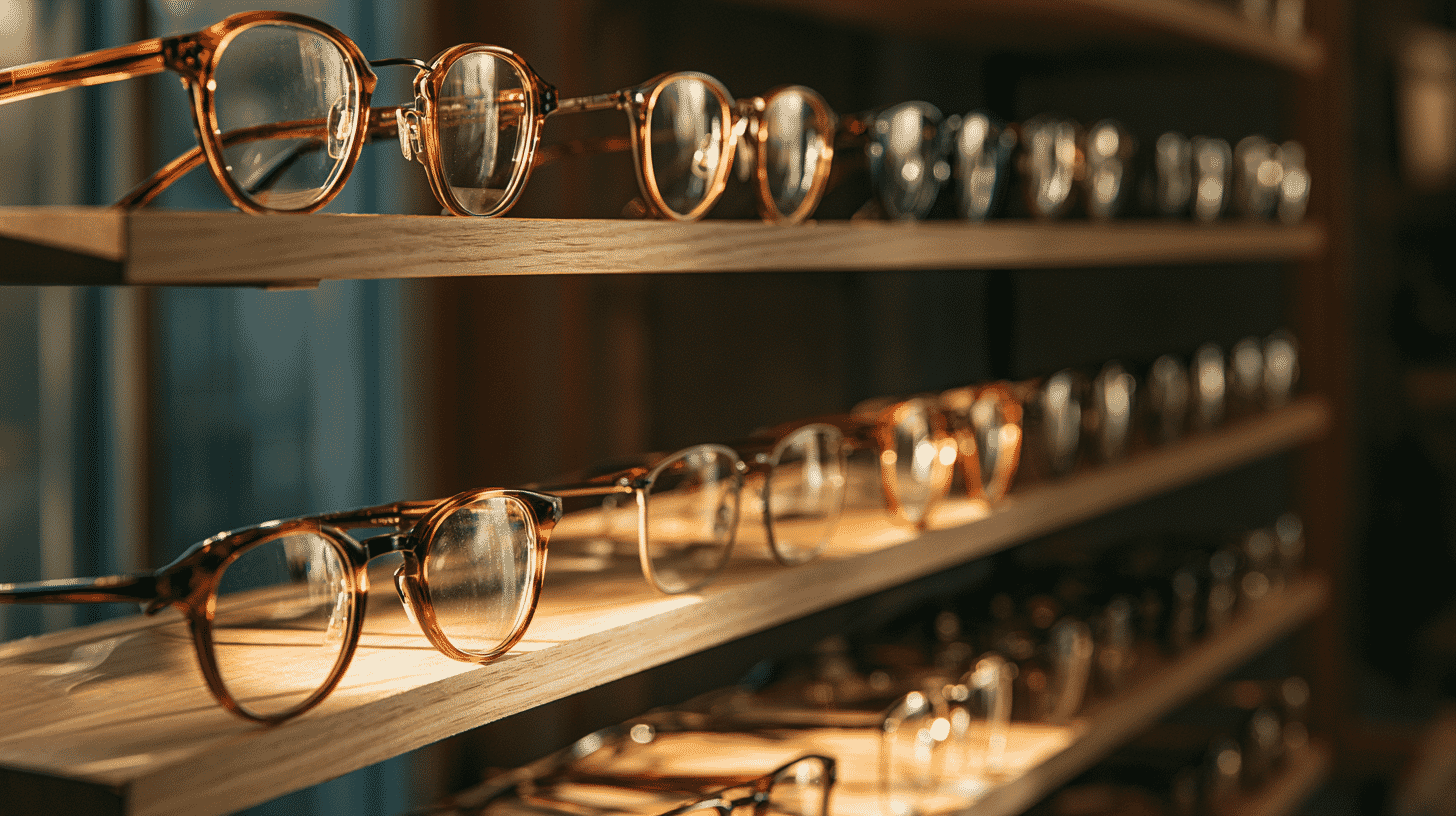
One of those shops is Zoff Harajuku in Shibuya. It carries roughly 1,200 frames, and more than half the people walking through the door are from overseas. This is not a tourist landmark. It is an eyewear store.
Customers explain themselves plainly. A shopper from Hong Kong told the broadcaster that Japan is cheaper, roughly half what she would pay at home, and was surprised that the eye test and the lenses were included in the price. A woman from Spain had read online that Japanese shops hand glasses over the same day, and came in on the eve of her flight out.
The unexpected bestseller is prescription sunglasses with UV protection. For visitors from countries with hard sunlight, that exemption covers tinted lenses as well. The same report cited chain-store research putting sunglasses usage among Japanese people at around 16 percent. A product locals largely skip has become something tourists come looking for.
The land grab in central Osaka
Where demand is real, it shows up in where companies put their money. On July 10, 2026, Meganetop, the Shizuoka-based operator of the Meganeichiba chain, relocated its Shinsaibashi flagship inside Osaka's Shinsaibashi-suji arcade and reopened with more floor space. It stocks close to 2,000 models, led by own-brand frames starting at 15,000 yen including tax, about $94 at 159 yen to the dollar as of August 24, 2026. A new measuring unit gives voice guidance in nine languages and reads both eyes at once, halving the time the test used to take. From measurement to handover, the company says, 25 minutes is possible. More than 60 percent of the store's sales go to inbound customers.
Washin, based in Tokyo, opened a Kansai flagship in Shinsaibashi on April 29, 2026, and added an Umeda store in May. It keeps Grade 1 certified spectacle fitters, a national qualification, on the floor and pitches adjustments shaped to non-Japanese facial structure. OWNDAYS moved into Umeda in November 2025; the company said its Kansai sales for June through September 2025 were up about 30 percent year on year.
The exchange rate is doing work here too. In January 2026, the Nikkei reported that Japanese glasses run about 20 percent cheaper than in markets such as the United States.
Where Japan's rules diverge
Japan does not skip the prescription because it skips regulation. It classifies the product differently.
Japan's pharmaceutical and medical device law sorts devices by risk. Glasses land in the general category, which a shop may sell with no filing and no designated supervisor on staff. Contact lenses land in the tightly controlled one, where the retailer needs a licence and a qualified supervisor on the floor. For glasses, then, no statute requires a prescription to buy a pair, and testing and selling may happen under one roof.
There are exceptions. Glasses used to treat conditions such as amblyopia or strabismus in children are covered by public health insurance, and those do start with a doctor. What needs no prescription is everyday vision correction.
The skill side does have credentials. In fiscal 2021 the health ministry added spectacle fitting to Japan's national trade skills testing system and named the Japan Optometric Association as the examining body; the certification itself, Certified Spectacle Fitter, began in April 2022. There are two grades, and the Grade 1 badge is the one Washin advertises. It replaced a private certification that had run since 2001 and closed at the end of March 2022.
What the certification does is narrower than it sounds. Passing the exam is what lets someone use the title; nothing stops a shop without a certified fitter from selling glasses.
The American system starts from the opposite premise. The Federal Trade Commission's Eyeglass Rule is built around the separation of examination and dispensing, and it obliges ophthalmologists and optometrists who perform a refraction to hand the patient a copy of the prescription whether or not they ask. The patient then takes that piece of paper wherever they like. Britain is blunter still: Section 27 of the Opticians Act 1989 restricts the sale of optical appliances to registered medical practitioners and registered opticians, or to sales made under their supervision, and the exempted categories carry a condition that the appliance match a written prescription issued after a sight test.
Same-day glasses look less like Japanese speed than like a by-product of a system that never split the exam from the sale.
What the convenience costs
The flip side of skipping the prescription is skipping the doctor.
Blurry vision is not always a matter of the wrong numbers. Eye disease can sit behind it, and a shop's vision measurement will not find that. This is a large part of why other countries route people through a clinician first. Even Japan's own certification was framed that way: the health ministry described the new qualification as a means for spectacle technicians to work alongside eye specialists in protecting public eye health. Not needing a prescription is not the same as not needing an eye exam.
The Japan Ophthalmologists Association certifies shops that keep a qualified fitter on staff and work with eye specialists, under a scheme whose rules were updated in April 2026. The aim is to widen the supply of glasses made to a clinic's prescription. Even where the law does not require one, the medical side is pushing that way.
Hideyuki Araki, chief researcher at the Resona Research Institute, told the Yomiuri that Japanese manufacturing carries value in its own right, that high service quality feeds into a good travel experience, and that between those strengths and the absence of a prescription requirement, Japanese eyewear has the groundwork to pull in inbound demand.
So what does it take where you live? A referral, an appointment, a wait? And how long from the eye test to the glasses in your hand?
References
- https://news.yahoo.co.jp/articles/09c36f9a86d1a5d0343b87fc115a7d16df13795c
- https://s.mxtv.jp/tokyomxplus/mx/article/202507110650/detail/
- https://www.mhlw.go.jp/stf/seisakunitsuite/bunya/koyou_roudou/jinzaikaihatsu/ability_skill/ginoukentei/index.html
- https://www.megane-joa.jp/
- https://www.ftc.gov/business-guidance/resources/complying-eyeglass-rule
- https://www.legislation.gov.uk/ukpga/1989/44/section/27/enacted
- https://www.nikkei.com/article/DGXZQOUB244O80U5A221C2000000/
- https://www.city.nara.lg.jp/uploaded/attachment/23961.pdf
- https://www.gankaikai.or.jp/for-medical-personnel/itaisaku/detail/1199299_2099.html
- https://prtimes.jp/main/html/rd/p/000000061.000045881.html
- https://www.ryutsuu.biz/store/s070981.html









Global Discussion
4 comments