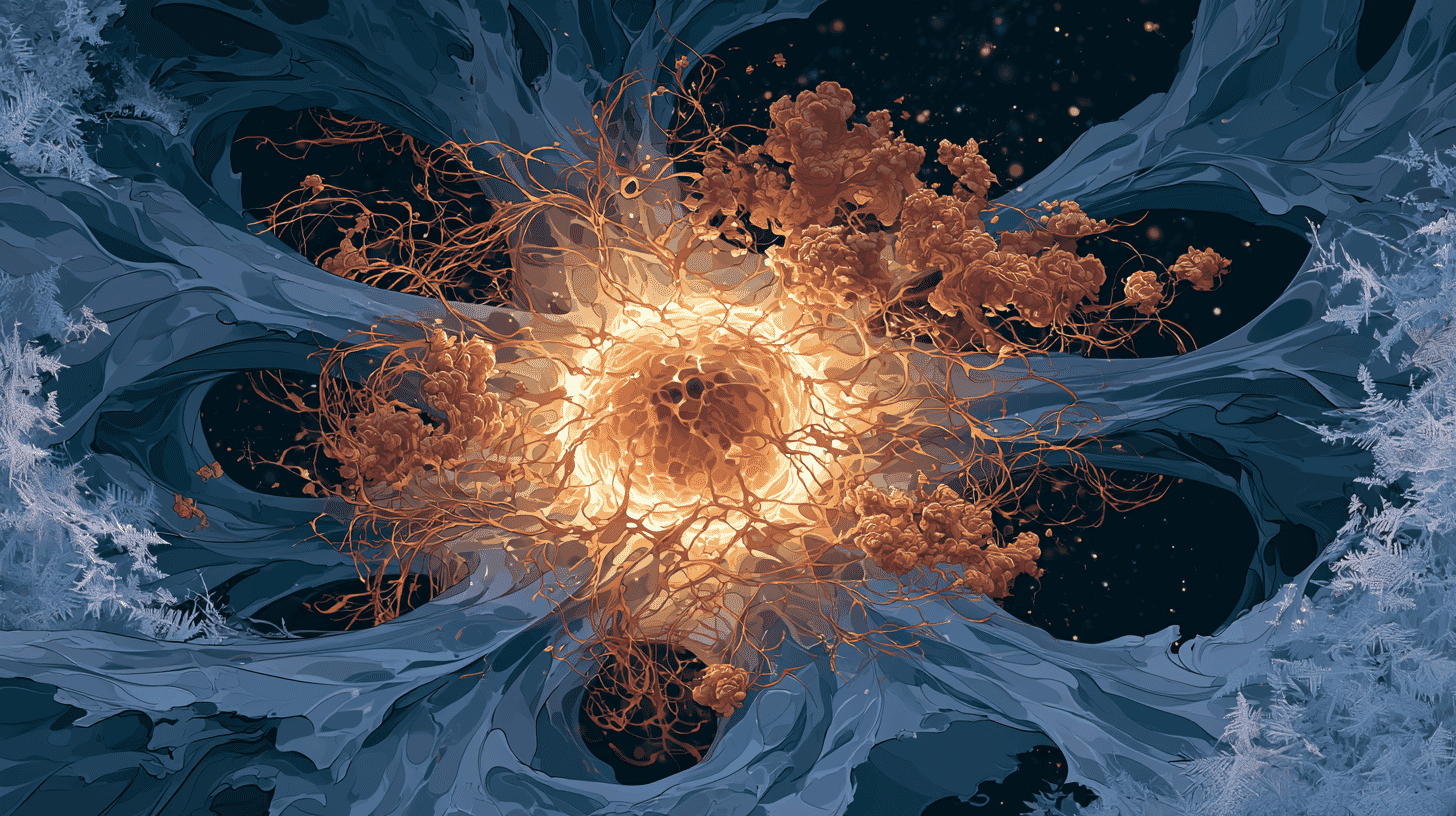
🧊 Cold has been killing living things since long before humans learned to make fire. Hypothermia, frostbite, and on a global scale, cold-related deaths outnumber heat-related ones by roughly nine to one. Yet a surprisingly basic question has hung in the air the whole time: deep inside a cell, what does cold actually pull the trigger on? A team at Japan's Konan University, working with a millimeter-long worm, has come back with an unlikely suspect: copper, the same metal in your wiring and your pipes.
The question nobody quite finished answering
We actually know a lot about how cold kills a body. Hypothermia scrambles the heart's rhythm and shuts systems down; frostbite freezes tissue solid. Those mechanisms have been studied for a long time.
What stayed thin was the layer underneath: when a single cell dies from cold, what specifically goes wrong? The body-level picture was filled in; the molecular one had gaps. As the original report on the new study put it, the workings of how low temperature drives cells and bodies to death have not been well explained, even as cold remains a leading cause of temperature-related death worldwide. (In Japan, deaths linked to cold have outnumbered heatstroke deaths in several recent years, a reversal of the usual headline assumption.)
That gap is what the Konan group went after.
A newer kind of cell death, named after copper
For decades, scientists catalogued a handful of ways a cell can die on purpose: apoptosis, necroptosis, ferroptosis (an iron-driven death), and others. Then in 2022, a team led by Peter Tsvetkov described a genuinely new one and called it cuproptosis: cell death driven by copper.
Copper is not a villain by nature. Every animal needs trace amounts of it to run essential enzymes, and cells keep its levels on a tight leash. But push copper past a certain threshold and it turns destructive in a very specific way. Inside the mitochondria, the cell's power plants, copper latches directly onto a set of proteins in the energy-producing TCA cycle. Those proteins clump together, a downstream group of iron-sulfur proteins gets stripped out, and the resulting stress tips the cell into death. It is distinct from the older death pathways, with its own fingerprint.
One detail makes the whole thing feel almost poetic: the discovery helped explain why life evolved such ancient, careful systems for keeping copper in check. The metal has apparently been a loaded gun in our cells for a very long time.
What the worm showed
Konan's team, led by Professor Atsushi Kuhara with doctoral student Serina Yamashiro, suspected this copper-driven death might be part of how cold kills, and tested the idea in Caenorhabditis elegans, a transparent roundworm that is a workhorse of biology precisely because its cells are easy to watch and its genes easy to manipulate. The paper appeared in Nature Communications in 2026.
They zeroed in on a worm carrying a mutation in SLCR-46.1, a protein that ferries copper around the lysosome (the cell's recycling compartment). In that mutant, the cold did something telling. Copper piled up in the pharyngeal muscle, the tissue the worm uses to pull in food, and the animal died in the cold.
Then came the part that turns correlation into something stronger. When the researchers suppressed the genes tied to cuproptosis, the mutant worms survived the cold far better. When they used a chelator, a molecule that grabs copper and hauls it out, the cold deaths dropped again. And the effect was not just a quirk of the mutant: in ordinary, wild-type worms too, blocking cuproptosis reduced cold death. Pull the copper, and the cold loses some of its bite.
A final result reaches past the worm. When the team grew mammalian cells at lower-than-normal temperatures, the genes associated with cuproptosis became more active. The same wiring, it seems, lights up under cold in cells much closer to our own.
How far this actually goes
This is a study in a roundworm, backed by a gene-expression signal in cultured mammalian cells. It does not mean a person who dies of hypothermia is suffering "copper poisoning," and it does not rewrite what frostbite is. Human cold death is a whole-body, largely circulatory event; what Konan's team mapped is a mechanism inside cells. The leap from "this pathway operates in a worm's throat muscle" to "this is why people freeze to death" is several careful steps long, and the researchers have not taken them.
What they have done is identify, for the first time, that cuproptosis, whose role inside a living animal had been unclear, is part of how cold lethality works in an animal at all. That is the genuinely new piece.
Why a worm's cold death might matter to a transplant patient
What makes this niche result matter is what it could unlock downstream, and here the researchers point the way themselves.
Almost everything in transplant medicine is a race against temperature. Organs and cells are chilled to slow them down and buy time, but cold is a double-edged tool: it preserves, and it also damages. If cold injury runs partly through cuproptosis, then learning to dampen that pathway, with a chelator or by tuning the right genes, could mean cells and organs that tolerate the cold longer and come through preservation in better shape. Longer safe windows ripple straight into the cold chain that moves transplants, cell therapies, and biological samples around the world.
That is a promise, not a result: the work sits at the basic-science end of the pipeline, and the road to a hospital is long. For now, the finding is smaller and stranger than any "cure for the cold." In at least one animal, cold appears to kill using a metal we usually never think about.
Japan is one of the places where, in recent years, the quiet toll of cold has begun to outweigh the dramatic one of heat. Where you live, which gets more of the attention and the budget: the heat wave everyone talks about, or the cold that does the larger share of the killing?








Global Discussion
4 comments