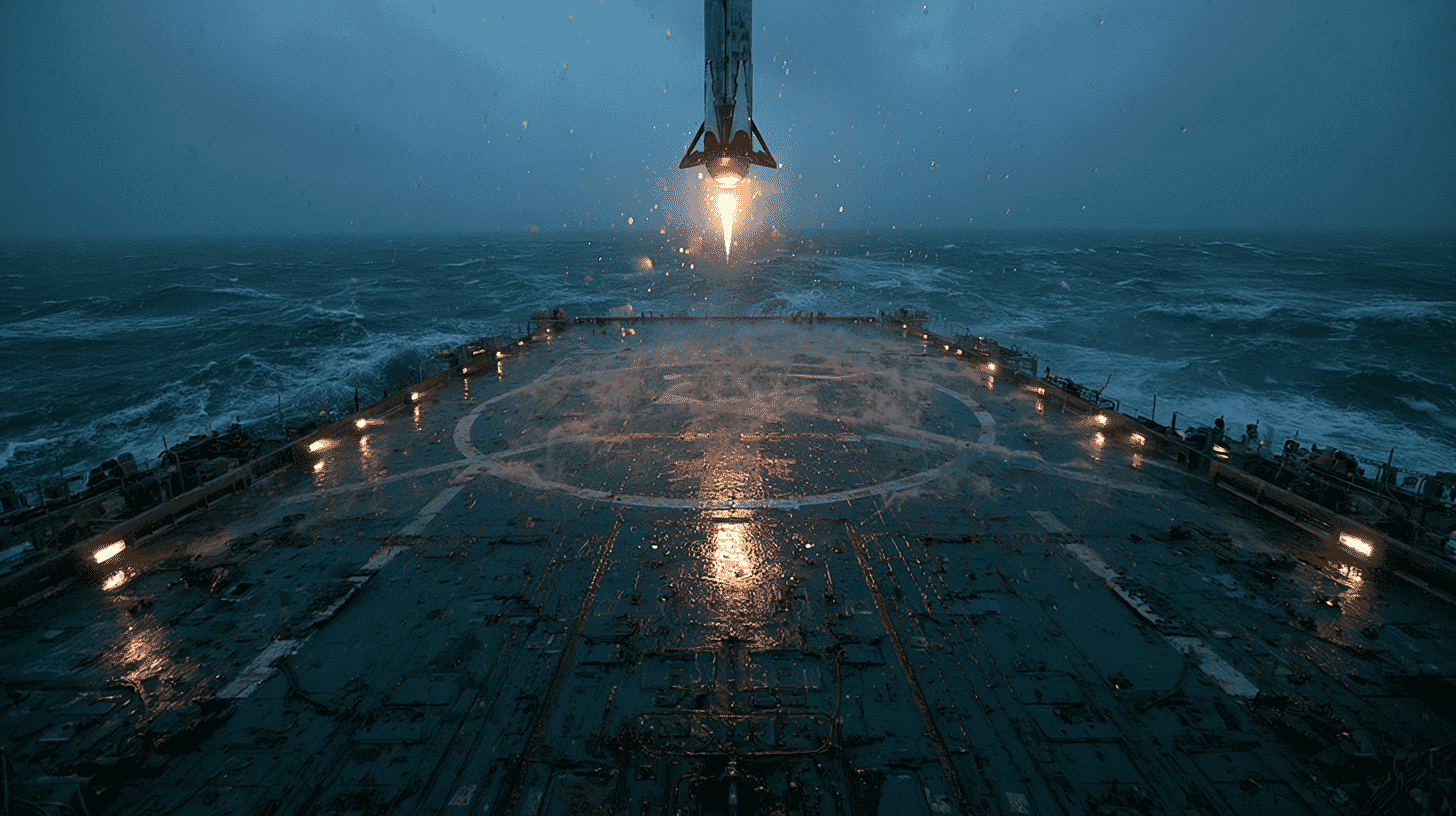
🚀 Japan's largest shipping line has been moving cargo across oceans since 1885. Now it wants to park a returning rocket booster on one of its ships. The idea started in a corporate training class, and it may end up deciding how much Japan pays to reach orbit.
An idea that showed up in the wrong shape
NYK Line runs one of the world's biggest merchant fleets. Container ships, car carriers, LNG tankers. Not rockets.
A few years ago, employees in an internal program for developing new businesses pitched something unusual: launch rockets from ships. Through that work, the team crossed paths with Mitsubishi Heavy Industries, the manufacturer of Japan's flagship H3 rocket. MHI made a counter-offer. Forget launching for now. Come help us with the harder problem on the other end of the flight: catching the rocket when it comes back down.
On December 20, 2024, the resulting project was selected by JAXA's Space Strategy Fund, a multi-year government program that lets private companies take on long-horizon hardware bets. NYK was the first shipping company ever chosen. Joint research and development formally began in April 2025.
The logic is unglamorous and specific. A reusable rocket only saves money if you can land its first stage somewhere and fly it again. Landing requires a large, flat, unpopulated area under the flight path. Japan does not have one.
By using ships and making use of the sea, the problem might be solvable, Daisuke Suga, who leads NYK's space business development team, told the trade paper Nikkan Kogyo Shimbun. It is how a company sounds after more than a century of treating the ocean as usable real estate.
Two ships, one landing pad
The system NYK and MHI have sketched out uses two vessels.
The first is the recovery ship. It waits at the projected splashdown point, roughly 1,000 kilometers offshore according to Nikkei, and functions as the landing deck. It carries a dynamic positioning system (DPS), the same technology offshore supply vessels use to hover over a wellhead, holding its position against swell and current. During the actual recovery it is completely unmanned. The booster comes down, lands, and is secured on deck.
The second is the command ship, which is crewed. It carries the recovery ship out to the landing zone, supervises the whole sequence remotely, and escorts the booster home.
Three technical problems sit underneath that description. The rocket and the ship have to exchange information reliably while both are moving. The ship has to stay on its mark while the sea does not cooperate. And the deck has to survive the exhaust plume and impact of a descending rocket stage without deforming.
On July 24, 2025, ClassNK, Japan's ship classification society, granted the concept an Approval in Principle, confirming the technical validity of the overall system design before basic design begins. NYK says it was the first AiP ClassNK has issued for a space-development system that includes ships.
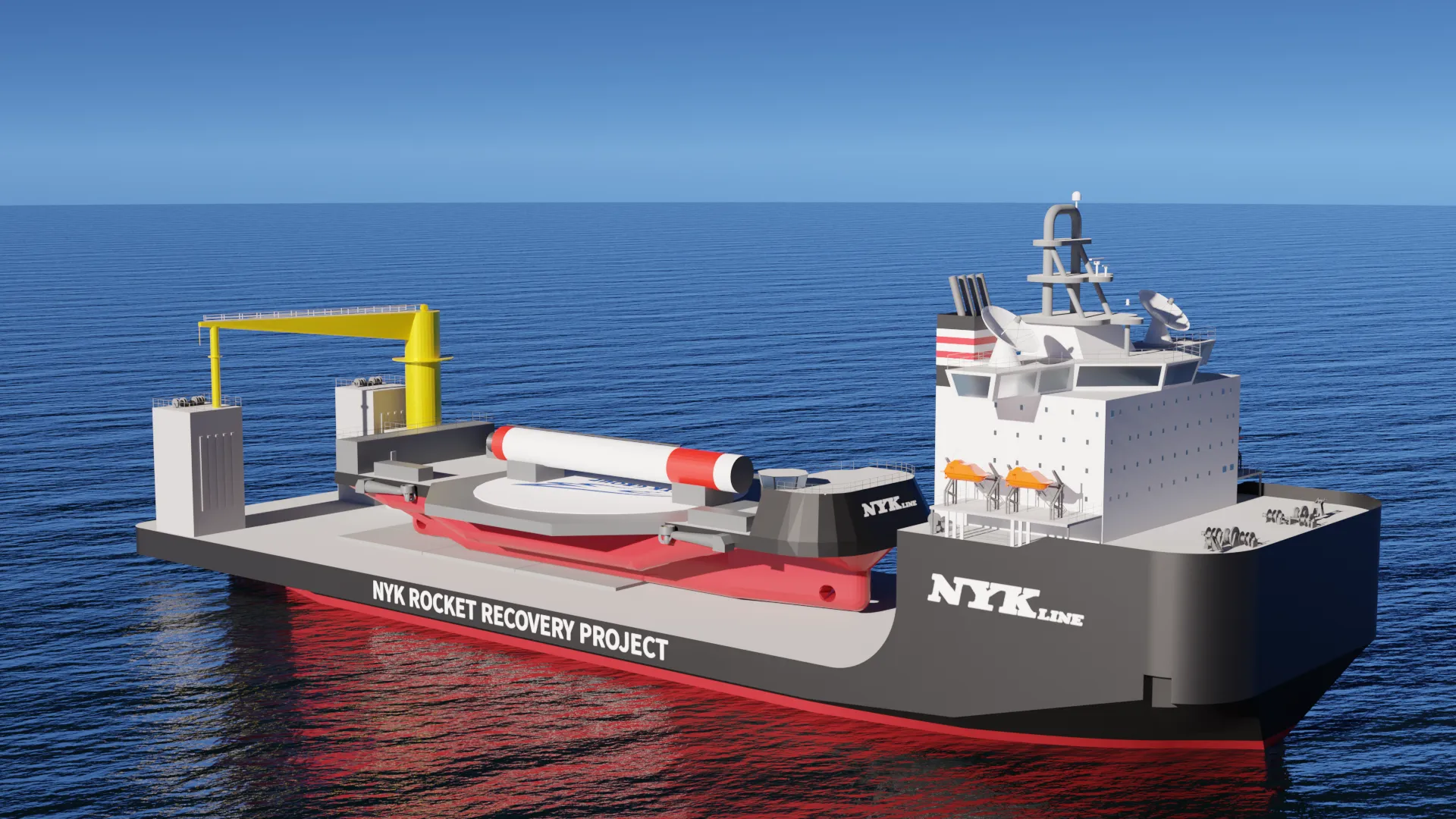
Source: NYK Line
A classification society is the body that certifies whether a hull is safe to sail. That it signed off here means Japan is not treating rocket recovery as a rocket problem with a boat attached. It is treating it as naval architecture, subject to the same review as an LNG carrier.
MHI handles everything on the rocket side. NYK handles the ships, working with what the Japanese industry calls the maritime cluster: the shipyards, equipment makers, and classification bodies that cluster around shipbuilding. The plan is to demonstrate the recovery technology in a simulated environment by the end of fiscal 2028, reaching TRL 5, the midpoint of the technology readiness scale used in space development.
SpaceX solved this. That does not mean Japan can copy it.
SpaceX has landed boosters at sea since April 2016, when a Falcon 9 first stage touched down on the droneship Of Course I Still Love You after a cargo run to the space station. By August 2025 the company had logged its 400th drone-ship landing. Boosters typically come down 600 to 675 kilometers downrange, sometimes beyond 1,200.
But look at what a droneship actually is. It is a converted deck barge with thrusters bolted to the corners. It has no propulsion of its own for the transit, so a chartered tugboat drags it out to the landing zone days in advance. Elon Musk has said it can hold position within about three meters, even in rough weather.
Cheap, ugly, effective. And built by the same company that builds the rocket, flies the rocket, and eats the cost when the rocket falls over.
Japan is doing the opposite. The rocket maker, the ship operator, and the certifier are three different organizations, and the ships are purpose-designed rather than repurposed. Whether that is a weakness or a strength is the interesting question. Splitting the work across companies adds coordination overhead that SpaceX simply does not pay. It also means Japan can pull on an entire shipbuilding industry that the United States, whose commercial shipyards have largely withered, no longer has.
There is a second asymmetry, and it is cultural rather than technical. SpaceX got good at landing rockets by destroying a lot of them on camera. Japanese space projects are scrutinized as public expenditure, and visible failure carries a political cost. It is hard to iterate quickly under those conditions.
Everyone in Japan is suddenly trying to land a rocket
NYK's project is one piece of a broader push that arrived all at once.
JAXA has been developing RV-X, a small reusable-rocket demonstrator about 7.3 meters tall and 1.8 meters across. The flight profile is deliberately modest: rise about ten meters, translate sideways, land upright. After repeated postponements for weather and equipment trouble, JAXA flew the first test on July 11, 2026, at its Noshiro test site in Akita Prefecture. The vehicle lifted off at 6:14:55 a.m., climbed to about 11 meters, translated roughly 16 meters sideways and touched down after about 40 seconds, tracking the published plan (ten meters, fifteen meters, forty seconds) almost exactly. It was JAXA's first such flight test since RVT-9 in 2003, twenty-three years earlier. Data from RV-X feeds into CALLISTO, a larger reusable-stage experiment run jointly with the French and German space agencies.
Then there is Honda, which is not a space company and has said so cheerfully. In June 2025, at its test facility in Taiki, Hokkaido, the carmaker's research arm flew a 6.3-meter experimental rocket to 271.4 meters, held it steady, and landed it 37 centimeters from the target after 56.6 seconds of flight. Honda says it is aiming for suborbital flight, 100 kilometers up, by 2029.
Behind all of it is a number. Japan's H3 rocket was designed around a target price of about 5 billion yen per launch, roughly 31 million dollars. Reports in 2021 described a government plan for a successor with a reusable first stage, targeting around 2.5 billion yen, about 15 million dollars, by 2030. Reuse is the only lever that moves that number.
And the demand is real. Earth observation, extreme weather monitoring, broadband constellations: satellite orders are multiplying faster than anyone can build rockets to lift them. The bottleneck is not satellites. It is rides.
The part NYK is not hiding
Here is where the story gets more honest than most corporate space stories.
In a conference paper written by NYK engineers and researchers from the company's technology institute, MTI, the authors note that around 2030, immediately after this research concludes, launch frequency and therefore recovery frequency will still be low. A recovery-ship business on its own, they write, may be difficult to make profitable. So the team is already studying how to redirect the same technology toward offshore launch services and other extensions of the vessel.
That is a candid thing to publish about your own project. The engineering is solvable. The business depends on whether Japan ever launches often enough to need a landing pad in the Pacific.
NYK is hedging by building outward. It has deepened a partnership with Oceanic Constellations, a Kamakura startup founded in November 2023 that has raised roughly 4 billion yen, about 25 million dollars, and whose digital-twin simulation platform is being used to test recovery scenarios before any steel is cut. Their agreement, initially about recovery alone, was expanded in May 2026 to cover offshore launch as well.
Which is a reasonable bet. If Japan ends up exporting anything from this, it may not be the rocket. It may be the unfashionable, hard-won competence to hold a steel deck perfectly still while the ocean tries to move it.
Somewhere in your country there is probably an industry quietly retooling itself for a business it was never built for. Has anyone noticed yet?
Update: JAXA's first RV-X flight test succeeded on July 11, 2026: about 11 meters of altitude, about 16 meters of lateral travel, roughly 40 seconds in the air, all matching figures the agency had published in advance. A follow-up test at around 100 meters is planned, with no date announced. (Added August 2026)
References
- https://newswitch.jp/p/49693
- https://www.nyk.com/news/2025/20250724_02.html
- https://www.nikkei.com/article/DGXZQOUC245070U5A720C2000000/
- https://global.honda/jp/topics/2025/c_2025-06-17c.html
- https://www.kenkai.jaxa.jp/research/rvx/rvx.html
- https://sorae.info/biz/20260521-oceanic-constellations.html









Global Discussion
0 comments