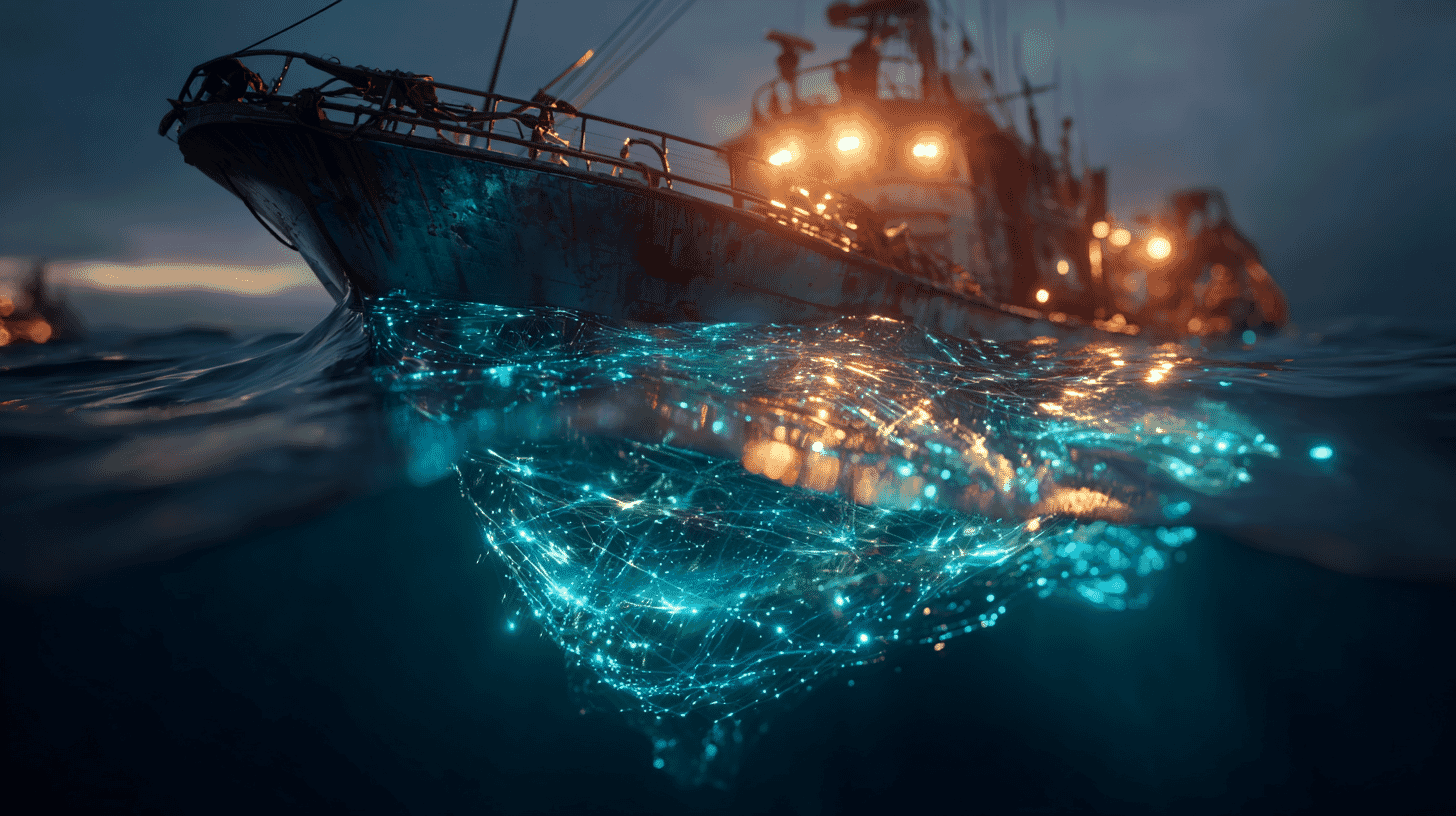
Nearly half the world's fishing vessels see the ocean through the "eyes" of one Japanese company. From a tiny electrical repair shop in Nagasaki, Furuno Electric turned fishing from guesswork into science: fish finders, then radar, GPS, and AR navigation. This is the story of the hidden Japanese giant that powers the world's seas with technology that "sees the invisible."
From "That Gadget Is a Gimmick" to Global Dominance
The story of Furuno Electric is inseparable from Japan's postwar hunger crisis.
When World War II ended in 1945, Japan's fish catch had plummeted to less than half of prewar levels. Most fishing boats had been commandeered by the military, and postwar occupation restrictions and fuel shortages dealt further blows. Yet the nation desperately needed animal protein.
In this era, two brothers, Kiyotaka and Kiyosada Furuno, were running a modest electrical shop in Minamishimabara, Nagasaki Prefecture, fixing radios and doing wiring work on fishing boats. Kiyotaka, the elder brother, had a vision: what if science could replace the luck and intuition that fishermen relied on? Inspired by surplus military sonar equipment (acoustic depth sounders used by the Imperial Japanese Navy), he set out to develop a device that could detect schools of fish using ultrasound.
In 1948, an improved prototype was installed on a fishing boat. When Kiyosada, monitoring the device, pointed to a shadow on the screen and declared "fish are here," the fishermen scoffed, "There are no fish in a place like this." But when they turned on the fish-attracting lights, a massive school of sardines erupted toward the surface.
Success, however, was not yet assured. On another outing, Kiyosada confidently identified what he believed to be sardines. The nets came up filled with jellyfish. Furious fishermen threw him into the sea. The Japanese pun spread quickly: "Tanchiki (the detector) wa inchiki (a fraud)." Returns piled up, and the brothers faced ruin.
The turning point came in 1949 on the Goto Islands off Nagasaki. A boat owner named Tomichiro Masuda, whose vessel had the lowest catch in the entire harbor, was the only one willing to give the Furuno brothers a chance. In a last-ditch effort, Masuda's boat followed the fish finder's guidance and hauled in a record-breaking catch. On one night alone, the haul was worth around 6 million yen, at a time when the average Japanese salaryman earned roughly 120,000 yen a year. As Masuda's boat returned daily flying the tairyo-bata (the traditional "big catch" banner), boat owners queued outside the Furuno workshop in Nagasaki to buy the 600,000-yen device that had once been dismissed as a scam. One even offered Kiyosada a monthly salary of 1 million yen to captain his boat.
From a Nagasaki Repair Shop to "FURUNO" on Every Ocean
In 1955, Kiyotaka Furuno declared his ambition: "We will make Furuno a global brand." He incorporated the company as Furuno Electric Co., Ltd. After touring 11 Western nations and returning convinced of the company's competitive edge, he moved the headquarters to Nishinomiya, Hyogo Prefecture in 1964, close to Kobe's major port, ideal for export logistics.
Furuno's growth was propelled by applying its core philosophy, "seeing the invisible", to one domain after another.
From fish finders to radar. In 1957, Furuno took on maintenance contracts for British-made radar, and by the following year had started developing its own compact marine radar. The original antenna weighed 60–70 kg; Furuno's first model, completed in 1962, brought that down to just 18 kg. Initially sold under OEM arrangements, the company soon acquired its distributors and launched under its own "FURUNO" brand. European yacht owners, seeing the antenna spinning on fishing boats, asked what it was, and the compact radar spread from there. Some, taking the Japanese name for an Italian one, pronounced it "Faroono."
From sonar to satellite positioning. In 1973, Furuno developed an early satellite positioning receiver for maritime use, placing it at the forefront of GPS technology at sea. Today, the company supplies GNSS (Global Navigation Satellite System) chips and modules used far beyond the maritime world, and is one of only three manufacturers globally producing precision timing receivers for telecommunications infrastructure.
From the ocean to hospitals and highways. Furuno's ultrasound expertise didn't stay at sea. The company developed bone densitometers for medical diagnostics, weather observation systems, ground displacement monitoring equipment, and even components for Japan's ETC (Electronic Toll Collection) highway system.
What Furuno Sees on the Horizon
Today, Furuno Electric has sales and service bases in more than 80 countries, with overseas revenue accounting for roughly 60% of total sales. For the fiscal year ended February 2026, consolidated revenue reached ¥140.6 billion (about $940 million) and operating profit ¥16.2 billion (about $110 million), a third straight record year. The company forecasts ¥148.5 billion in revenue for the year ending February 2027.
With 49% of the global fishing vessel electronics market and 43% of commercial ship radar, Furuno is now pushing toward the next frontier of maritime technology.
Smart bridges. In Northern Europe's North Sea fisheries, futuristic bridge (wheelhouse) systems are being adopted that integrate data from radar, sonar, communications, and other sensors. These systems don't just locate fish with high precision, they can even optimize which port to land the catch at for the best market price. Furuno supplies the core technology for these smart bridge installations.
Fish finders that judge how fat the fish are. The latest generation of Furuno fish finders can identify not only the species of fish underwater but also estimate their size and condition, essentially how "plump" they are. For the aquaculture industry, this technology directly optimizes harvest timing. As global fisheries shift from wild catch to farming, Furuno's technology is evolving in step.
AR navigation and AI. Furuno has developed an Augmented Reality (AR) navigation information display system that overlays real-time route data, obstacle information, and vessel traffic onto the actual seascape visible from the bridge. The company is also advancing AI-powered autonomous navigation technology, working toward a future where ships can operate safely with minimal crew.
IEEE Milestone recognition. In September 2024, Furuno's fish finder, the one first commercialized in 1949, was designated an IEEE Milestone by the Institute of Electrical and Electronics Engineers, the world's largest technical professional organization. This honor, shared by innovations like the Volta battery, the Shinkansen bullet train, and the QR code, has been bestowed on only about 260 achievements in history. A single fish-finding device from postwar Japan had earned its place in the annals of human technological achievement.
The Enduring Value of "Seeing the Invisible"
What began as one pair of brothers' determination to "let fishermen see what's beneath the waves" in the chaos of postwar Japan has, 78 years later, become the technological backbone of maritime safety and efficiency worldwide. The device once mocked as "inchiki" (a fraud) is now an IEEE Milestone.
Furuno was selected for Japan's "Global Niche Top 100" by the Ministry of Economy, Trade and Industry in 2020. Since 1971 it has collected 257 NMEA (National Marine Electronics Association) awards; its radars have taken the Best Radar category for more than 40 years running, and five Furuno-linked products won in 2025 alone. For sailors around the world, the name "FURUNO" is synonymous with reliability and trust.
The company is also looking beyond business. Through its "Umi wo Mirai ni" (Oceans for the Future) project, Furuno is contributing to marine environmental conservation. The company has presented research on blue carbon, carbon absorbed by marine ecosystems, signaling its evolution from "a company born from the sea" to "a company that protects the sea."
Furuno's founder Kiyotaka Furuno once said simply: "Wherever there is ocean, there are fishermen, and they need fish finders." That straightforward conviction changed the world's seas.
Japan is home to a company that reached the global summit by "seeing the invisible." What technologies support the fishing and maritime industries in your country?
References
- https://www.furuno.com/en/
- https://www.furuno.co.jp/corporate/history/
- https://prtimes.jp/main/html/rd/p/000000021.000089783.html
- https://www.kjpaa.jp/aboutus/case/furuno
- https://www.nikkei.com/article/DGXMZO66093120R11C20A1960E00/
- https://en.wikipedia.org/wiki/Furuno
- https://news.yahoo.co.jp/articles/bb0abcebe5e471bf0dbbe3ad51a1974b08e53deb




Global Discussion
14 comments