
☕ Anyone who has made pour-over coffee knows the moment: the filter clogs, and the water just sits there. A team at the Institute of Science Tokyo (Science Tokyo) has studied that kind of jam using tiny whirlpools of current inside a superconductor. According to the university, it is the first experiment to show that clogging is a phase transition.
Why clogging is so hard to study
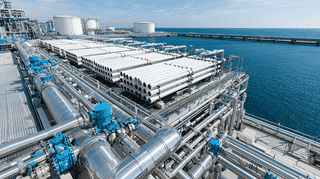
Clogging is everywhere. In its announcement, the university lists places where people rely on it on purpose, such as coffee filters, masks and air conditioners, as well as water treatment and dialysis. It also lists places where it causes trouble: cooling-water pipes, IV tubes and blood vessels. Crowds and animals squeezing through a narrow gate jam up too.
The catch is that a flow of particles can stop for more than one reason. A particle can get stuck on something on its own. Or particles can push against each other at a narrow spot until everything behind them backs up. In real systems both happen at once, so it is hard to tell which one is actually stopping the flow.
According to the team's paper, computer simulations had already predicted that the change from flowing to fully clogged is a nonequilibrium phase transition. But as far as the authors know, no experiment had shown it.
The test bed: whirlpools inside a superconductor
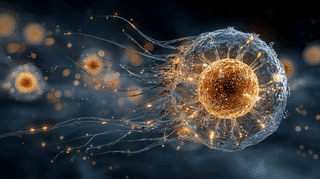
The researchers used a thin superconducting film of molybdenum and germanium in an amorphous, non-crystalline form. When a magnetic field is applied to a superconductor like this, the field threads through the film in tiny bundles called vortices, each wrapped in a swirl of current.
These whirlpools make a handy test bed. Send a current through the film and the vortices get pushed along, producing a voltage proportional to their speed. The push is set precisely by the current, and the speed is read from the voltage, so a flow of particles can be tracked with electrical measurements alone.
The film also contains tiny defects scattered at random. A moving vortex can get caught on one of them, one vortex at a time. Physicists call this pinning. But when caught vortices line up like a wall, they leave only narrow gaps. Because vortices repel each other, the ones arriving behind get held back at those gaps. That is clogging.
Pushing backward to tell two kinds of stopping apart
The team's key observation was that a clog breaks up almost immediately when the push is reversed. So they first drove the vortices into the narrow gaps until they clogged, then pushed them the other way and watched how the flow slowed down.
The flow slowed in two stages. A sharp early drop came from vortices that slipped out of one clog and quickly jammed again at another narrow gap nearby. A slow later decline came from moving vortices gradually getting caught on defects. When the team reversed the push only briefly, just enough to nudge the clogged vortices, only the fast stage appeared, because a short reversal does not free vortices stuck on defects.
The two processes run on timescales about three orders of magnitude apart, roughly 1,000 times. Yet as the driving current approached a certain value, both times grew sharply at the same point and followed the same law. The number describing that growth, called a critical exponent, came out at about 1.3 for both.
Why physicists care about being in the same family
A phase transition is a sudden change in behavior at a tipping point, like water turning into ice. One of the odd facts of physics is that completely different systems can follow the same numbers near their tipping points. Systems that share those numbers form what physicists call a universality class.
The clogging measurements, along with another exponent, matched the values for a class known as two-dimensional directed percolation. It describes systems falling into a state they can enter but cannot leave on their own, which physicists call an absorbing state. A flow that has fully clogged and stopped is exactly that kind of state.
In theory, directed percolation is the leading class for transitions into an absorbing state, but it long resisted a clean experimental test. In 2007, Kazumasa Takeuchi and Masaki Sano of the University of Tokyo and their colleagues reported what they called the first clear experimental evidence for it, in liquid crystals switching between two kinds of turbulence.
The Science Tokyo group has also used its vortex system to study three other transitions and found that all of them belong to this class. Clogging is now the fourth. The university frames the result as a unified guide for understanding many kinds of clogging.
Still, what the team actually tested was vortices inside a superconductor. This experiment cannot tell us whether coffee filters, pipes or crowds of people follow the same numbers.
Sheep, grains and colloids: the global hunt for a law of clogging
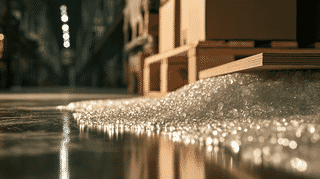
In 2014, an international team led by Iker Zuriguel of the University of Navarra in Spain compared sheep rushing through a gate to get food, computer simulations of pedestrians leaving a room, grains pouring out of vibrated silos, and simulated colloids (tiny particles suspended in a liquid) squeezing through a narrow opening. In every case, the waiting time between one body passing and the next followed the same type of statistical law. Placing a single column in front of the sheep's gate even made long stoppages less frequent.
Not everyone agrees that clogging deserves to be called a phase transition. In 2015, a University of Pennsylvania team studying grains draining from hoppers argued that there is no sharp threshold, no hole size above which the flow will never clog, and that every hopper has some chance of jamming. The Science Tokyo experiment adds a case where the push can be set precisely with an electric current, and where the tipping point and its exponents were actually measured.
In 2018, Charles Reichhardt and Cynthia Reichhardt at Los Alamos National Laboratory in the US simulated particles pushed through a random array of obstacles. Adding a periodic shaking force, an AC drive, on top of the steady push helped break up clogs, and they found an optimal frequency and strength for the shaking. As of October 2026, the Science Tokyo team's own next step is an experiment that adds AC shaking to the steady flow of vortices. The aim is to find ways to prevent clogging in a more realistic system, where pinning also plays a part.
Whether a clogged coffee filter or kitchen drain obeys the same numbers as whirlpools in a superconductor is still an open question. Which clog drives you up the wall where you live?






Global Discussion
4 comments