Kyoto's hotels are losing their Japanese guests, and they've never been more profitable. In 2025, Japanese overnight stays at major Kyoto hotels fell 10% for the third straight year. Foreign guests, meanwhile, surged 14.6% to a record high, pushing room rates to all-time peaks. At the same time, Himeji Castle introduced "dual pricing" ($6.30 for locals, $16 for everyone else) and doubled its revenue in a single month. Welcome to Japan's tourism polarization.
Kyoto by the Numbers: A City Splitting in Two
Data released by the Kyoto City Tourism Association in April 2026 paints a stark picture of divergence. At the city's major hotels (105 to 115 properties), Japanese overnight stays totaled 3.549 million in 2025, down 10.0% from the previous year, marking the third consecutive annual decline.
Foreign overnight stays, by contrast, hit 7.008 million, up 14.6% and the fourth consecutive year of growth. The total reached 10.549 million stays, with occupancy rates climbing to 80.6%.
The average daily rate (ADR) tells the story of where the money is flowing. At ¥21,286 ($134) per room, it set a new record since tracking began in 2016, up 5.8% year-on-year. Revenue per available room (RevPAR) hit ¥17,156 ($108), up 9.6%.
In short, Kyoto's hotel industry is generating record revenue despite losing a significant chunk of its domestic clientele.
Why Japanese Tourists Are Abandoning Kyoto
The reasons are layered but interconnected.
Price is the most immediate barrier. With the yen hovering around 159 to the dollar, Japan is a bargain for foreign visitors. But for Japanese travelers, the same weak currency means their domestic purchasing power hasn't kept pace with soaring accommodation costs. Business hotels in central Kyoto that once charged ¥10,000 ($63) per night now routinely demand ¥30,000–50,000 ($189–$314) during peak seasons.
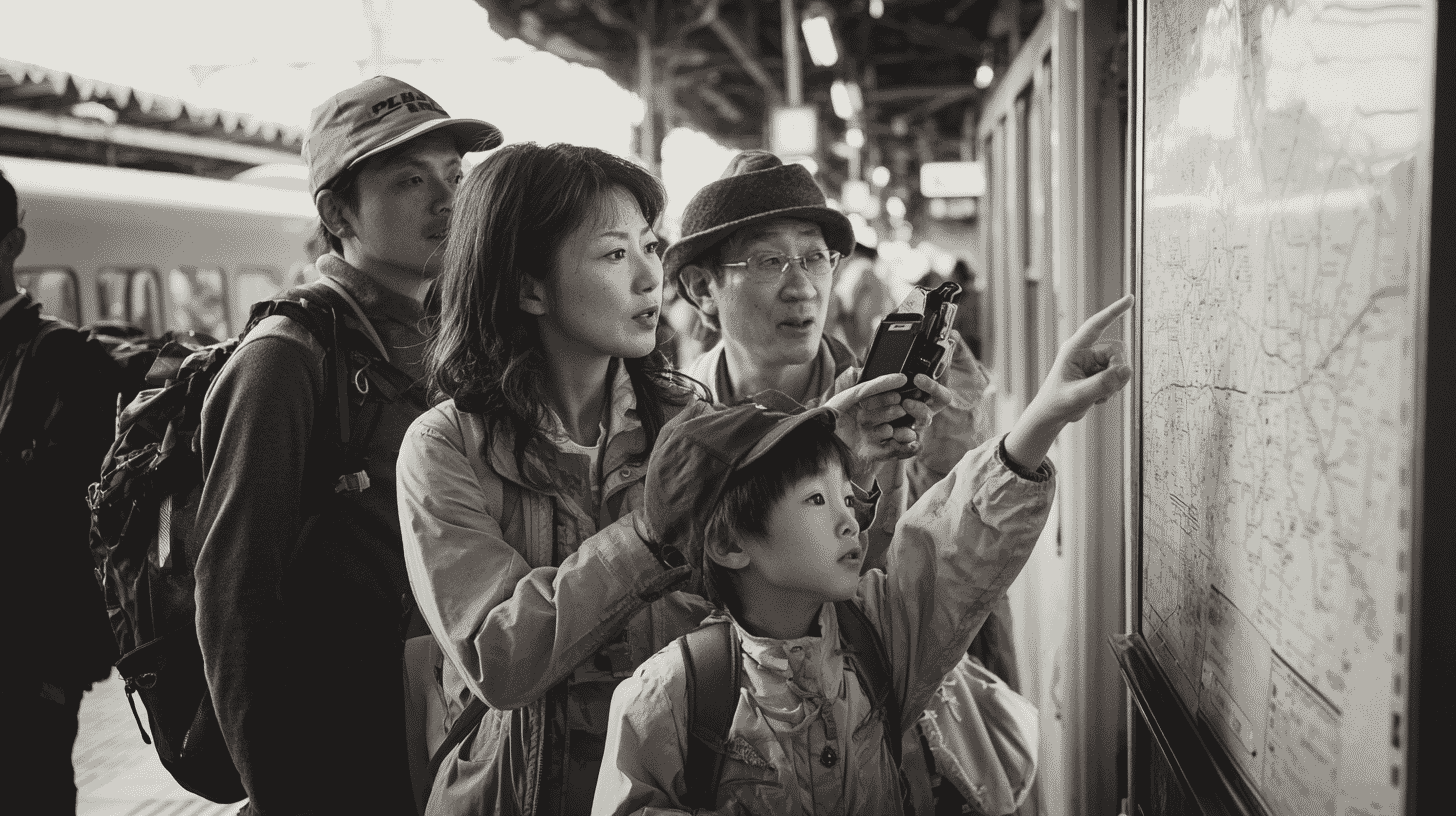
Then there's the sheer crush of people. Kyoto's population is 1.43 million. In 2024, 56.06 million tourists visited the city, roughly 40 visitors per resident over the course of the year. At Fushimi Inari Shrine, foreign visitors increased 46% while Japanese visitors dropped 23%. At Kitano Tenmangu Shrine, the divergence was even more extreme: foreigners up 42%, Japanese down 42%.
A 2024 citizen survey found that nearly 80% of Kyoto residents reported being troubled by tourist-related congestion and behavior.
Where Are the Japanese Going? The Nara Effect
Japanese tourists haven't stopped traveling, they're redirecting. Bloomberg reported that during Golden Week 2025, foot traffic at major temples and historical sites in Nara exceeded Kyoto's. The neighboring prefecture offers similar historical depth at lower prices and without the overwhelming crowds.
Within Kyoto itself, data shows Japanese visitors are shifting to lesser-known neighborhoods: Keihoku (up 59%), Yamashina (up 25%), and Takao (up 10%). The trend reflects a broader "hidden gem" movement amplified by social media, where travelers share quieter alternatives to the overtouristed hotspots.
Nationally, the pattern extends beyond Kyoto. Japan Tourism Agency data showed Japanese domestic overnight stays declining for 11 consecutive months through March 2025. JTB projected Golden Week domestic travelers would fall 7.2% year-on-year, while overseas travel from Japan would rise 10%.
Himeji Castle: The Dual Pricing Experiment
While Kyoto grapples with the slow erosion of its domestic visitor base, Himeji Castle in Hyogo Prefecture has taken a more direct approach to managing its tourism economics.
On March 1, 2026, the UNESCO World Heritage site introduced a tiered pricing system. Himeji city residents continue paying ¥1,000 ($6.30), while everyone else, Japanese or foreign, pays ¥2,500 ($15.70). All visitors under 18 enter free regardless of residency.
The catalyst was financial necessity. The castle, whose main tower was completed in the early Edo period (early 1600s), needs an estimated ¥28 billion ($176 million) over the next decade for stone wall seismic reinforcement, wall repairs, and general preservation. Mayor Hideaki Kiyomoto has been blunt about his philosophy: the castle is a cultural asset, not an observation deck competing for visitor numbers.
Notably, the city initially considered raising prices only for foreign visitors but abandoned that approach after facing criticism of discrimination. The resident/non-resident framework instead rests on the logic that Himeji taxpayers already contribute to the castle's preservation through municipal taxes. Columnist Boris Kohara, who was born in Russia and raised in Himeji, suggested framing it as a "resident discount" rather than "dual pricing" to reduce backlash.
Month One Results: Revenue Doubled
At a press conference on April 7, 2026, Mayor Kiyomoto revealed the first month's results.
March saw approximately 140,000 paying visitors, a 17% decline from the same month the previous year. Japanese visitors specifically dropped about 20%. But revenue told a different story: approximately ¥270 million ($1.7 million) for the month, doubling the previous year's ¥130 million. The city projects an annual revenue increase of roughly ¥1 billion ($6.3 million).
The mayor characterized the visitor decline as "within expectations" and noted that many other municipalities with historical heritage sites have been reaching out to study the model. The ¥2,500 price tag makes Himeji the most expensive among Japan's 12 castles with surviving original towers, yet those who truly want to experience the castle are still coming.
A Global Pattern: From Venice to Bali
Japan's tourism polarization mirrors a worldwide phenomenon. Venice introduced a €5 ($5.40) day-tripper entry fee in 2024 and expanded it to 54 days in 2025. Barcelona has seen residents protest with water guns against tourist overload. Bali now charges foreign visitors 150,000 rupiah ($10) and has begun requiring proof of financial means.
India's Taj Mahal has long charged foreigners more than 20 times the domestic rate. France's Louvre Museum differentiates between EU and non-EU visitors.
In Japan, the momentum is accelerating. Kyoto is planning dual bus fares, ¥200 ($1.30) for residents, up to ¥400 ($2.50) for others, by fiscal 2027. The national departure tax will triple from ¥1,000 to ¥3,000 ($19) in July 2026. And Japan's latest 5-year tourism plan, approved in March 2026, includes guidelines to make dual pricing easier to implement at public facilities.
The Deeper Question
The data from Kyoto and Himeji Castle illuminates a structural shift in Japanese tourism. On one side, a weak yen and global travel demand are flooding famous sites with international visitors willing to pay premium prices. On the other, Japanese domestic travelers, squeezed by inflation and priced out of their own cultural landmarks, are quietly redirecting to less crowded, more affordable alternatives.
For the hotel industry, the math works: higher-spending foreign guests more than compensate for departing domestic ones. But a tourist destination abandoned by its own citizens carries a different kind of risk, one that spreadsheets don't easily capture.
Professor Chieko Ikeda of Osaka Metropolitan University argues that national-level leadership is needed to create a sustainable tourism vision. For a country that has staked its economic future on becoming a "tourism nation" targeting 60 million visitors by 2030, the question is becoming inescapable: whose tourism industry is this, exactly?
Is overtourism reshaping the tourist destinations in your country too? What do you think of dual pricing systems, fair solution or discriminatory practice? Share your perspective in the comments.
References
- https://news.yahoo.co.jp/articles/4f2c4bcb5cc8937fa0a36bfbec5e4787a6707a04
- https://www.kyokanko.or.jp/report/hotel202512
- https://news.yahoo.co.jp/articles/20bf73fa40fffa743c452ad2fef35ca1b7b59f78
- https://www.nikkei.com/article/DGXZQOUF076230X00C26A4000000/
- https://www.bloomberg.com/jp/news/articles/2025-08-01/T08NBLGQ1YT500






Global Discussion
13 comments