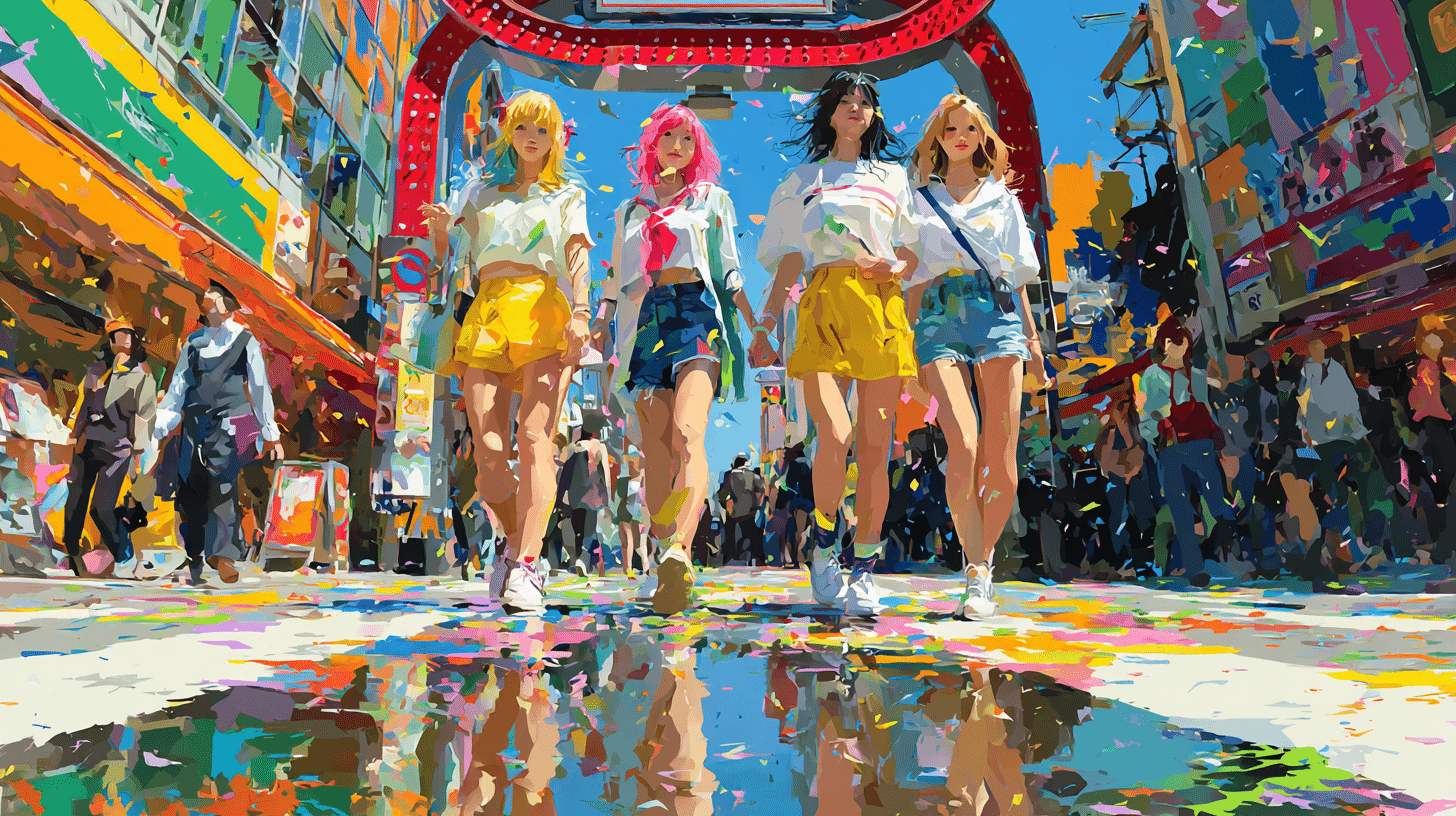
A culture born in the backstreets of Harajuku now shakes festival stages around the world. Kyary Pamyu Pamyu, Atarashii Gakko!, FRUITS ZIPPER, CANDY TUNE: every one of these artists was launched by a single Tokyo company called Asobisystem. Here's how CEO Yusuke Nakagawa spent 18 years building a pop culture ecosystem that turned "Kawaii" into a global movement.
From "Hairdresser Night" to a Culture Revolution
Asobisystem's origin story begins in 2002, when Yusuke Nakagawa, then a student at Toyo University, started a club event called "Biyoshi Night" (Hairdresser Night). Since hairdressers in Japan typically have Tuesdays off, Nakagawa rented out a club on Monday nights, creating a space where fashion, music, and lifestyle collided. The event quickly became a cult hit.
In 2007, Nakagawa formalized his network into Asobisystem Co., Ltd. While neighboring Shibuya was dominated by the "gal" fashion boom, Harajuku offered something different, a neighborhood where individuality and creative freedom thrived. Nakagawa bet everything on that energy, eventually coining the term "Aomoji-kei" (blue-letter culture) to describe the alternative, more playful fashion movement that defined Harajuku's identity. Think of it as the anti-mainstream, fashion magazines with blue mastheads rather than the red ones associated with conservative women's media.
"We don't have a fixed core business," Nakagawa has said. "What matters is people. Entertainment is the ultimate people business." His guiding philosophy has never been about chasing trends, it's about creating culture.
Kyary Pamyu Pamyu: The YouTube-Era Kawaii Icon
The artist who put Asobisystem on the global map was undeniably Kyary Pamyu Pamyu. When Nakagawa first met her as a reader model (a type of non-professional magazine model popular in Japan), his immediate impression was that she was "incredibly earnest", always punctual, always responsive, at a time when the reader model scene was still loosely organized.
Paired with electronic music producer Yasutaka Nakata, Kyary debuted as a music artist and appeared on NHK's Kohaku Uta Gassen, Japan's most prestigious New Year's Eve music show, essentially the equivalent of performing at the Super Bowl halftime show, from 2012 to 2014. Her world tours transformed "Kawaii" from a niche Japanese aesthetic into a globally recognized cultural concept.
The infrastructure of Kyary's era was YouTube. Her music videos racked up millions of views worldwide, proving that Japanese pop culture could transcend language barriers through sheer visual and sonic impact. After the birth of her first child, Kyary returned to the stage at ASOBIEXPO 2025 in July, performing live for the first time in roughly 14 months.
Atarashii Gakko!: TikTok's "Youth Representatives of Japan"
If Kyary belonged to the YouTube era, the next breakthrough belonged to TikTok.
Atarashii Gakko! (officially "Atarashii Gakko no Leaders," meaning "Leaders of the New School") is a four-member dance-vocal unit consisting of SUZUKA, MIZYU, KANON, and RIN. Formed in 2015, the group choreographs all their own routines and calls themselves the "Youth Representatives of Japan", a tongue-in-cheek title that captures their explosive, rule-breaking energy.
Their turning point was "Otona Blue," released as a digital single on May 1, 2020. The group had just come off a major label, and there was no budget for a music video, so they filmed themselves acting grown-up around town on their phones and posted it to social media. That was the promotion. Three years later, in 2023, the song's head-swinging dance went mega-viral on TikTok.
In 2021, they signed with 88rising, the U.S.-based label known for championing Asian artists, and debuted internationally. By 2023 they had performed on Kohaku, and "Otona Blue" took an Excellence Award at that year's Japan Record Awards. On April 14, 2024, they closed out the Gobi Stage at Coachella with a 45-minute solo set, arriving in custom dotera robes to a crowd that overflowed the tent. The Japan Record Awards gave them a Special International Music Award that December.
Nakagawa reflected on this shift: "YouTube was the platform in Kyary's era, but since Atarashii Gakko!, TikTok has been the major driver. The algorithm is incredibly powerful when it comes to spreading content."
KAWAII LAB.: Japan's Answer to K-Pop Training Systems
In 2022, Nakagawa witnessed the formidable K-Pop idol training infrastructure firsthand and made a pivotal decision: "We have to do Japanese idols." He launched KAWAII LAB., an idol discovery and development project inside Asobisystem, with the concept "From Harajuku to the World."
FRUITS ZIPPER: "The Cutest Thing About Me" Goes Global
The seven-member FRUITS ZIPPER debuted in April 2022, and their song "Watashi no Ichiban Kawaii Tokoro" (The Cutest Thing About Me) became an instant TikTok sensation. In 2023, they won Best New Artist at the Japan Record Awards, one of the country's most prestigious music honors, and played overseas dates in Thailand and Taiwan.
2025 was their breakout year on every front. Their third single, "Kawaii tte Magic," took the No. 1 spot on Oricon's weekly singles chart. They played an unusual number of summer festivals for an idol group. In August, a two-night third-anniversary run at Saitama Super Arena drew roughly 50,000 people, and they announced a Tokyo Dome show from that stage. At year's end came the Kohaku debut they had been chasing. Then, on February 1, 2026, about 50,000 people filled Tokyo Dome for "ENERGY," their first solo show there. Their debut venue held 150.
CANDY TUNE: "Baibai FIGHT!" Storms the Charts
CANDY TUNE, a seven-member group that debuted on March 14, 2023, was KAWAII LAB.'s third act. Their track "Baibai FIGHT!" came out as a digital release in 2024 and did nothing much for a year. Then, in 2025, it caught on TikTok and held the No. 1 spot on the platform's popular-songs chart for 10 straight weeks, the longest run in TikTok's history. Total TikTok plays passed 3.8 billion. The song took an Excellence Award at the 67th Japan Record Awards, and the group made its Kohaku debut alongside FRUITS ZIPPER.
At Kohaku, CANDY TUNE and FRUITS ZIPPER performed back to back, with CANDY TUNE handing the mic across for a high-five between songs. Member Bibian Murakawa has said the group joined Asobisystem wanting to be FRUITS ZIPPER.
The Expanding KAWAII LAB. Universe
Today, KAWAII LAB. encompasses five groups: FRUITS ZIPPER, CANDY TUNE, SWEET STEADY, CUTIE STREET (whose "Kawaii dake ja Dame desu ka?" became a massive hit), and MORE STAR. Counting IDOLATER, which disbanded in 2023, that's six acts in four years.
What makes KAWAII LAB. unique in the idol industry is its overwhelmingly female fanbase. Traditional Japanese female idol groups typically attract predominantly male fans. KAWAII LAB. flipped that: these are female idols supported by female fans, built around self-expression rather than the conventional male-gaze dynamic.
"The Day It Goes Viral Is the Real Release Date"
Two keywords define Nakagawa's approach: "aji-hen" (flavor change) and "chinetsu" (underground heat).
"Aji-hen" means subtly evolving a group's musical direction and visual identity as they grow, rather than locking into a single formula. "Chinetsu" refers to the accumulated passion between fans and artists. A TikTok moment might be fleeting, but the heat that builds between creator and audience over time is what truly makes a star.
Nakagawa also works by a striking principle: the day something goes viral on TikTok is the real release date. In traditional music industry thinking, a release date is set months in advance. For Asobisystem, the market decides when a song actually launches.
He describes his managers as closer to marketers than traditional talent handlers, and views every Asobisystem employee as a creator. "Nobody here is someone's 'attendant,'" he says. "Everyone can create something." Artists and staff make new things together, and he likens the result to a chemical reaction.
ASOBIEXPO: A Festival of Harajuku Culture
On July 20, 2025, approximately 12,000 fans gathered at Makuhari Messe for "ASOBIEXPO 2025," celebrating Asobisystem's 18th anniversary. The music-and-culture festival featured over 10 acts including Kyary Pamyu Pamyu (her post-maternity live return), Atarashii Gakko!, the KAWAII LAB. groups, virtual being KizunaAI, Toua, Klang Ruler, and PiKi.
Kyary closed the night. She ran "Fashion Monster," "Kimi ni 100 Percent," and "Candy Candy" before premiering a new song, "KURU KURU HARAJUKU," which she calls the sharpest thing she's made. At the entrance, a "Welcome Back Kyary" board filled up with instant photos and messages from fans.
From Harajuku to the World
What Nakagawa has built transcends the typical talent agency model. Asobisystem is better understood as a pop culture ecosystem, integrating event production, talent management, music, fashion, media operations, and inbound tourism initiatives (through the "Moshi Moshi Nippon Project") into a single interconnected operation.
The through-line across 18 years has been Harajuku itself, a neighborhood Nakagawa describes as a place that continuously generates something from nothing. At each technological inflection point, Asobisystem has adapted: YouTube powered Kyary's global breakthrough, TikTok propelled Atarashii Gakko! to Coachella, and the same platform launched KAWAII LAB.'s groups into the mainstream.
The timeline tells the story: Kyary on Kohaku (2012–2014), Atarashii Gakko! on Kohaku (2023) and at Coachella (2024), FRUITS ZIPPER and CANDY TUNE both debuting on Kohaku (2025), and FRUITS ZIPPER at Tokyo Dome (2026). Harajuku-born Kawaii culture is not a passing fad.
In Japan, "Kawaii" has evolved far beyond a fashion label or music genre. It's a philosophy of self-expression: the freedom to love what you love without apology. That message resonates in any language, which is precisely why it keeps crossing borders.
Does your country have a similar pop culture ecosystem, one that handles everything from discovering artists to launching them globally? And is there a cultural concept in your country equivalent to Japan's "Kawaii"?








Global Discussion
14 comments