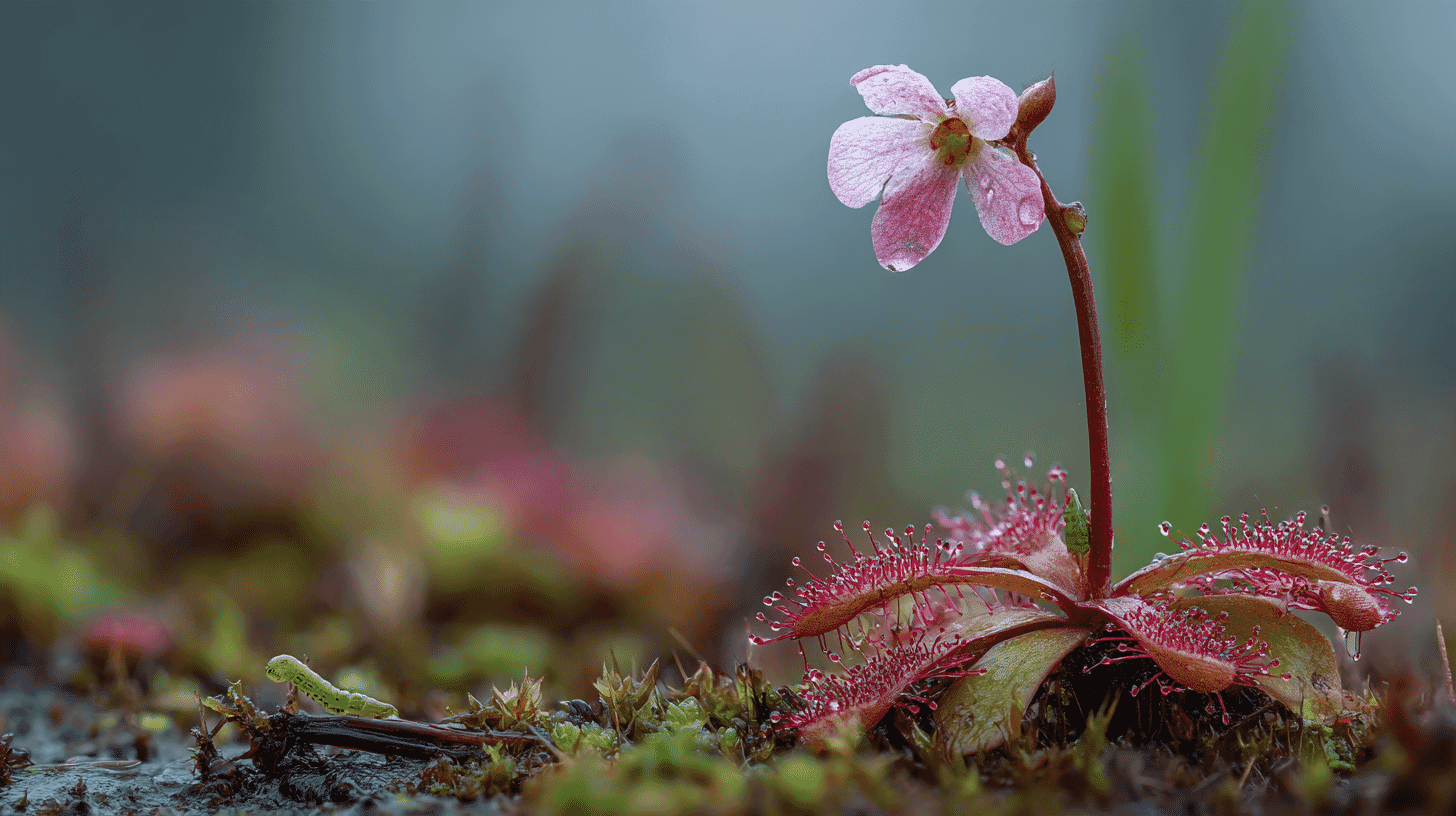
🌸 A plant that eats insects is being eaten by one. The spoon-leaved sundew, a small carnivorous plant, closes its flowers harder when touched if its leaves were damaged beforehand. A team from Naruto University of Education and other institutions showed this by cutting leaves to mimic a caterpillar's feeding, and Japanese media described it as "memory" in a plant without a brain. What the plant is actually holding on to, though, the researchers have not yet worked out.
The insect-eater that insects eat
Despite its Japanese name, komousengoke, which contains the word for moss, the spoon-leaved sundew (Drosera spatulata) is not a moss. It is a flowering plant in the sundew genus. Red hairs line its spoon-shaped leaves, and the sticky droplets on their tips glue small insects in place so the plant can absorb their nutrients. Its pink flowers stay open for only about half a day.
One insect that walks across these traps without trouble is the caterpillar of the sundew plume moth (Buckleria paludum). In 2020, Haruka Osaki, a researcher at the Museum of Nature and Human Activities, Hyogo, and Kazuki Tagawa, an associate professor of evolutionary ecology at Naruto University of Education, reported from observations in Okinawa that the caterpillars lick the mucilage off the glandular hairs as they go. With the glue gone, the hairs don't bend toward the "prey" and the leaf doesn't curl.
The moth doesn't live only in Japan. Hampshire Moths, a British recording site, lists it as a nationally scarce species, found on damp heaths and bogs in scattered parts of England and Wales, where its caterpillars feed on round-leaved sundew (Drosera rotundifolia).
The caterpillars eat more than leaves. As they grow, they move into the flowers and eat the ovules, the parts that would become seeds. In 2018, Tagawa found that sundew flowers close within about 2 to 10 minutes when the base of the flower is touched. Later experiments by the group showed that the movement helps protect the ovules from the caterpillars.
The video shows a related species, Drosera tokaiensis, closing its petals (posted by Tagawa).
Closing too often and not closing both have a price
The trigger is simple: something touched the area near the flower. But the touch doesn't always come from a caterpillar. Wind, rain and harmless animals can all brush a flower.
The researchers frame this as a dilemma. Close by mistake, and the plant wastes the energy of a fast movement and loses a chance at cross-pollination, meaning pollen from a different plant, which gives the offspring more genetic diversity. Miss a real caterpillar, and the ovules get eaten and that flower sets no seed.
The team's clue was the order in which the caterpillars eat. Right after hatching they feed on leaves; a few days later, bigger, they move on to flowers and fruit. A plant whose leaves have been eaten is therefore likely to have its flowers targeted soon. If the plant uses leaf damage as a forecast that the flowers are next, damaged plants should respond more strongly to an ambiguous touch.
15 plants against 17
The paper appeared online in the journal Ethology on July 2, 2026. The work was funded by grants from the Japan Society for the Promotion of Science. The experiment was an indoor one, with controlled light and temperature. The team cut leaves off 15 plants one day before the flowers opened, to simulate herbivory, and left 17 plants untouched as controls. Once the flowers opened, they mimicked a caterpillar climbing the stem by pinching the calyx tube, just below the flower, with tweezers once per second, 10 times in all.
Measured 15 minutes after the stimulus, the plants with cut leaves had closed their flowers to a significantly tighter angle than the controls.
Timing mattered too. Control plants closed only weakly early in the morning, right after opening, and more strongly as their internal clock brought them toward the normal closing time. The researchers read this as pollination taking priority while the flower is fresh, and defense later. The plants with cut leaves always closed strongly, whatever the hour; in the team's reading, defense had moved ahead of pollination.
The herbivory, though, was simulated by cutting leaves, not by real caterpillars. A 2021 review introduced by Tokyo University of Science notes that plants recognize defense-triggering compounds, called elicitors, in insects' saliva and other secretions. Whether a clean cut produces the same response as actual chewing can't be judged from the university's materials and the paper's abstract.
What is being kept when we call it "memory"?
Naruto University of Education's announcement puts "memory" in quotation marks. Its Japanese-language research summary says the results suggest the plant kept the information about the damage for at least one day and used it to adjust its later response, adding that this could be regarded as "a kind of memory." The English abstract of the paper is more restrained. It doesn't use the word memory at all and calls the effect "cross-organ priming." Priming is the term for an earlier stimulus making a plant's response to a later one stronger or faster.
Tagawa says the next steps are the molecular mechanism, including which chemicals are involved, and comparisons across species to trace the evolutionary background.
According to the same Tokyo University of Science review, plants that have been attacked once are known to respond faster and more strongly to a second attack, an effect thought to involve epigenetic regulation, which changes how genes are switched on without altering the DNA sequence itself. In the Venus flytrap, which shuts after its trigger hairs are touched twice, a group including Saitama University showed in 2020 that calcium signals may act as a kind of memory of the first touch. Whether anything similar happens in a sundew flower hasn't been tested.
As the research group puts it, a 2013 study on the sensitive plant, Mimosa pudica, had shown that damage strengthens the defensive movement of the damaged organ itself. Here, damage to the leaves changed how a different organ, the flower, moved. Leaf damage affecting flower defenses is not new in itself when it comes to chemical defenses. In a paper published in 2005, researchers at the University of California, Davis, reported that mechanically damaging the leaves of wild tobacco (Nicotiana attenuata) reduced the eating of its flowers and fruit in the field.
Where this sits in the "plant intelligence" fight
Talk of plant "memory" and "learning" has been contentious for a long time. In the mid-2000s, some researchers began promoting "plant neurobiology," arguing that plants have something like a nervous system. In 2007, 36 plant scientists signed a letter in the journal Trends in Plant Science pushing back: they argued there is no evidence that plants have neurons, synapses or anything like a brain, and that the label adds nothing to the understanding of plant physiology or cell biology. Two of the field's proponents, František Baluška and Stefano Mancuso, replied in a 2009 paper that they were not applying animal brains and synapses dogmatically but using the terms in a plant-specific sense.
The sundew study doesn't take either side. The Japanese summary does mention the possibility that the plant's "decision-making" changed, but what was measured was the angle of a flower 15 minutes after a touch. The data go as far as showing that damage the day before changed how strongly the plant responded.
The team does not mention farming applications. This is basic research on how a wild carnivorous plant behaves.
Where you live, how comfortable are people with saying a plant can "remember"?
References
- https://scienceportal.jst.go.jp/newsflash/20260930_n01/
- https://www.naruto-u.ac.jp/news/%e3%80%90%e3%83%97%e3%83%ac%e3%82%b9%e3%83%aa%e3%83%aa%e3%83%bc%e3%82%b9%e3%80%91%e6%a4%8d%e7%89%a9%e3%81%8c%e8%91%89%e3%82%92%e9%a3%9f%e3%81%b9%e3%82%89%e3%82%8c%e3%81%9f%e7%b5%8c%e9%a8%93%e3%82%92/
- https://www.naruto-u.ac.jp/wp-content/uploads/2026/08/media-20260818003956-vdhtlV6c.pdf
- https://doi.org/10.1111/eth.70093
- https://www.botany.one/buckleria-paludum-the-caterpillar-that-has-a-taste-for-danger/
- https://www.hantsmoths.org.uk/lep.php?code=45.029
- https://www.tus.ac.jp/today/archive/20210215_0956.html
- https://scienceportal.jst.go.jp/newsflash/20251106_n01/
- https://link.springer.com/article/10.1007/s00442-005-0284-0
- https://blumwald.ucdavis.edu/sites/g/files/dgvnsk6161/files/files/page/Alpi-2007.pdf
- https://pmc.ncbi.nlm.nih.gov/articles/PMC2688289/









Global Discussion
4 comments