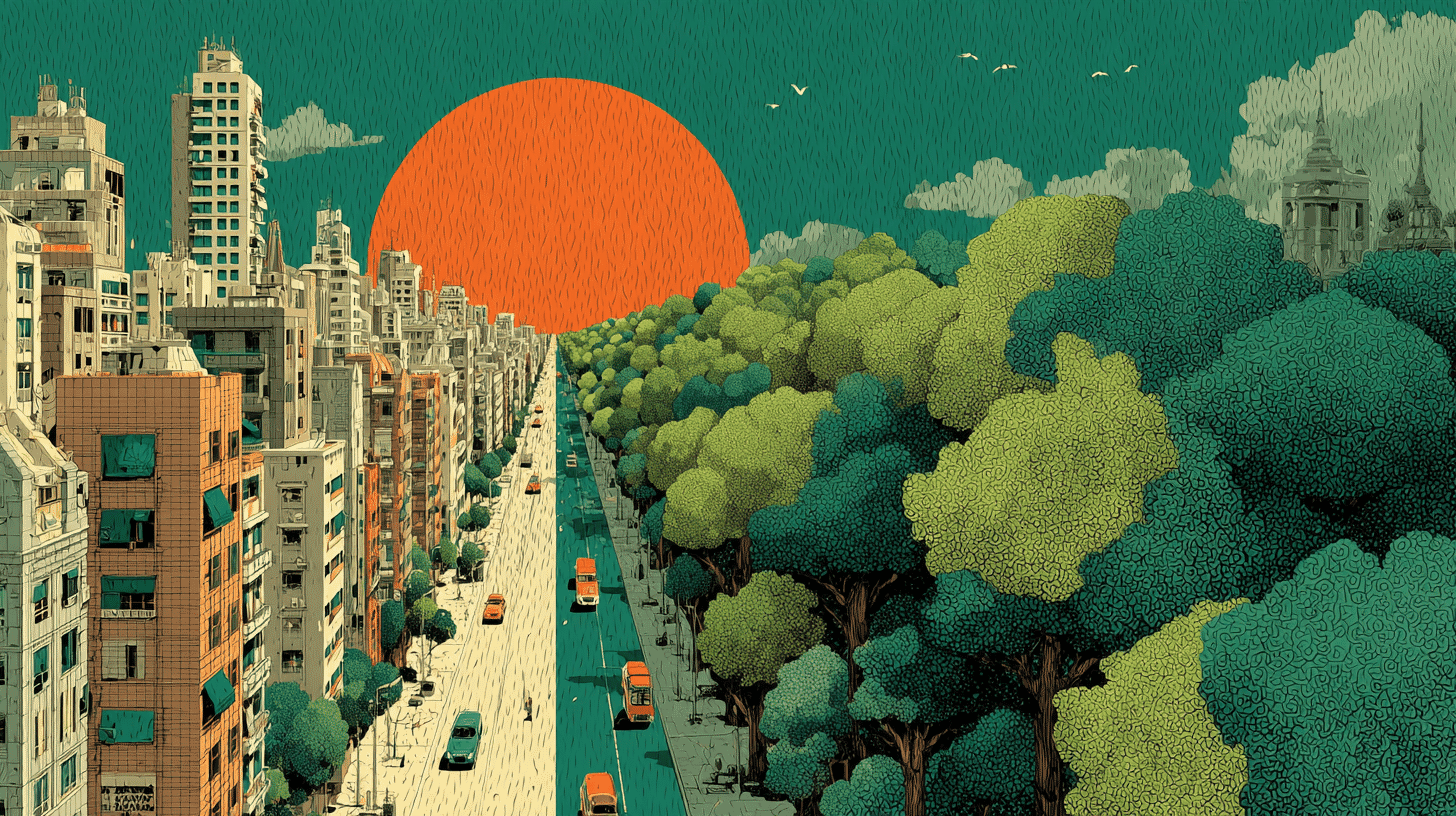
🌳 In Japan, summer used to come with a free amenity: shade.
A tree-lined street is measurably cooler than a bare one. The glare drops, the pavement stops radiating heat, the walk becomes bearable. But Japanese cities are quietly losing that cover. New satellite research shows Tokyo's tree canopy shrank by a fifth in under a decade, and the country has roughly half a million fewer street trees than it did at its peak.
What the canopy data shows
In 2024, a research team at the University of Tokyo's landscape planning lab, led by graduate researcher Kinya Shiraishi, published an analysis of how much of Tokyo is actually shaded by trees.
Their metric was tree canopy cover: the share of ground covered, seen from above, by the branches and leaves of trees. Using satellite imagery and a vegetation index, and checking the results against 10,000 sampled points, they compared the city in 2013 and in 2022.
Across Tokyo's 23 central wards, canopy cover fell from 9.2% to 7.3%. That's a drop of 1.9 percentage points, or roughly a 20% decline in just nine years. In raw area, the wards lost around 1,200 hectares of shade, comparable to about 256 Tokyo Domes.
The losses weren't even. The study found a clear gap between neighborhoods: Chiyoda Ward, home to the Imperial Palace, had the highest canopy cover at 16.7%, followed by Shibuya at 14.4% and Minato at 12.4%, while Sumida Ward in the older eastern lowlands had the lowest at 2.9%. By rate of decline, Suginami Ward led at 39.5%, followed by Nerima at 38.2% and Setagaya and Nakano at 34.7%.
And the biggest single driver wasn't street trees at all. Broken down by land use, the steepest fall was on detached-housing land, down 40.6%, against 21.4% for roads, 18.2% for educational and cultural facilities and 8.3% for parks. As land prices rise and inheritance taxes bite, large garden plots get sold and subdivided into small houses, and the garden trees come down with them.
Half a million fewer street trees
Street trees are still part of the story, and there the public numbers are just as blunt.
According to the periodic road-greenery survey compiled by Japan's National Institute for Land and Infrastructure Management, the number of tall street trees nationwide peaked around 2002 at roughly 6.79 million. By the 2022 survey it had fallen to about 6.29 million, a loss of some 500,000 trees in two decades.
Many of those trees date to the same era. Japan planted street trees in large numbers from the high-growth decades of the 1960s and 70s onward, partly to improve the look of new roads and partly to blunt air pollution. Sixty years on, a lot of them are old.
That aging shows up in a separate government dataset. A nationwide survey by the ministry found that street trees toppled, felled by decay, rot or storms, roughly 26,000 times between 2018 and 2022, an average of about 5,200 a year, and that falling trees or branches caused around 200 accidents annually. On March 30, 2026 the ministry published guidelines to promote street-tree inspection, telling road managers to prioritize school routes and emergency transport roads and to add close-up visual patrols on foot to the usual distance checks.
Why Japan is removing trees
Put those pressures together and the removals start to look less like neglect and more like a series of rational, constrained choices.
An old, oversized tree is a liability. A weakened limb really can come down on a sidewalk, and inspecting and pruning large trees means aerial platforms and specialist crews. Then there are the everyday complaints: leaves clogging gutters and drifting into shops, caterpillars in spring, slippery pavements after rain. For an official fielding those calls, removing a tree is often the quietest fix.
Money tightens the vise. As Japan's population ages, welfare spending crowds municipal budgets, and tree maintenance is an easy line to trim. One common money-saving move is to replace large, broad-crowned species with smaller ornamentals that need less pruning. Cheaper to keep, but casting far less shade.
There's also a quieter issue in how Japanese cities prune. Crews often cut trees back hard, sometimes leaving little more than a pole. Arborists elsewhere consider this severe topping unusual; it shortens a tree's life and, by the logic of the US Forest Service's "i-Tree" valuation model, strips away much of the value a mature canopy delivers. A street can keep its tree count and still lose its shade.
Singapore, Paris and New York are investing
While Japan trims, several major cities are doing the opposite, treating tree cover as climate infrastructure rather than decoration.
Singapore launched its OneMillionTrees movement in April 2020, aiming to plant a million trees in a decade as part of a "City in Nature" vision. Progress has been fast enough that the National Parks Board pulled its 2030 target forward to end-2027, and reports in early 2026 indicated the million mark had already been passed.
Paris, under mayor Anne Hidalgo, committed to planting 170,000 trees and has been turning paved squares near landmarks into small "urban forests," backed by a budget of more than €100 million; the city wants greenery across roughly a third of its area.
New York City currently has tree canopy over about 22% of its land, roughly three times the figure for Tokyo's 23 wards, and a 2023 law commits it to reaching 30% by 2040 through a dedicated Urban Forest Plan. New York State, separately, is aiming for 25 million new trees by 2033. Seoul has built "wind path forests" along rivers and roads to channel cooler air into its dense core.
The common thread is heat. Summers are getting longer and fiercer, and an established tree is one of the cheapest ways to cool a street. A study of nearly 9,000 cities published in Nature Communications in May 2026 found that urban tree cover already offsets close to half of the extra heat thrown off by pavement and buildings. Researchers caution that the benefit is uneven and weakest in the hot, lower-income cities that need it most, and that trees will cancel only about 10% of the warming expected by mid-century, or roughly 20% with ambitious planting.
What gets measured
There's a reason the University of Tokyo team measured canopy rather than counting trunks, and it's worth dwelling on.
For decades, Japan's greenery debate ran on quantity: how many trees, how many hectares of park. A tree count, though, can hold steady while the actual shade collapses, especially if mature broad-crowned trees are swapped for small ornamentals, or pruned down to poles. Counting trunks misses that entirely. Measuring canopy, increasingly with satellite imagery and LiDAR, captures what a pedestrian actually feels.
It also points toward smarter spending. Research on New York found that planting trees along just 1.5% of the street network, the hottest and busiest segments, cut heat-exposed travel by nearly a fifth. Shade, placed deliberately, goes a long way.
A widening gap
None of this erases the trade-offs. A weak limb can hurt someone; a stretched city budget really does have to choose between repaving a road and pruning a row of zelkovas. The officials removing trees aren't careless. They're working with shrinking resources and a constant stream of complaints.
But the gap with other major cities is widening, and at the worst possible time. As Japanese summers stretch toward nearly half the year of serious heat, the cities that kept their canopy, or rebuilt it, will be measurably cooler places to live.
So here's the question worth arguing over. Look down your own street. Is the green filling back in, or thinning out? And if your city is planting, who decided that, and who's paying for it?
References
- https://www.tokyo-np.co.jp/article/364438
- https://www.mlit.go.jp/report/press/road01_hh_002080.html
- https://www.nilim.go.jp/lab/bcg/siryou/tnn/tnn1050pdf/ks105005.pdf
- https://www.nparks.gov.sg/treessg/one-million-trees-movement
- https://www.weforum.org/stories/2022/08/paris-trees-climate-change/
- https://www.urbanforestplan.nyc/
- https://phys.org/news/2026-05-trees-counter-world-urban.html
- https://www.nikkei.com/article/DGXZQOUE241YB0U6A220C2000000/




Global Discussion
0 comments