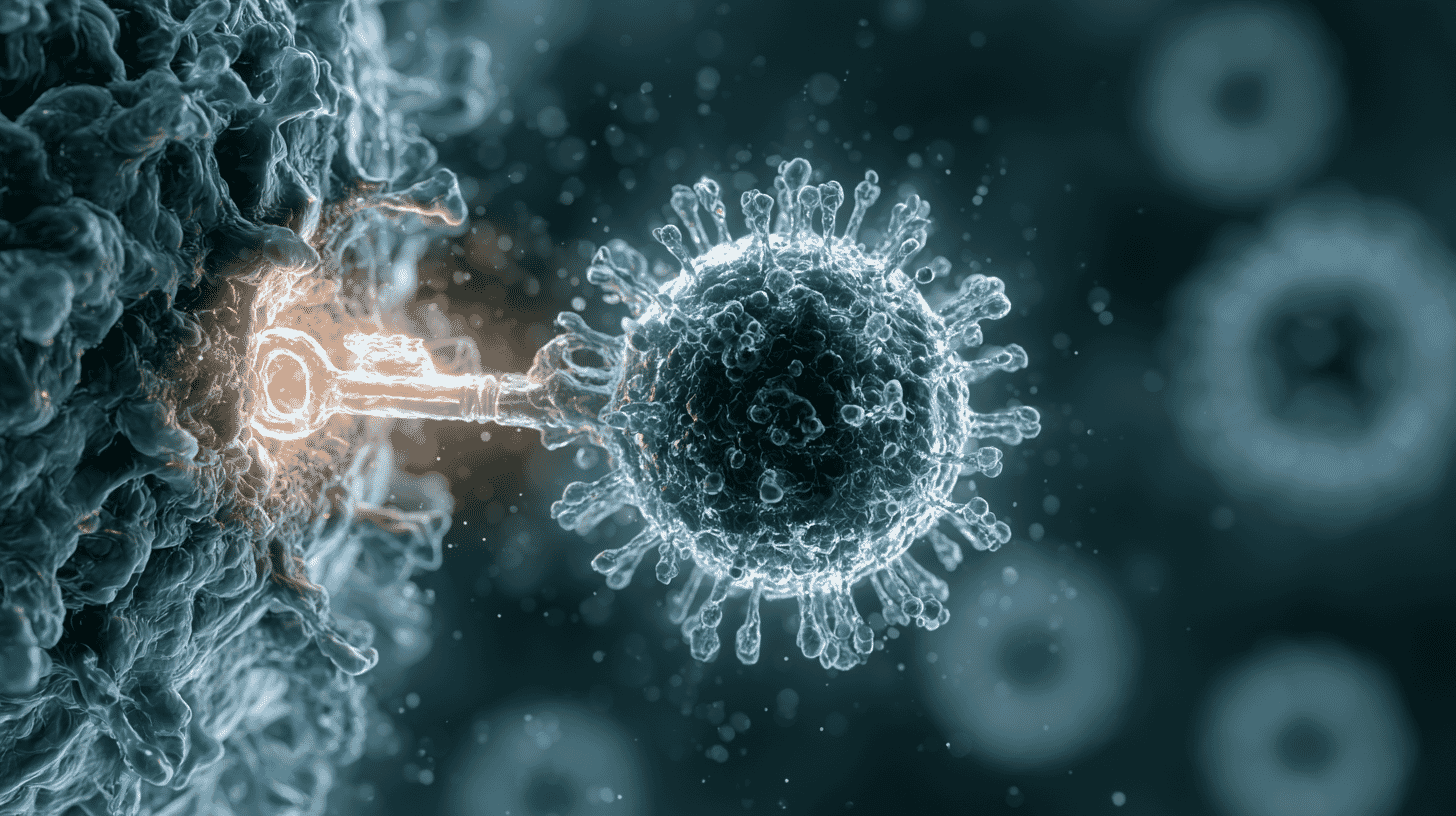
🦠 A virus that gives you a cold. A surgeon who couldn't let go of an idea. And a cancer so aggressive that, for the patients in this story, doctors had run out of standard options. On June 8, those three threads finally tied together: Japan approved Telomelysin, the world's first tumor-killing virus drug cleared for esophageal cancer. Getting here took 35 years.
The surgeon who wanted to treat cancer with a virus
Toshiyoshi Fujiwara was a young Japanese surgeon studying abroad at MD Anderson Cancer Center in Texas in 1991, at a moment when oncology was being rewired by a single idea: cancer is, at heart, a disease of genes. If broken genes drive a tumor, the logic went, then maybe you could fix or exploit them. Fujiwara's first attempt was to load a harmless cold virus, an adenovirus, with p53, a famous tumor-suppressor gene, and inject it straight into a tumor.
That early work planted a stubborn question that would follow him home to Okayama University: could a virus be turned into a weapon that destroys cancer on its own, while leaving healthy tissue alone?
The answer he and his team landed on was elegant. Most cancer cells switch on an enzyme called telomerase, which lets them keep dividing without aging out, while normal cells barely use it. So the researchers took a mild type-5 adenovirus and rewired its replication switch to fire only when telomerase is present. Inside a cancer cell, the virus copies itself by the hundreds of thousands (Okayama University describes it multiplying 100,000 to a million times in a single day) and bursts the cell apart. In a normal cell, the virus gets in but finds no telomerase to flip the switch, so it simply sits there and fades. They called it Telomelysin.
In 2004, Fujiwara teamed up with Yasuo Urata, a pharmaceutical-industry veteran who had worked at Ono Pharmaceutical and Japan Tobacco, to spin the science out of the university and into a company: Oncolys BioPharma.
Why "promising" took two decades to become "approved"
Having a clever virus in a lab dish is not the same as having a medicine, and the gap between the two is where most biotech stories quietly die.
Telomelysin's human testing started not in Japan but in the United States, with a Phase I safety trial beginning in 2006 under the US Food and Drug Administration. The basic idea held up: in those early patients, the company reported no severe side effects and some shrinkage at the injection sites.
The harder wall was regulatory and conceptual. A self-replicating, genetically modified virus is not a normal pill; it is a living thing being deliberately introduced into a person's body, and every hospital that wanted to use it had to build detailed handling protocols for it. In his company columns, Urata wrote bluntly about how long it took simply to get Japanese trial approval, and about the work of pushing through that "wall" of regulation around gene-modified replicating viruses. There was also a quieter problem: a virus injected into a tumor only attacks what it can reach. On its own, Telomelysin was a local treatment looking for the right local battle.
The accident that pointed at the esophagus
The turning point came from the lab bench rather than the clinic. Researchers found that Telomelysin did something they hadn't designed it to do: it interfered with cancer cells' ability to repair their own DNA. Radiation therapy kills tumors precisely by damaging that DNA, but cancer cells are maddeningly good at patching themselves back up. Knock out the repair crew, and the radiation lands much harder.
That discovery reframed the whole project. Instead of asking the virus to win alone, the team paired it with radiation and went looking for a cancer where that combination would matter most. They found it in esophageal cancer, specifically in patients who can't have surgery and can't tolerate standard chemo-radiation because their bodies are too weakened. For those people, the menu of real options is close to empty.
From 2013, Okayama University ran a clinical study injecting Telomelysin into the tumors of such patients during a course of radiation. Company-run trials followed: a Phase I from 2017 at Okayama University and the National Cancer Center Hospital East, then, from 2020, a Phase II across 17 of Japan's high-volume esophageal-cancer centers. The drug is delivered through an endoscope threaded down the throat, with the virus injected directly into the tumor: three doses over the weeks of radiation, no incision required.
What the trial showed, and what it didn't
The approval rests on a pivotal phase II trial, OBP101JP, run at 17 hospitals in Japan. It enrolled 37 patients with stage II to III esophageal cancer who were unsuited to both surgery and chemo-radiation; roughly 76 percent were over 80, and almost all had squamous cell carcinoma. The local complete response rate at 18 months was 50.0 percent, clearing the pre-set threshold. Overall survival at 18 months was 56.6 percent and cancer-specific survival 70.1 percent. The company has also reported an interim look at 24 weeks, when 41 percent of patients saw their cancer disappear completely and 58.3 percent benefited to some degree. For a population that had effectively been told there was nothing standard left to try, that is a striking result.
The health ministry's advisory subcommittee on regenerative medicine and biological products signed off on May 21, and the formal manufacturing-and-marketing approval landed on June 8. Telomelysin (generic name suratadenoturev) is now cleared for esophageal cancer that can't be removed surgically and isn't suited to chemo-radiation. Notably, it came through as a standard approval rather than the conditional, time-limited kind, which is unusual for a regenerative medicine product in Japan. It was also a Sakigake priority-review designee; the reexamination period runs ten years, and post-approval surveillance will cover all 85 planned cases. Fujifilm Toyama Chemical will handle distribution, starting at roughly 80 hospitals with a goal of expanding past 300. Sales are planned for later this year once the drug is added to the reimbursement price list; the official price hasn't been set.
[Update] On June 24, 2026, the Central Social Insurance Medical Council agreed that Telomelysin will be handled as a pharmaceutical for reimbursement purposes, moving the pricing process a step forward. (Added June 25, 2026)
It's worth being precise about the "world first" claim, because it's narrower than the headlines suggest. Oncolytic viruses, meaning viruses engineered to kill cancer, are not new. The United States approved the first one, T-VEC, for melanoma back in 2015, and Japan approved its own, Delytact, for a brain cancer in 2021. Both of those are built from herpes virus. What's genuinely new about Telomelysin, according to Oncolys and Okayama University, is that it's the first such drug approved anywhere specifically for esophageal cancer, and likely the first oncolytic adenovirus product to reach the market. The treatment also isn't gentle in every respect: reported side effects include a drop in lymphocytes, inflammation of the esophagus, and fever.
A small Japanese lab against a global killer
The stakes here are bigger than one approval. Esophageal cancer is one of the world's deadlier cancers. By GLOBOCAN's 2022 count, there were roughly 511,000 new cases and 445,000 deaths a year, about three-quarters of them in Asia. In East Asia, including Japan and China, the squamous-cell type that Telomelysin targets dominates. This is not a niche disease.
There's a second, quieter reason this matters. Drugs that begin inside a university lab rarely survive the journey to a pharmacy shelf; the cost, the years, and the regulatory gauntlet usually hand the finish line to large drugmakers. A treatment carried from a single surgeon's 1991 idea all the way to approval by an academic spinout is, in Japan's drug industry, genuinely rare, and a quietly encouraging sign for the next researcher with a strange idea and no big company behind them.
None of this makes Telomelysin a cure. It's aimed at a specific, difficult group of patients, it works alongside radiation rather than replacing it, and the long-term picture will only come into focus as more people are treated. But for a patient facing esophageal cancer with no surgery and no standard chemo-radiation on the table, "we have something to try" is not a small sentence.
Japan tends to treat cancer aggressively, with surgery and chemo-radiation as the front line. When those aren't possible, the options thin out fast. How does your country handle the patients who fall through that gap? And would a virus injected straight into a tumor feel like hope, or like science fiction, to people where you live?
References
- https://news.yahoo.co.jp/articles/1a73dbd5e00b834a99eb6eb3e197b091a6f84bb1
- https://www.okayama-u.ac.jp/tp/release/release_id1480.html
- https://prtimes.jp/main/html/rd/p/000003654.000072793.html
- https://www.oncolys.com/jp/column/2017.html
- https://medica.sanyonews.jp/article/6345/
- https://finance.logmi.jp/articles/384079
- https://www.mixonline.jp/tabid55.html?artid=80257






Global Discussion
4 comments