🔋 Radioactive waste doesn't stop being a problem once it's buried. It has to be watched so any leak is caught early, and the instruments doing the watching need electricity. A cable can snap in an earthquake. A battery means someone has to go in and swap it. So a team at Japan's National Institute of Advanced Industrial Science and Technology (AIST) asked a question that sounds backwards: what if the waste powered its own watchman?
They have now tried it inside the Fukushima Daiichi nuclear plant. The output is tiny, about 1 microwatt. For a sensor that only reports now and then, that may be enough.
Make it glow, then catch the light
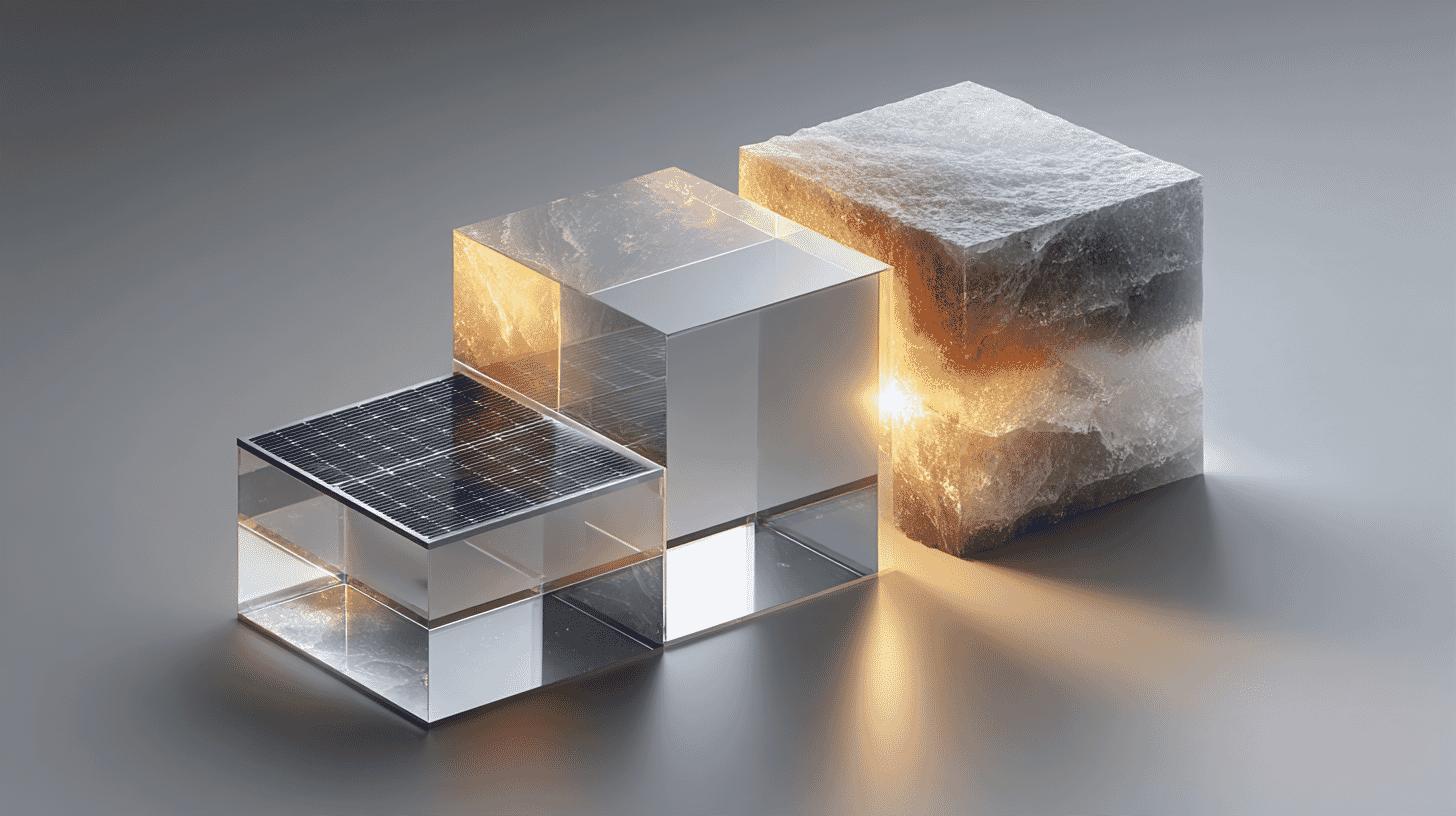
The device, reported by the Japanese industrial daily Nikkan Kogyo Shimbun on October 20, 2026, borrows a trick from radiation detectors. A crystal of cesium iodide gives off a faint flash of light when gamma rays pass through it. Detectors count those flashes to measure radiation. The AIST team, led by group leader Takeshi Fujiwara, turns them into electricity instead by pointing a solar cell at the crystal.
Rooftop solar panels are built for sunlight, which mixes many colors. The crystal's glow sits in a narrow band, so the team made a cell from a gallium indium phosphide compound semiconductor tuned to that light. The crystal is a single crystal, which lets more of the light escape, and it is wrapped in mirrors that steer the light toward the cell.
The prototype, about the size of a plastic drink bottle, contains no radioactive material. Its energy comes from gamma rays given off by whatever waste it sits beside.
A few hours inside Fukushima Daiichi
According to the newspaper, the team generated power in the radiation environment of Fukushima Daiichi and used it to run a wireless transmitter. The details are in a preprint, a paper not yet peer reviewed, that the researchers posted on SSRN on February 7, 2026. As of October 23, 2026, we could find neither a peer-reviewed version nor a press release from AIST.
The preprint says the device was placed inside a storage facility at the plant that holds contaminated materials, at a spot where the dose rate was about 35 millisieverts per hour. For scale, Japanese rules cap a radiation worker's exposure at 50 millisieverts a year. Someone standing at that spot would reach the annual limit in under an hour and a half.
The harvested power first goes into a thin-film rechargeable battery. An ultra-low-power management circuit then releases it in short bursts to a sub-gigahertz radio transmitter. With no external power, the system sent several transmissions over a few hours. Comparing the stored voltage before and after each one, the team found that gamma-ray harvesting covered a substantial share of the energy the transmissions used.
The preprint also reports a limit: at this little power, the circuit needs a certain amount of energy just to wake up from a dead stop, and that requirement became a serious limit on restarting itself again and again without help.
2.5 volts, about 1 microwatt
The number that stands out in the Japanese report is 2.5 volts, enough voltage for memory chips and radio modules, and cells can be wired in series to push it higher. But voltage isn't power. Volts describe how hard the current is pushed; watts describe how much energy actually flows. Published material also doesn't make clear whether the bottle-sized prototype is the same device described in the preprint.
The preprint puts the power at about 1 microwatt, one millionth of a watt. That will never charge a phone. What it can do is trickle energy into a small battery until there's enough for one sensor reading and a short radio burst, then start filling up again.
For a monitor sitting next to buried waste, that trade can make sense, because in principle it needs no cable and no battery swaps for as long as the waste keeps emitting. Nikkan Kogyo reports that such a power supply could lower facility running costs and reduce the risk of losing power to earthquakes or broken lines.
Output should depend on how much radiation reaches the crystal, so the device would produce more where conditions are worse. A US team saw that pattern in the lab, as described below. The flip side: waste becomes less radioactive over the years, and output will fall along with it.
No radioactive material inside
Nuclear batteries have made headlines before, but most work differently. In December 2024, the UK Atomic Energy Authority (UKAEA) and the University of Bristol unveiled a battery that seals carbon-14 inside diamond and delivers continuous microwatt-level power. Carbon-14 has a half-life of 5,700 years. In January 2024, the Chinese startup Betavolt announced its BV100, which pairs nickel-63 with a diamond semiconductor. The company says it delivers 100 microwatts at 3 volts and can run for 50 years.
Both carry their radioactive source inside, which makes them self-contained. In exchange, they involve a regulated isotope: UKAEA points out that British rules require strict safety procedures for carbon-14.
The AIST device runs on radiation that's already there, and stops once it's moved away from the waste. For a monitor that only has to work at a waste site, that isn't a drawback.
AIST isn't the first to try the idea. A 2017 paper in the journal Progress in Nuclear Energy already examined using a scintillator and a photovoltaic cell to turn radiation from spent nuclear fuel into electricity. More recently, in early 2025, researchers at Ohio State University and the University of Toledo described a prototype of about 4 cubic centimeters in the journal Optical Materials: X that also pairs a scintillator crystal with a solar cell. In tests at Ohio State's Nuclear Reactor Laboratory, it produced 288 nanowatts with cesium-137 and 1.5 microwatts with the much stronger cobalt-60. The team saw its uses close to the sources of nuclear waste, for example in waste storage pools.
What sets the Japanese work apart from the Ohio State tests is the setting. It ran at a real decommissioning site rather than in a lab, and the harvested power was used to send data.
Next: making it cheap
Nikkan Kogyo describes the project as being at the proof-of-concept stage. Single crystals are expensive, so the team plans to move to polycrystalline cesium iodide and redesign the device, dropping the mirror enclosure, into something easier to manufacture. No timeline for practical use has been given.
Letting hazardous waste power the equipment that watches over it is an unusual idea. Would it go over well where you live?
References
- https://newswitch.jp/p/50575
- https://doi.org/10.2139/ssrn.6191942
- https://laws.e-gov.go.jp/law/347M50002000041
- https://bristol.ac.uk/news/2024/december/diamond-battery-media-release.html
- https://www.ukaea.org/case-studies/carbon-14-diamond-battery/
- https://www.techradar.com/phones/a-tiny-radioactive-battery-could-keep-your-phone-running-for-50-years
- https://news.osu.edu/scientists-design-novel-battery-that-runs-on-atomic-waste/
- https://doi.org/10.1016/j.omx.2025.100401
- https://doi.org/10.1016/j.pnucene.2016.10.004





Global Discussion
4 comments