🪲 Two boys went bug-hunting on a small island in southern Japan and thought they'd grabbed a crab. What they actually caught was a stag beetle with a slim, dainty "female" jaw on one side and a big, brawny "male" jaw on the other. It is the kind of oddity that makes people reach for the word gynandromorph, half-male and half-female. Except, as one museum expert gently pointed out, this little beetle might not be one at all.
The beetle they mistook for a crab
The find happened at Keinan Elementary School in Minamitane, a town on Tanegashima, the rocket-launch island off the southern tip of Kagoshima Prefecture. Two fifth-graders spotted something hunched in the grass. One of them figured it was a crab, scooped it up, and only then realized: it was a stag beetle.
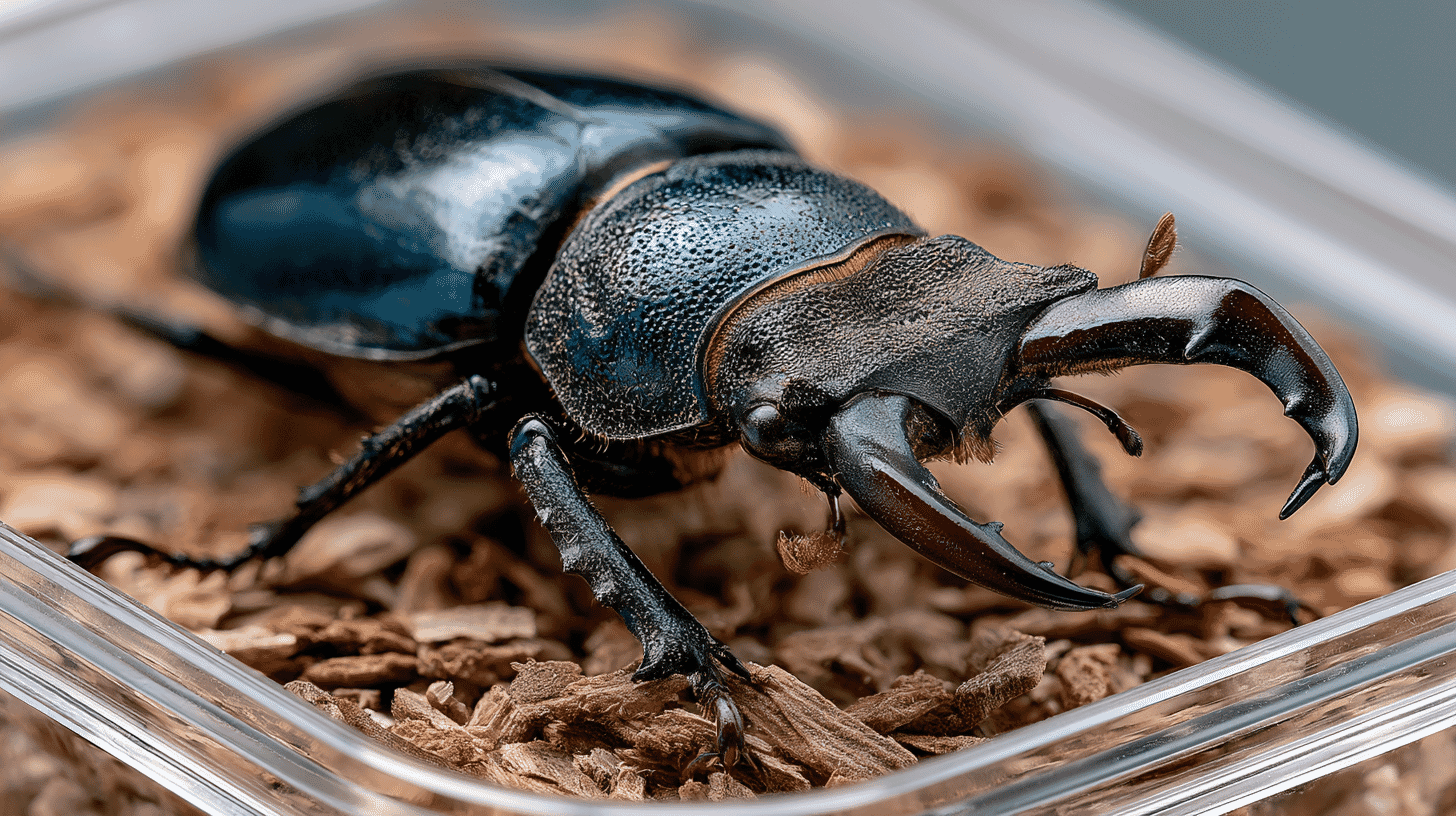
It now lives in a clear case in the principal's office, about 4.5 centimeters long. What makes people lean in close is its pair of "ōago," the oversized mandibles that give stag beetles their pincer look. On the left, the jaw is small and delicate, the way a female's would be. On the right, it's large and curved, unmistakably the jaw of a male. The school's science teacher said the mismatched pincers jolted loose a childhood memory: a similar beetle reported on TV 28 years earlier.
Half male, half female? Not so fast
The tidy story writes itself: a beetle split straight down the middle. But when photos reached Koji Nakamine, a curator at the Kagoshima Prefectural Museum, he was careful not to jump.
In a genuine left-female, right-male animal, the two halves differ everywhere, not just in one body part. The overall build, the size, even the sheen of the shell would fall out of sync between the two sides. This beetle doesn't do that. Apart from the jaws, it's uniform: same shape, same gloss, left and right. So rather than a male-female mosaic, Nakamine reads it as an asymmetry of the mandibles: most likely a developmental variation, a quirk that turns up in nature at very long odds. In his words, he'd never seen one himself.
Which is worth pausing on, because the textbook version, a real gynandromorph, is one of the strangest tricks in biology.
What a real gynandromorph actually is
A gynandromorph is a single animal built partly from male cells and partly from female ones. It isn't a hermaphrodite, which carries both sets of reproductive organs; it's more like two genetic sexes sharing one body. In the most striking cases, the split is bilateral: female on one side, male on the other, divided almost perfectly down the midline.
How does that happen? Usually through a mistake in the very first cell divisions of the embryo. As the fertilized egg starts copying itself, a sex chromosome can get lost or mis-sorted in one of the new cells. From that point on, that cell and everything descended from it carry a different genetic sex than the rest. If the slip-up happens at the very first division, one whole half of the body grows up female and the other half male.
Here's the part that makes insects such show-offs about it. In mammals, sex is broadcast body-wide by hormones. Testosterone and estrogen travel through the blood and shape the whole animal at once. Insects mostly don't work that way. They have little to no circulating sex hormone, so each cell reads its own chromosomes and decides its own sex, locally, on its own. A female-patterned wing and a male-patterned wing can therefore grow side by side on the same body. The classic image is a butterfly with one brown "female" wing and one iridescent-blue "male" wing. Think of it this way: mammals get their sex announced over a loudspeaker, while in insects every cell casts its own vote.
Which is exactly why Nakamine hedged. A true gynandromorph stag beetle would give itself away across the entire body, not just at the tips of its jaws.
Why a lopsided beetle is a big deal in Japan
To understand the fuss, you have to know how much Japan loves its beetles. Every summer, kids fan out with nets and cages to hunt kabutomushi (rhinoceros beetles) and kuwagata (stag beetles), then raise them at home on fruit and jelly cups. Elementary schools keep them as class pets. There's a long tradition of mushi-zumō, beetle sumo, pitting two males against each other. Pet shops sell larvae by the tub. The habit runs deep enough that Satoshi Tajiri, the creator of Pokémon, has traced the whole franchise back to catching bugs as a boy.
The obsession isn't only Japanese. Exotic beetle-keeping and specimen collecting have a serious global following, and among collectors, gynandromorphs sit in a prized category all their own, listed at specialist insect auctions right alongside rare "aberrations." So a stag beetle with mismatched jaws, found by two kids, lands squarely in the middle of a culture already primed to be delighted by it.
The boys, for their part, had a more down-to-earth take. One pointed out that the small jaw would be useless in a fight, which, to him, was a plus: kept safe at school, this beetle won't brawl with rivals and get itself killed. The other just wants to feed it, change its soil, and keep it around as long as he can.
Whatever the label lands on, a rare mutation or a genuine gynandromorph, the beetle did the thing a Japanese summer is supposed to do: it got two fifth-graders crouched in the grass, looking hard at something alive. In your country, do kids go hunting for beetles, or keep them as pets? And have you ever come across a creature that nature seemed to have assembled just a little differently?









Global Discussion
4 comments