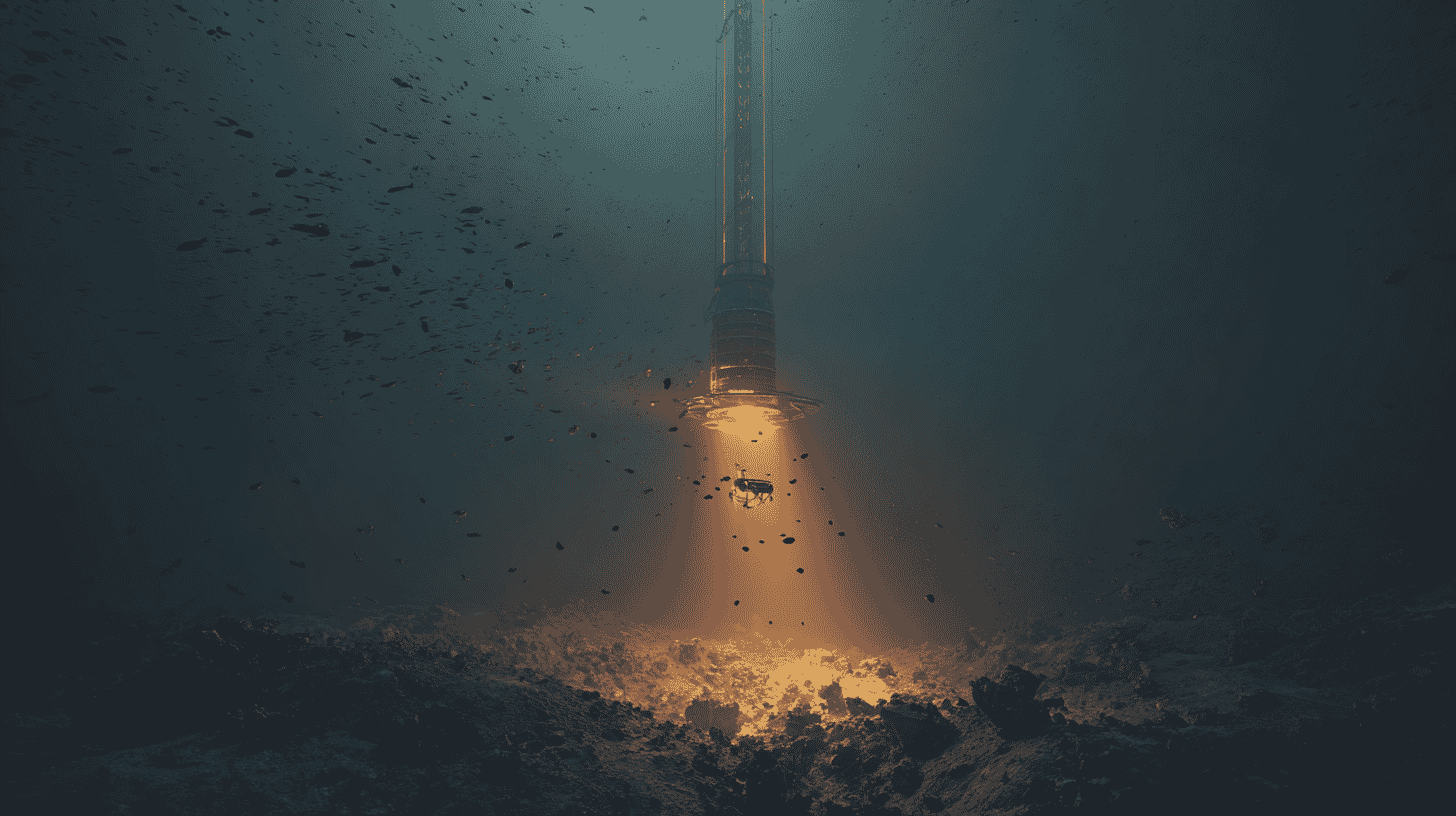
Japan's exclusive economic zone is the sixth largest in the world. At the bottom of its seas, 6,000 meters below the surface, lies rare earth mud 20 times richer than China's land-based mines. In early 2026, the research vessel Chikyu pulled this mud to the surface for the first time in history. The notion that Japan is a resource-poor nation is being rewritten from the ocean floor.
A Historic Milestone: Extracting Rare Earth Mud from 6,000 Meters Deep
In mid-January 2026, the deep-sea drilling vessel Chikyu departed Shimizu Port in Shizuoka Prefecture, heading for waters near Minamitorishima (Marcus Island), roughly 1,900 kilometers southeast of Tokyo. Its mission: to extract "rare earth mud" from the seabed approximately 6,000 meters below the surface.
In early February, Japan's Cabinet Office and the Japan Agency for Marine-Earth Science and Technology (JAMSTEC) announced the extraction was successful. Science Minister Yohei Matsumoto posted a real-time update on X (formerly Twitter), underscoring the government's keen interest. No one in the world had previously extracted rare earth mud from this depth, making it a landmark achievement in deep-sea resource development.
The test was conducted under the Strategic Innovation Creation Program (SIP) ocean project. A full-scale mining trial is scheduled for February 2027, and if successful, it will pave the way for industrialization from fiscal year 2028 onward.
What Exactly Is Rare Earth Mud?
Rare earth mud is a clay-like sediment that has accumulated on the deep ocean floor over tens of millions of years. It formed as the remains of marine plankton absorbed rare earth elements dissolved in seawater. A team led by Professor Yasuhiro Kato at the University of Tokyo first identified massive deposits near Minamitorishima in 2013.
This mud has been dubbed "dream mud" for good reason. It contains high concentrations of rare earth elements, particularly neodymium and heavy rare earths such as dysprosium, critical components in EV motors and wind turbine generators. The deposits are vast and widely distributed across the deep sea floor. They occur in flat layers, making exploration relatively straightforward. The mud is remarkably clean, containing almost no radioactive thorium or uranium. And rare earths can be extracted using simple dilute hydrochloric acid processing. The rare earth mud near Minamitorishima is 20 times richer than Chinese land-based mines, making it the highest-grade deposit in the world. Just the most promising areas within Japan's EEZ contain enough resources to meet the country's domestic demand for decades to centuries.
Japan's Undersea Treasure Map: Four Types of Seabed Minerals
Rare earth mud is just one of four major seabed mineral resources found within Japan's waters.
Seafloor massive sulfide (SMS) deposits, also called hydrothermal deposits, form when metal-laden hot water from underwater volcanic activity cools and precipitates. They contain copper, zinc, lead, gold, and silver. Found at depths of 500 to 3,000 meters in the Okinawa Trough and Izu-Bonin Arc, these deposits gained global attention in 2017 when JOGMEC (Japan Organization for Energy and Metals) achieved the world's first continuous ore lifting from 1,600 meters off Okinawa. Surveys have confirmed over 51.8 million tons of estimated resources across these areas.
Cobalt-rich ferromanganese crusts coat seamount slopes in layers several centimeters thick. They contain cobalt, nickel, platinum, and rare earth elements. Waters around Minamitorishima are considered especially promising, and JOGMEC successfully tested drilling equipment at 930 meters depth in 2020.
Manganese nodules are potato-sized lumps of iron-manganese oxide scattered across the deep sea floor, rich in copper, nickel, and cobalt, the "battery metals" essential for lithium-ion batteries. A June 2024 survey confirmed a continuous distribution zone exceeding 10,000 square kilometers within Japan's Minamitorishima EEZ, containing an estimated 230 million tons. That is equivalent to more than 75 years of Japan's annual cobalt consumption. In February 2025, Pacific Metals Co. achieved the world's first commercial-scale continuous smelting of manganese nodules.
Engineering Innovation: Japan's Closed-Loop Mining System
To extract rare earth mud from extreme depths, Japanese engineers developed a proprietary "closed-loop circulation" mining system.
Building on mud circulation techniques used in oil and gas drilling, the system lowers a long pipe from the Chikyu to the seafloor, connecting it to a cylindrical "mining machine." Water circulates internally while a drill collects the sediment, which is then pumped up to the ship.
The key advantage is that the entire operation runs as a closed system. Disturbed sediment does not leak into the surrounding water, minimizing suspended particle dispersion and protecting deep-sea ecosystems. The team had already proven the concept at 2,470 meters in 2022, the 2026 trial dramatically scaled this up to the 6,000-meter class.
Because rare earth mud occurs in thin layers rather than thick seams, future commercial operations will likely require a mobile approach, drilling at one location before moving to the next. Developing efficient relocation technology remains a key engineering challenge.
Why Now? Economic Security and the China Risk
The urgency behind seabed resource development is driven by the geopolitical vulnerability of rare earth supply chains.
China accounts for roughly 70 percent of global rare earth production and dominates refining and magnet manufacturing as well. In the 2010 "Rare Earth Shock," China effectively imposed an export embargo that sent shockwaves through global industry. In 2025, China restricted exports of seven types of rare earths as retaliation against U.S. tariffs. Rare earth magnet exports plunged 70 percent year-on-year in May 2025, directly impacting Japan's automotive sector.
EV drive motors, wind turbines, smartphones, LED lighting, defense equipment, modern high-tech industry simply cannot function without rare earths. Depending on a single country for these materials has become an untenable risk.
The Japanese government's "Ocean Development Priority Strategy" positions seabed mineral industrialization as a pillar of economic security. If the Minamitorishima project succeeds, Japan could become the world's third-largest holder of rare earth reserves, fundamentally reshaping its resource identity.
The Global Deep-Sea Mining Tug-of-War
Deep-sea resource development is not solely a domestic Japanese affair. Seabed minerals in international waters are designated "common heritage of humankind" under the UN Convention on the Law of the Sea (UNCLOS) and managed by the International Seabed Authority (ISA).
The ISA had aimed to finalize its commercial mining regulations, the "Mining Code", by 2025, but failed to reach consensus. Negotiations have been pushed to 2026. Member states remain deeply divided: Germany, Canada, and Portugal have called for moratoriums, while others push for rapid development.
In March 2025, The Metals Company (TMC), a Canadian deep-sea mining startup, announced it would bypass the ISA entirely and seek mining permits under U.S. domestic law. The Trump administration issued an executive order to accelerate deep-sea mineral development. The ISA secretary-general condemned this as a violation of international law that undermines multilateral governance.
Japan's approach stands in stark contrast. It focuses on development within its own EEZ, maintains rigorous environmental monitoring, and operates within the ISA framework for international waters.
Protecting the Deep: Environmental Safeguards
Environmental impact is the most contentious issue in deep-sea mining. The deep ocean floor harbors poorly understood ecosystems, and mining activities could disperse sediment plumes, disrupt habitats, and harm biodiversity in ways that may be irreversible.
Japan's SIP ocean project has deployed a proprietary environmental monitoring system called "Edokko-1 COEDO" on the seafloor. This system provides real-time surveillance of sediment plume dispersion and impacts on deep-sea organisms during extraction operations. The project has also contributed to developing ISO international standards for environmental monitoring, which are being applied to simultaneous seafloor-and-surface monitoring operations.
For post-extraction waste management, the closed-loop circulation system purifies processing water aboard the ship and returns it in an environmentally controlled manner. Scientists have cautioned that depending on the scale of operations, some deep-sea ecosystems may suffer long-term or permanent damage. This underscores the importance of a cautious, phased development approach.
The Road to Commercialization: Targeting the 2030s
Japan's current Ocean Energy and Mineral Resources Development Plan sets out timelines for each resource type.
For rare earth mud, the January 2026 extraction test (now completed) leads to a full-scale mining trial in February 2027, with an industrialization decision targeted for fiscal year 2028 onward. Hydrothermal deposits and cobalt-rich crusts will undergo economic viability assessments by fiscal year 2027 to determine next steps. Methane hydrate commercialization aims to launch private-sector-led projects by fiscal year 2030. Manganese nodule development remains in the strategic planning phase beyond fiscal year 2028.
A robust industry-academia-government collaboration ecosystem supports these efforts. The University of Tokyo's Rare Earth Mud and Manganese Nodule Development Consortium brings together researchers and private companies. The Nippon Foundation is co-planning large-scale manganese nodule extraction trials. Mitsui Ocean Development & Engineering and the JGC Group contribute critical FPSO (floating production storage and offloading) and subsea engineering expertise.
Significant hurdles remain: reducing extraction costs, minimizing environmental impact, aligning with international regulations, and attracting private investment. But the 2026 success marks a clear transition from "Can we do this?" to "How do we scale it?"
In Japan, the concept of an "ocean nation" identity is experiencing a revival. But what about your country? Is deep-sea mining being discussed where you live? How does your country balance environmental protection with the need for critical minerals?
References
- https://www.jamstec.go.jp/j/about/press_release/20251223/
- https://utf.u-tokyo.ac.jp/project/pjt124
- https://www.enecho.meti.go.jp/about/special/johoteikyo/kaiyokaihatukeikaku.html
- https://www.jogmec.go.jp/metal/metal_10_000002.html
- https://www.nli-research.co.jp/report/detail/id=80495?site=nli
- https://www.wri.org/insights/deep-sea-mining-explained







Global Discussion
16 comments