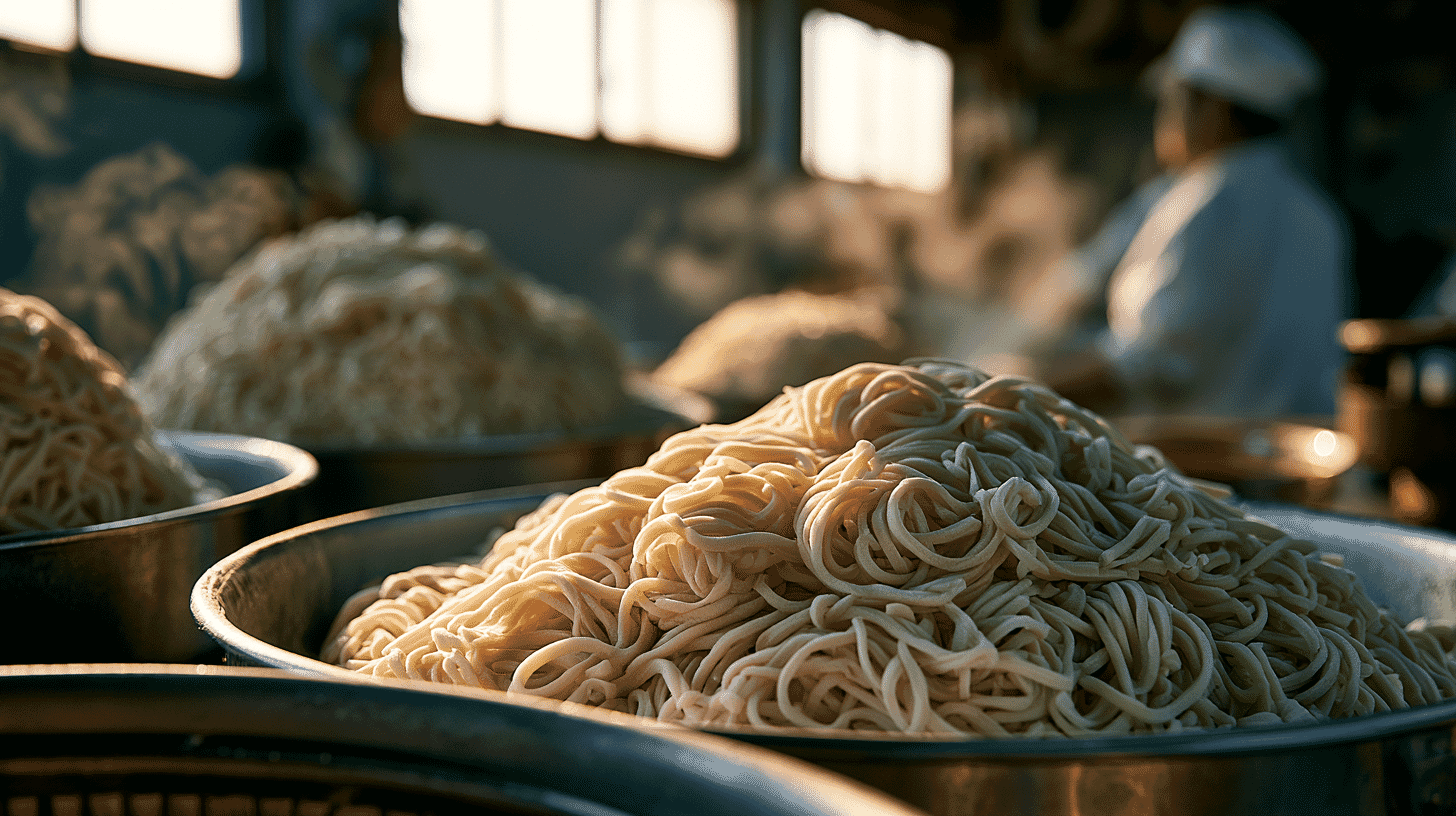
🍜 In Kagawa, the small Japanese prefecture that calls itself "udon country," a quiet fact rarely makes the news: every year, thousands of tons of perfectly good udon get thrown away. Years ago, people started asking whether all those discarded noodles could become something useful. So what happened to those ideas? Two answers emerged, and they could hardly be more different. One team turned the waste into electricity. Another turned it into paper.
The "udon country" problem nobody talks about
Kagawa, on the island of Shikoku, eats and produces more udon per person than anywhere in Japan. Sanuki udon, the local style, thick and springy, is a point of regional pride and a magnet for food tourists. But all that production has a shadow side. Noodles that don't sell, off-spec batches, and leftover scraps add up fast. Kagawa University estimates the prefecture generates several thousand tons of discarded udon a year. Kagawa uses roughly 60,000 tons of wheat a year for udon, and prefectural figures put the discarded share at around 3,000 tons in wheat terms.
The scale at a single business can be startling. One frozen-udon maker reported throwing out around 250 tons a year per factory, about 1,500 tons across its six plants, and paying roughly ¥20 million (about $130,000 at ¥150 to the dollar) just to dispose of it, according to reporting by Nikkan Kogyo Shimbun's Newswitch. It was a manufacturer's offhand complaint, what a waste, that set everything in motion. In Japanese, the word is mottainai: a pang of guilt at letting something usable go to waste. That single word is the seed of both stories here.
The factory that makes electricity from noodles
The first answer came from a machinery maker in Takamatsu called Chiyoda Manufacturing. Starting around 2009, the company worked with the National Institute of Advanced Industrial Science and Technology (AIST) and Kagawa's prefectural food research center on a simple question: udon is mostly starch and sugar, so could you ferment it into fuel?
You can. Add enzymes, yeast, and water to waste udon and it ferments into bioethanol in a couple of days. By 2013, the team had a practical-scale plant that could continuously produce about 200 liters from one ton of waste udon, according to Nikkan Kogyo Shimbun's Newswitch; the plant itself was completed in 2012 with support from Japan's NEDO energy agency.
Then the project changed direction. By the company's own account, only about 10% of the noodle actually ended up as ethanol, leaving the other 90% unused, and the process demanded tight control of temperature and pH that food manufacturers buying the plant could not realistically maintain day to day. So Chiyoda skipped the ethanol step and fed the waste udon straight into a methane digester instead. The timing helped: Japan's feed-in tariff had set a generous ¥39 per kilowatt-hour for power generated from methane. That is where "udon power" was born.
The numbers are modest but real. According to the Nikkei, the plant takes in about two tons of waste udon and food scraps a day and generates around 400 kilowatt-hours, enough to cover 30 to 40 households, earning roughly ¥3.7 million (about $25,000 at the same rate) a year in electricity sales. The cycle doesn't stop at power: the sludge left after fermentation becomes fertilizer, which is spread on wheat fields, and that wheat is milled into flour to make new udon. The consortium behind the project calls it "making udon from udon."
What makes this more than a local curiosity is that it scaled. Chiyoda runs the system at its own plant and has sold the equipment to supermarkets and food companies across Japan. More than a decade on, the project is still active in 2026, running eco-tours, releasing a video on "udon and carbon recycling," and hosting study visits and school outreach. The "whole-udon circulation project" has also won a minister's award in Japan's national community-building prizes. The biggest remaining hurdle is unglamorous but familiar to anyone in recycling: the cost of collecting and trucking the waste to the plant.
The private sector isn't alone. Since June 2022 the city of Takamatsu has been running a trial at its eastern sewage treatment plant, mixing waste udon into sewage sludge to boost digester gas output. Three noodle companies supplied the waste at first; a fourth joined in March 2026. From fiscal 2026 the city plans a fuller assessment of how the co-digestion affects plant operations.
When one ball of udon becomes ten sheets of paper
The second answer is stranger, and warmer. It comes from Naotaka Tanaka, a professor of applied microbiology at Kagawa University's Faculty of Agriculture.
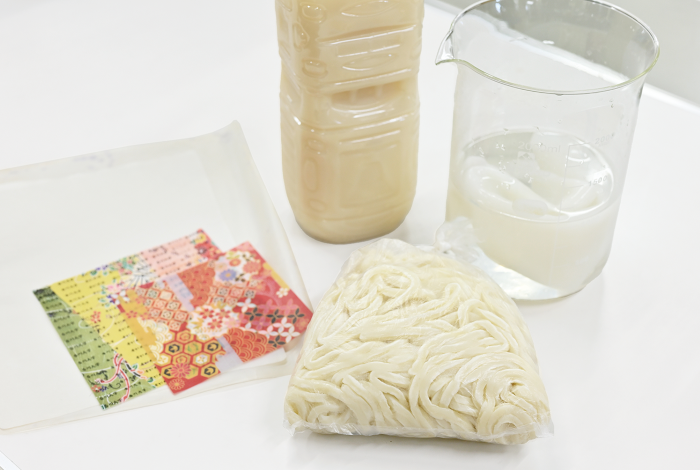
For about 15 years, Tanaka had been making paper in a quirky way: not from trees, but from microbes. Certain bacteria in the family that includes acetic-acid microbes naturally weave cellulose. Left to sit in a nutrient broth for about four days, they form a cellulose film; dry it, and you get paper. According to a 2025 interview published by Kagawa University in its Next Innovation series, Tanaka originally did this just to give his students something they could touch, since most microbiologists have never actually seen "microbial paper." What surprised him was the result: the sheets came out remarkably strong and light.
Source: Kagawa University, Next Innovation vol.18
Then came the local twist. Wanting his work to give something back to the region, Tanaka realized the sugar in Kagawa's mountain of waste udon could feed the microbes. Breaking udon down into sugar is easy, so he tried it, and it worked. By his account, a single ball of udon yields enough cellulose for about ten sheets of A4 paper.
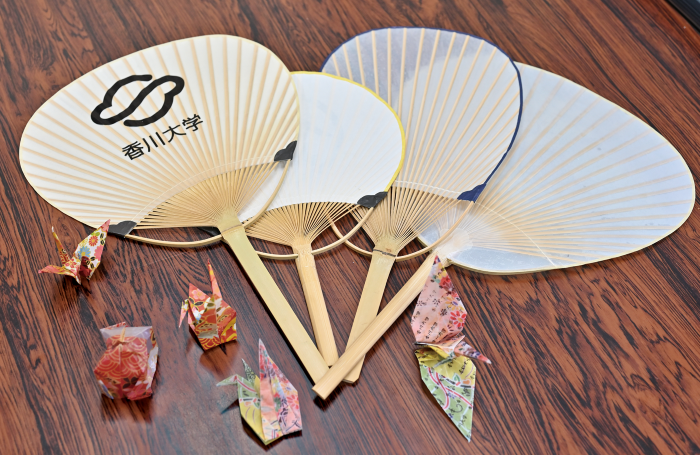
Because the paper is light and doesn't tear even when wet, he saw another possibility: using it for Marugame uchiwa, the round paper fans that are a traditional craft of Marugame City. When he approached the city's tourism office, it connected him with local artisans. Then something unplanned happened. A welfare facility in Marugame asked whether its members could make the paper themselves. The facility had struggled to offer enough variety of work, and culturing the cellulose turned out to be a task its members could take on. The hardest part, Tanaka has said, was finding culture conditions reliable enough that anyone, in a place that had never handled microbes, could produce a uniform film every time.
Source: Kagawa University, Next Innovation vol.18
Tanaka now talks about teaming up with companies to push the material beyond paper: as a plastic substitute, since it's strong when dry, or even in cosmetics, using its clingy texture when wet. It's biodegradable, too: bury it and microbes break it down like a fallen leaf. But he has set one non-negotiable condition. However much demand grows, the welfare facility's supply gets used first.
What a thrown-away noodle is worth
Two teams, one pile of waste, two completely different answers. One asked, what energy is locked inside this? The other asked, what could this become? Neither pretends to have solved food waste single-handedly. The energy plant still wrestles with collection costs, and the paper is, for now, a craft product rather than a mass material. But both started from the same small, very Japanese feeling that throwing something usable away is a kind of loss.
A noodle famous for being eaten now ends up as a lightbulb's glow or a fan for a summer night. What gets quietly thrown away where you live, and could it be worth more than the trash bin suggests?
References
- https://www.kagawa-u.ac.jp/sdgs_action/sdgs/28055/
- https://www.kagawa-u.ac.jp/next-innovation-vol18/
- https://newswitch.jp/p/9564
- https://www.nikkei.com/article/DGXMZO48085150R00C19A8962M00/
- https://www.itmedia.co.jp/smartjapan/articles/1312/10/news021.html
- https://tbs-mri.com/n/ndcc46f9c1361
- https://www.udon0510.com/





Global Discussion
3 comments