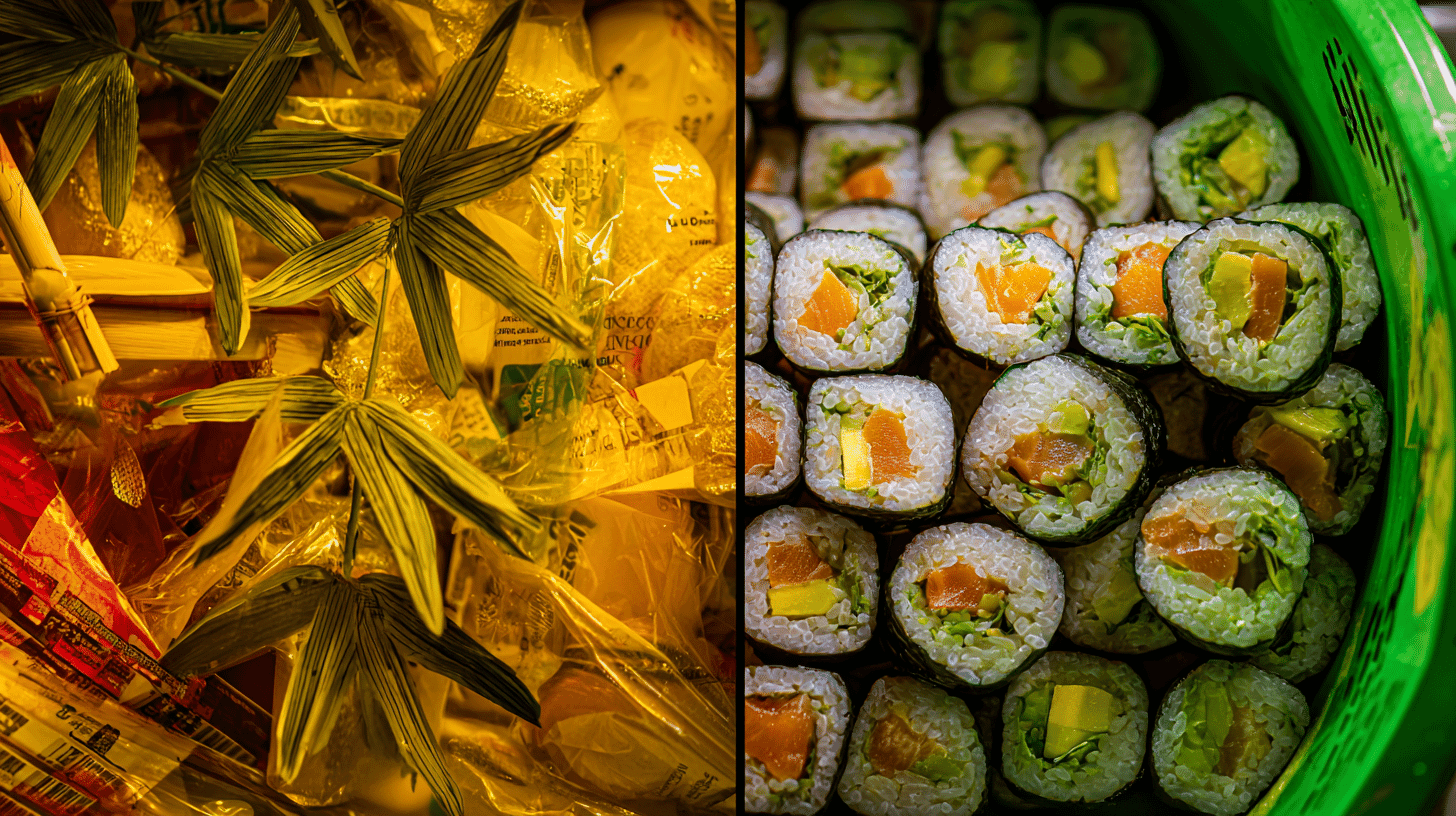
On the eve of spring, millions of Japanese face a lucky direction and silently devour an entire sushi roll to invite good fortune. The Setsubun tradition now moves ¥73 billion in a single day. On the same night, an estimated ¥1.65 billion worth of those rolls goes in the bin, uneaten. So much for "mottainai".
What Is Ehomaki? A "New Tradition" Born in Osaka, Spread by Convenience Stores
Ehomaki is a thick sushi roll eaten on Setsubun (the day before the start of spring, typically February 3) while facing that year's lucky direction, the compass point where Toshitokujin, the deity of good fortune, is believed to reside. Tradition calls for eating the roll silently, without cutting it, while making a wish. The seven fillings represent the Seven Lucky Gods of Japanese mythology, symbolizing the act of "rolling in good fortune."
The custom is believed to have originated in Osaka's entertainment districts during the early 1900s, where geisha would eat nori-wrapped sushi rolls facing the lucky direction as a ritual for prosperity. After fading during wartime, the tradition was revived in the 1960s and 70s by Osaka's sushi and seaweed trade associations as a marketing campaign.
The national breakthrough came in 1989, when a Seven-Eleven store in Hiroshima began selling the rolls under the name "ehomaki", a brand-new term coined specifically for the product. By 1998, the chain had rolled out ehomaki nationwide. By the 2000s, every major convenience store and supermarket had joined the frenzy. A 2011 survey found that more Japanese people ate ehomaki on Setsubun than participated in the traditional bean-throwing ceremony (mamemaki), effectively crowning ehomaki as the holiday's main event.
In other words, unlike bean-throwing, which traces back to the Nara period (8th century), ehomaki is a relatively modern commercial invention. Understanding this origin is essential to grasping why the food waste problem exists at all.
Behind the ¥73 Billion Market: Why ¥1.6 Billion Ends Up in the Trash
According to estimates by Katsuhiro Miyamoto, Professor Emeritus at Kansai University, the total economic ripple effect of ehomaki in 2026 reached approximately ¥72.88 billion, a staggering figure for a single food item consumed in essentially one day. Direct sales were estimated at around ¥32.98 billion, a significant increase from ¥27.48 billion in 2025.
Yet the same analysis estimated that roughly ¥1.649 billion worth of ehomaki would be discarded as unsold waste, based on a disposal rate of over 5%.
The structural causes run deep. Ehomaki is the ultimate one-day product, it has virtually zero commercial value after Setsubun. Yet retailers fear that running out of stock on the big day will brand them as a "poorly stocked shop," driving customers to competitors. The unspoken logic: better to overstock and discard than to lose a single sale.
There's also a strategic dimension. Supermarkets view ehomaki as a traffic driver, customers who come in for sushi rolls also buy meat, fish, vegetables, drinks, and side dishes. The profit from these ancillary purchases can outweigh ehomaki losses, creating a rational business incentive to overproduce.
Meanwhile, ehomaki prices keep climbing. Research from Teikoku Databank shows the 2026 average price rose 11.7% year-over-year, driven by ingredient inflation, rice prices jumped over 30%, while nori seaweed suffered record-poor harvests. Despite rising costs, the premium trend accelerated, with some department stores offering rolls stuffed with gold leaf, wagyu beef, abalone, and caviar at prices exceeding ¥10,000 (approximately $65) per roll.
Does Pre-Ordering Solve Anything?
Since 2019, Japan's Ministry of Agriculture, Forestry and Fisheries (MAFF) has urged retailers to adopt reservation-based sales to match supply with demand, and each year it invites retailers to sign up to a waste reduction initiative. In 2026, 71 did.
But field investigations reveal cracks in the system. Food waste journalist Rumi Ide spends every Setsubun night counting unsold rolls across the country. Even at convenience stores with reservation systems, premium ehomaki sit on the shelf by the dozen.
Why do pre-orders fail to prevent waste? According to franchise owners, convenience store headquarters require order quantities to be finalized in December, well before the reservation deadline. Ide notes that one major chain set its 2026 ehomaki sales target at 117% of the previous year. Critics argue this turns the reservation system into "food waste reduction theater."
Yet success stories exist. The supermarket chain Hallows achieved a disposal rate of just 0.00004% in 2023, selling 310,000 rolls worth ¥170 million across 101 stores while barely wasting anything. Their approach, precise demand forecasting combined with disciplined operations, proves that high sales volume and minimal waste can coexist.
The Hidden Costs: Environmental and Social Impact
The damage extends beyond economics. Estimates based on 2023 data put the CO2 emissions tied to discarded ehomaki at 1,355 tonnes. The water wasted in producing those uneaten rolls would fill 570 standard 25-metre swimming pools.
The ingredients in ehomaki, nori, eggs, shrimp, fish, are precisely the items facing resource depletion and price spikes globally. Discarding them is not merely wasteful; it compounds existing supply chain pressures.
Furthermore, the cost of disposing unsold ehomaki (as part of general municipal waste) is borne partly by taxpayers. Japan spends over ¥2 trillion annually on waste processing, funds that could otherwise go to education, healthcare, or social services.
Japan's total annual food waste stands at 4.72 million tons, equivalent to roughly one rice ball per person per day. The government has pledged to halve food loss by 2030 (compared to 2000 levels), but time is running short.
What Consumers Can Do: Changing How We Buy
Food waste is not solely the industry's problem. Consumer behavior plays an equally important role.
Pre-ordering is the single most effective action. Reserving only the number of rolls your family will actually eat, and picking them up as promised, sends a clear market signal. Choosing half-size or bite-sized options reduces household waste as well.
Another option is to support stores that make genuine efforts to minimize waste, specialty sushi shops, reservation-only retailers, and local businesses that produce made-to-order rolls.
Making ehomaki at home is perhaps the most sustainable choice of all. You choose the fillings, control the portions, and produce zero commercial waste.
Most importantly, accepting that a store might be sold out on Setsubun night, and being okay with that, removes the pressure on retailers to overstock. The willingness to tolerate occasional inconvenience may be the most powerful anti-waste tool consumers have.
Between Culture and Sustainability
Ehomaki embodies something beautiful about Japanese culture: the desire to celebrate the turning of seasons through food, the quiet hope embedded in a wish made while facing the lucky direction, the warmth of a family sharing a ritual together.
But when this cultural practice became entangled with convenience store sales targets and supermarket marketing wars, the rolls meant to "wrap in fortune" began piling up in dumpsters. The gap between ¥73 billion in economic impact and ¥1.6 billion in waste reflects a structural tension not unique to Japan, it's the same tension between tradition, commerce, and sustainability that plays out in seasonal food events worldwide.
Updating traditions for a sustainable era doesn't mean abandoning them. It means finding smarter ways to celebrate.
Does your country face food waste problems tied to seasonal traditions? Christmas turkeys and cakes, Lunar New Year feasts, Thanksgiving dinners, Diwali sweets, how does your culture balance festive abundance with responsible consumption?
References
- https://news.yahoo.co.jp/pickup/6568261
- https://yorozoonews.jp/article/16326275
- https://news.yahoo.co.jp/expert/articles/a79246896fc977b9bd58352a2334bdc5e65afac2
- https://www.greenpeace.org/japan/news/story_61324/
- https://coki.jp/article/column/67792/
- https://www.maff.go.jp/j/shokusan/recycle/syoku_loss/kisetsusyokuhin.html
- https://www.no-foodloss.caa.go.jp/topic_feb2026.html




Global Discussion
16 comments