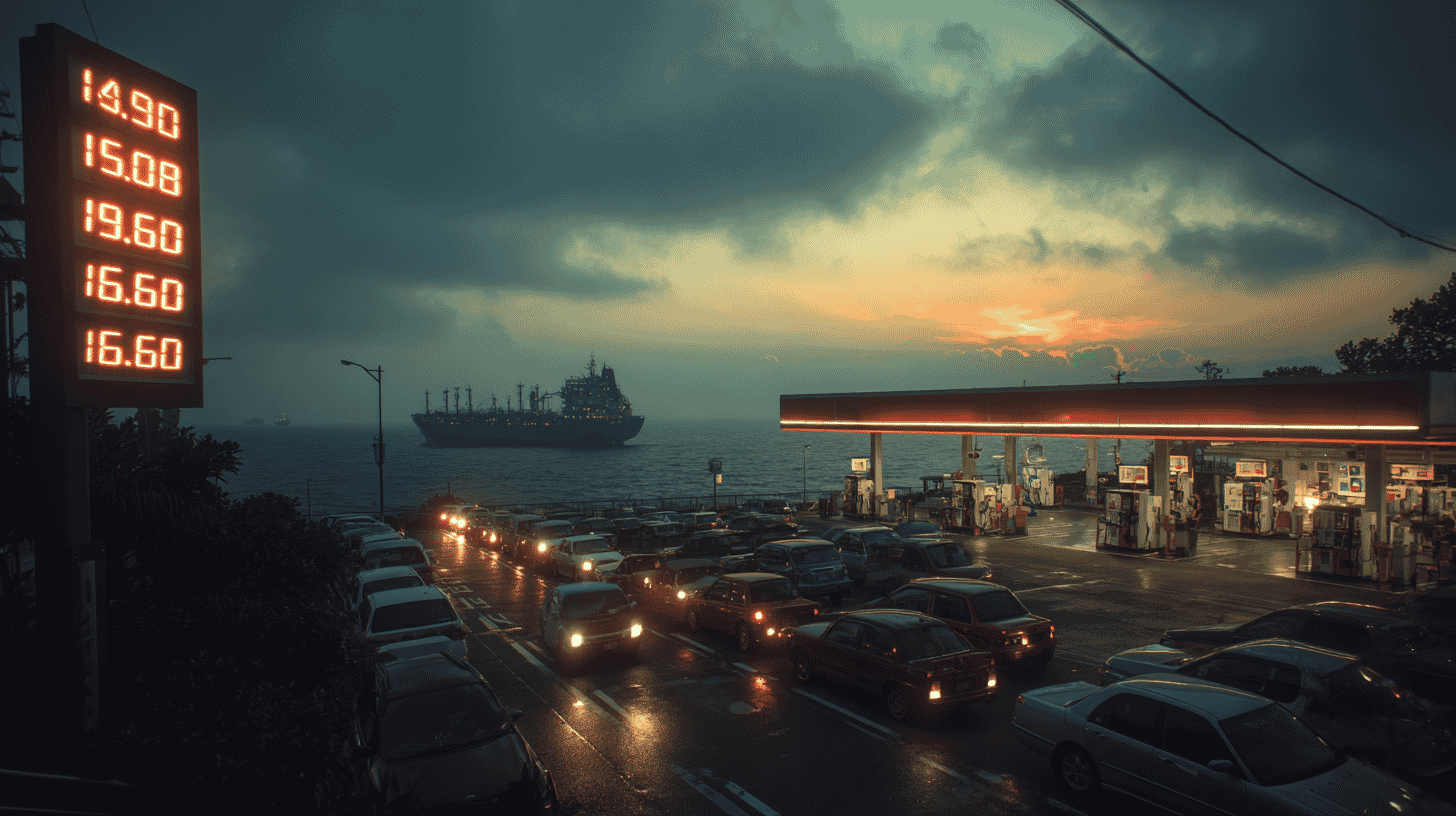
Japan's gasoline passed ¥190 per liter ($1.27/L, or $4.81/gallon) for the first time in history. In a single week, prices rose ¥29, matching the largest weekly jump on record. The cause is the de facto blockade of the Strait of Hormuz, through which over 90% of Japan's crude oil imports flow. A country that built its postwar prosperity on cheap energy now finds that lifeline cut.
Record-Shattering Prices at the Pump
On March 18, 2026, Japan's Ministry of Economy, Trade and Industry (METI) reported that the national average price of regular gasoline stood at ¥190.80 per liter ($1.27/L) as of March 16, above the previous record of ¥186.50 set on April 14, 2025. It was the highest figure since the survey began in August 1990, the first time the average has cleared ¥190, and the fifth consecutive weekly rise. The ¥29 jump matched the largest on record.
All 47 prefectures saw increases. Yamagata Prefecture recorded the highest at ¥198.50 ($1.32/L); Okayama posted the steepest rise, up ¥32.10 to ¥191.60. Tokyo averaged ¥193.30, with some stations crossing ¥200 ($1.33/L). Premium gasoline hit ¥201.80 nationally, and diesel reached ¥178.40.
The speed caught consumers off guard. Some stations raised prices by more than ¥30 overnight. Drivers rushed to fill up ahead of the next increase, crashing ENEOS's app under the traffic. It looked like Japan's 1973 oil shock, except this time the oil had actually stopped flowing.
The Hormuz Strait: The World's Energy Chokepoint Goes Silent
The root cause lies thousands of kilometers away in the Persian Gulf.
On February 28, 2026, the United States and Israel launched a major military strike against Iran, killing Supreme Leader Khamenei and bombing military installations. Iran's Islamic Revolutionary Guard Corps (IRGC) retaliated by declaring a passage ban on all vessels transiting the Strait of Hormuz.
The Hormuz Strait, about 34 kilometers (21 miles) wide at its narrowest point, connects the Persian Gulf to the Indian Ocean. According to METI, roughly 20 million barrels of crude oil and petroleum products pass through it daily, close to 30% of the world's oil exports, most of it bound for Asia. Before the crisis, around 120 ships transited each day. By early March, reports put that number at about five.
Inside the Persian Gulf, 68 oil-laden tankers sit idle, unable to pass. Analysts have described the gulf as a floating warehouse. Japan's major shipping lines, NYK Line and Kawasaki Kisen, have suspended passage through the strait.
Japan's Achilles' Heel: 93% Dependence on the Middle East
Japan imports virtually all of its energy. Per the Agency for Natural Resources and Energy, more than 90% of its crude oil comes from the Middle East, most of it transiting Hormuz. No other major industrialized nation comes close.
Bloomberg reported that 15 tankers carrying Middle Eastern crude were en route to Japan when the blockade began, the last of them due at Chiba port on March 22. After that, no new Middle Eastern crude was expected to land.
Since the 1973 oil shock, Japan has pursued three strategies: building strategic petroleum reserves, reducing oil-fired power generation, and diversifying import sources. The first two worked. Oil's share of electricity generation dropped from roughly 60% to about 7%, and national, private, and producer-country joint reserves together now cover about eight months of supply (248 days as of end-January 2026).
But diversification failed. Despite decades of pursuing alternatives from Southeast Asia, Africa, South America, and Russia, Japan's Middle East dependency actually increased over time.
LNG Is Less Exposed Than Crude, But Prices Are Another Matter
LNG gets lumped in with crude, and the structure is not the same.
The Agency for Natural Resources and Energy puts Japan's Middle East dependence for LNG at roughly 10%, far below crude, because sourcing was diversified years ago. Only about 6% of LNG imports come through Hormuz. As of March 1, 2026, power and gas utilities held just under 4 million tons in inventory, equivalent to roughly a year of the volume that normally arrives via the strait. On volume, LNG is not the pressure point.
Price is. The Asian LNG spot benchmark JKM climbed from $11.06/mmBtu on February 27 to $18.02/mmBtu by March 25. With Qatari shipments disrupted and buyers converging on the spot market, that feeds through to household electricity and gas bills via fuel-cost adjustment clauses. LNG-fired plants supply 33% of Japan's electricity, against 28% for coal and 7% for oil and other sources.
Government Response: Subsidies and Reserve Releases
The government restarted emergency fuel subsidies on March 19, paying ¥30.20 per liter ($0.20/L) to oil wholesalers to bring pump prices down to around ¥170 ($1.13/L). Industry minister Ryosei Akazawa explained that pre-subsidy inventory has to sell through first, so it takes one to two weeks to show at the pump. Without the subsidy, the following week's average was on track to exceed ¥200.
Paying for it is the harder part. On March 24 the cabinet approved ¥800.7 billion from the FY2025 contingency reserve, of which ¥794.8 billion went into the gasoline subsidy fund. At ¥30 per liter, that drains quickly.
Reserve releases are already underway. On March 16, METI temporarily cut the private stockholding obligation from 70 days to 55 and approved a release from the national reserve. Against the 400 million barrels that 32 IEA member countries agreed to release on March 11, the largest coordinated action in IEA history, Japan's share is about 80 million barrels. The national reserve is releasing roughly one month of domestic demand (about 8.5 million kiloliters), shipped from the Tomakomai-East, Kikuma, Shirashima, Kamigoto and Shibushi bases from March 26. It is only the second national-reserve release under Article 31 of the Petroleum Stockpiling Act, after the 2022 response to Russia's invasion of Ukraine.
The US-Japan Summit: Alaska Crude as a Lifeline?
On March 19, Prime Minister Takaichi met President Trump in Washington, with energy security high on the agenda.
The two governments discussed cooperation on Alaskan crude production as part of a $550 billion Japanese investment package in the US (roughly ¥87 trillion at ¥158 to the dollar). Takaichi said afterward that she had told Trump she wants to realize a joint venture to stockpile US-sourced crude inside Japan, framing it as diversification of supply for Japan and for Asia.
The arithmetic sets the limit. Alaskan production peaked at 2 million barrels per day in 1988 and has since fallen by 80% to roughly 420,000 barrels. The projected increase for 2026 is about 16,000 barrels per day, under 1% of Japan's total crude imports of roughly 2.3 million barrels daily.
US crude accounts for around 4% of Japan's oil imports. The Alaska track has real diplomatic value and signals diversification, but it does not close the Middle East gap in the near term.
Bypass Routes: Limited and Risky
Saudi Arabia and the UAE maintain pipelines that bypass Hormuz: the 1,200-kilometer East-West line to Yanbu on the Red Sea, and the Abu Dhabi-Fujairah line (ADCOP). Crude is already moving on the Red Sea route. But Yanbu's loading capacity runs to roughly one-fifth of normal Hormuz throughput, and countries like Kuwait have no bypass at all.
The volume that normally moves through Hormuz is about 20 million barrels per day, far beyond what any combination of bypasses can absorb. The Red Sea route carries its own risk: the Houthis drone-struck that same pipeline in 2019, and freight and insurance costs have soared.
How Japan Compares: Global Energy Security Strategies
Japan's extreme Middle East dependency stands in stark contrast to other major economies:
United States: The shale revolution made the US a net energy exporter, dramatically reducing Middle East dependence. The US Strategic Petroleum Reserve holds approximately 400 million barrels.
European Union: After Russia's invasion of Ukraine disrupted gas supplies, the EU rapidly diversified LNG sourcing from the US, Qatar, and others, while building mandatory gas storage requirements.
China: While still dependent on Middle East oil, China has built massive strategic reserves (estimated at 950 million barrels), secured pipeline supply from Russia and Central Asia, and aggressively expanded renewable energy capacity.
South Korea: Similar to Japan in its Middle East dependence, but South Korea has pursued joint stockpiling agreements with Saudi Arabia and direct crude purchase deals more aggressively.
Eight months of reserves buys time; it does not change the structure. How much alternative-route crude Japan can stack up, and what it does with the interval, is the open question. The ¥190 figure at the pump is where that question is being asked.
Japan is grappling with historic fuel prices and an energy crisis driven by its heavy reliance on Middle Eastern oil. How does your country handle energy security? Does it depend on imports, or has it achieved self-sufficiency? We'd love to hear how energy prices and policy look from where you live.
References
- https://www.bloomberg.com/jp/news/articles/2026-03-18/TC2WSFKK3NY800
- https://www.bloomberg.com/jp/news/articles/2026-03-18/TC13CNT9NJLS00
- https://toyokeizai.net/articles/-/937437
- https://www.nikkei.com/article/DGXZQOUA023RP0S6A300C2000000/
- https://www.alterna.co.jp/169225/
- https://news.yahoo.co.jp/expert/articles/bbb49835151d2ffa0635df0526d3625f7c62bef3
- https://roles.rcast.u-tokyo.ac.jp/publication/20260316









Global Discussion
14 comments