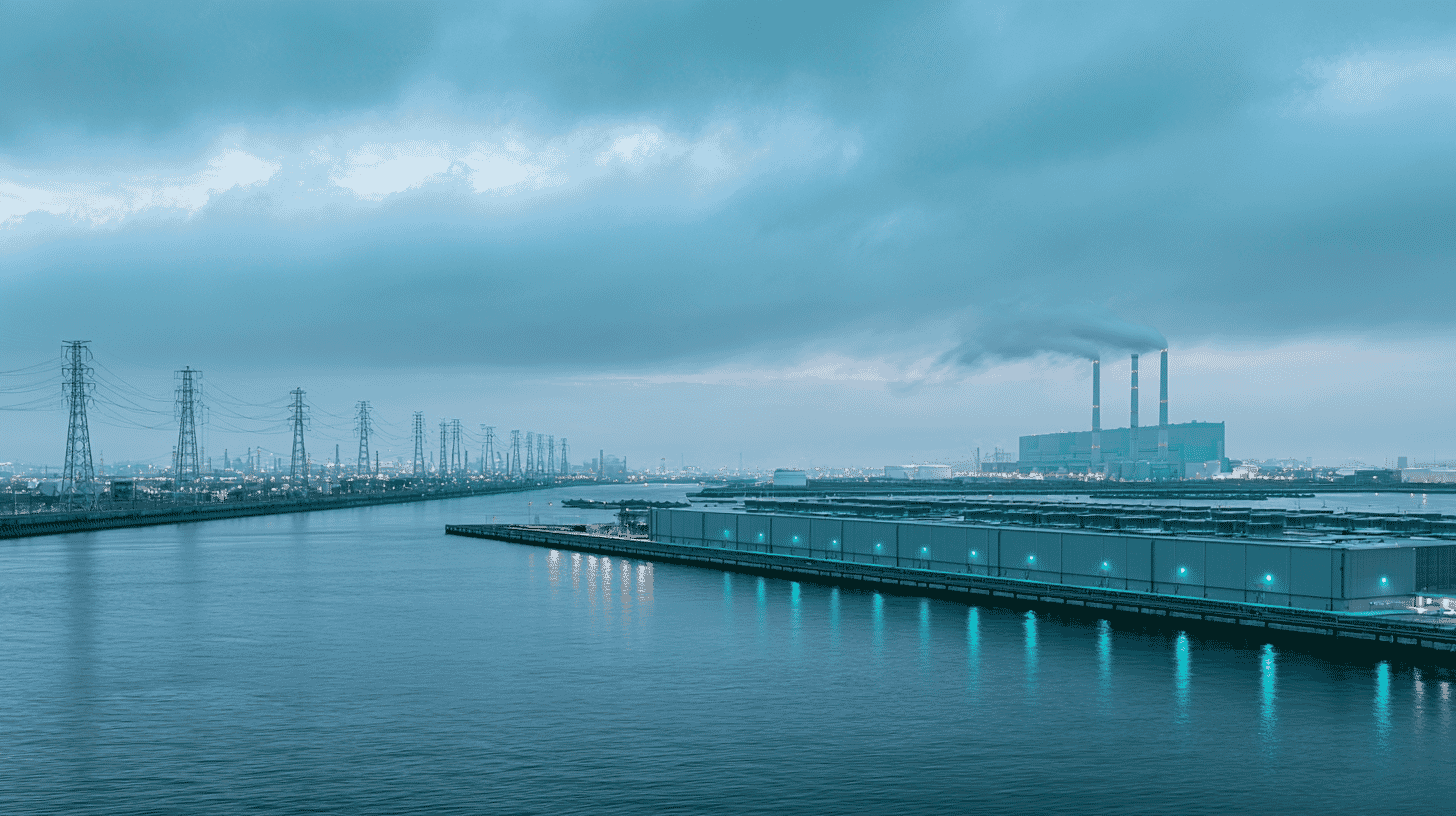
🔌 AI data centers swallow electricity, and plugging a big new one into the grid can take years. So Japan's largest power generator is flipping the logic. Instead of sending power out to a data center, it is bringing the data center to the power plant. The first one, in Chiba just east of Tokyo, comes with a price tag of more than $15 billion.
On October 1, 2026, JERA, which produces about a third of Japan's electricity, signed a memorandum of understanding with Dell Technologies and RHAELM, a London-based AI infrastructure company. Their first project is an AI data center of up to 400 megawatts (MW) at JERA's Chiba Thermal Power Station. The companies call it the largest single-site AI deployment in Japan, a claim that depends on how you count: a data center campus planned in Nanto, Toyama Prefecture, is also designed for about 400 MW in its first phase and up to 3.1 GW eventually. As of October 2026, operations are targeted to start around 2028.
Why build at the power plant?
The usual route for a data center runs from power plant to transmission grid to substation to server hall. Every large new customer has to wait for the grid to make room. A working group set up by Japan's communications and industry ministries flagged the problem in April 2025: as data center operators file ever-larger grid connection requests, the cost and time of expanding the grid rise with them. A month later, the same group's paper said near-term demand should be met by putting data centers where existing power infrastructure can be used. That thinking sits inside Japan's wider "Watt-Bit" policy of planning power and data networks together, which we explained here.
According to JERA, the data center will draw power on-site from a plant JERA already operates. In industry shorthand this is "behind the meter": the electricity reaches the customer without first passing through the public grid. The companies say this gets computing capacity running years sooner than the usual route of waiting for a grid connection.
The partners also plan to standardize generation, electrical equipment, cooling and computing as one package rather than designing each project from scratch. The Chiba site covers about 760,000 square meters.
One wording detail: JERA's Japanese release places the data center inside the power station's premises, while the English release and Reuters describe land adjacent to it.
What $15 billion pays for
The figure covers every phase: land, power infrastructure, construction and the AI computers themselves. The roles break down like this.
- JERA provides the land and the electricity. Reuters reported a 15- to 25-year power supply agreement.
- Dell supplies the Dell AI Factory, pre-integrated rack-scale computing systems built to be installed fast.
- RHAELM develops, builds, operates and finances the facility. US investment firm Apollo Global Management plans to act as its strategic investment and financing partner.
RHAELM is not a household name. It describes itself as a "sovereign AI" cloud company, meaning it builds AI computing that stays under a country's own control, and it operates in Europe and Asia-Pacific. Its CEO, Bradd Lewis, said in the release that the company was set up to turn underused power capacity into exactly this kind of national AI infrastructure.
So how big is 400 MW? The Chiba plant's maximum output is 4.38 gigawatts (GW). The data center would therefore take about 9% of everything the station can produce. A JERA official told Reuters that the site would come online in stages from 2028, with all 400 MW running in 2029. JERA and RHAELM also plan to study the same model at other JERA plants, aiming for several gigawatts of AI capacity nationwide in the 2030s.
It is a gas plant, and that matters
Chiba burns natural gas. Part of the station has an unusual backstory: three gas turbines were installed on an emergency basis after the 2011 earthquake left eastern Japan short of power, and they were converted to combined cycle, which reuses turbine exhaust heat to make more electricity, by 2014.
The release argues that Japan's ability to build AI infrastructure quickly depends on steady gas-fired generation and a resilient liquefied natural gas (LNG) supply chain. What it does not offer is a path to decarbonizing the data center's electricity. Renewables come up only in passing, in the chairman's comment. JERA's company-wide target, JERA Zero CO2 Emissions 2050, includes developing zero-emission thermal power. Its work on burning ammonia in a coal plant at Hekinan is one piece of that, as we reported earlier.
The earlier steps toward this deal were framed differently. In June 2025, JERA and cloud provider Sakura Internet agreed to study data centers at JERA's LNG plants around Tokyo Bay. They listed future decarbonization of the power supply as a topic, along with using the cold released when LNG is turned back into gas to cool servers. JERA's October 2025 agreement with the City of Yokohama named low-carbon power as the problem to solve. Chiba is the first of these ideas to arrive with a capacity, a budget and a date, and its pitch leads with speed and reliability.
The release leaves a second question open. JERA supplies most of the power used in the Tokyo area. If 400 MW goes straight to servers, does the grid lose that much supply, or will new generation be added? The announcement does not say. As the US case below shows, that is exactly where these projects can get stuck.
Japan is testing three kinds of sites at once
Two other answers surfaced around the same time. On August 27, 2026, a government-led council on the future of Fukui Prefecture's nuclear plant region added a plan to study attracting large data centers, including feeding them directly from nuclear plants. Japan's energy agency said it would sort out the technical and regulatory issues.
On September 1, 2026, shipping company NYK, NTT Facilities, renewable developer Eurus Energy and MUFG Bank unveiled a concept for floating data centers moored along port quays, at a scale of tens of megawatts. The consortium says building on water could cut construction costs by about 30% and shorten construction by roughly a year compared with land, and it aims to commercialize by 2030, Nikkei BP reported. The group's demonstration in Yokohama, running since March 2026, handles a load of about 20 kilowatts. Chiba's 400 MW is 20,000 times that.
The US has already hit the snag
Putting data centers next to power plants is a global trend, and we looked at the bigger picture in our piece on the AI power crunch. One closely watched test case is in Pennsylvania. In March 2024, Amazon bought a data center campus beside Talen Energy's Susquehanna nuclear plant, which supplied it directly. When the parties tried to raise the directly fed load from 300 MW to 480 MW, two utilities objected that the data center would effectively get priority over everyone else on the grid. In November 2024, the US Federal Energy Regulatory Commission (FERC) rejected the change.
In June 2025 the deal was rebuilt. Talen now supplies Amazon with up to 1,920 MW through 2042 "in front of the meter," meaning the power travels over the grid like any other sale.
Building at the plant is fast because it skips the grid. But the grid is shared, and when a large customer takes a plant's output directly, other users and regulators push back. Chiba will have to answer the same question sooner or later.
Where do the data centers in your country sit, and where does their power come from? If one were built near you, would you rather it sat beside a gas plant, a nuclear station, or floating in the harbor?
References
- https://www.jera.co.jp/news/information/20261001_2535
- https://www.jera.co.jp/en/news/information/20261001_2535
- https://theedgemalaysia.com/node/820159
- https://www.jera.co.jp/corporate/business/thermal-power/list/chiba
- https://www.city.chiba.jp/kankyo/kankyohozen/hozen/hyoka_toden_group3.html
- https://www.meti.go.jp/shingikai/economy/watt_bit/watt_bit_wg/pdf/001_01_02.pdf
- https://www.meti.go.jp/shingikai/economy/watt_bit/watt_bit_wg/pdf/002_01_00.pdf
- https://cloud.watch.impress.co.jp/docs/news/2020301.html
- https://www.city.yokohama.lg.jp/city-info/koho-kocho/press/kowan/2025/je.files/0001_20251003.pdf
- https://www.fukuishimbun.co.jp/articles/-/2684537
- https://www.denkishimbun.com/archives/415550
- https://www.bk.mufg.jp/info/pdf/20260901_dc_concept.pdf
- https://project.nikkeibp.co.jp/ms/atcl/19/news/00001/06068/
- https://project.nikkeibp.co.jp/ms/atcl/19/news/00001/05710/
- https://www.theregister.com/2025/06/12/amazon_talen_nuclear_deal/
- https://datacenterdynamics.com/en/news/gigawatt-scale-data-center-campus-planned-in-toyama-japan/









Global Discussion
4 comments